

Editor’s View: Lax food security must end in dangerous world
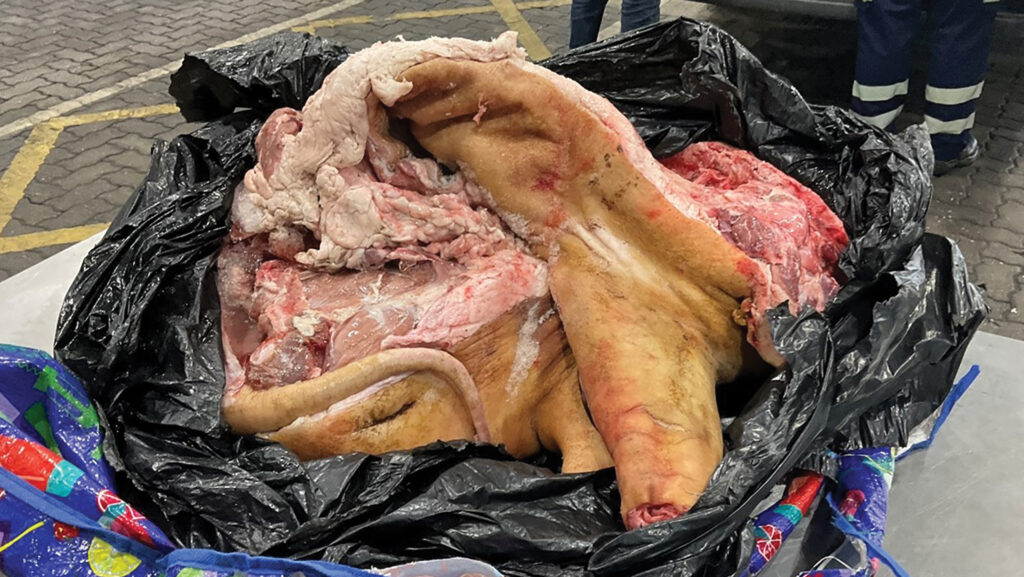 Pork seizure at Dover port © Dover Port Health Authority
 The flow of illegal meat imports across the border has for some time been one of the most salient threats to both the food and farming industry.
So it was dispiriting to learn that the problem is even worse than we previously knew, as Farmers Weekly reveals this week that there is little to no testing of illegal product seized by port officials for animal disease risk.
See also: Biosecurity blind spot leaves farmers exposed to disease risk
About the author

To squander any opportunity to get early warning of communicable diseases is appalling and emblematic of the gap between the government’s tough-talking approach of food security being national security and the reality on the ground.
Some in the defence community call it the “say-do” gap.
Yet even now, criticism of the Animal and Plant Health Authority (Apha), the agency directly responsible for safeguarding the public from threats of this type, must be nuanced – with ire directed instead at those that hold the purse strings.
As the National Audit Office (NAO) warned last year, Apha is stretched thin by an enormous and increasing workload, with bluetongue, avian influenza and many other issues.
This – according to NAO’s June 2025 report on resilience to animal diseases – has led to a reduction in routine activities within the agency’s Surveillance Intelligence Unit and the failure of both Apha and Defra to test contingency plans adequately.
Apha has also repeatedly reported it would struggle to respond effectively to severe or concurrent serious outbreaks of animal diseases, due to a lack of capacity and a lack of skills and expertise.
So it is doing a huge amount with the resources it has and, if it fails, it will be hard to say it could have done more with the money it has.
There is, of course, never a bad time to promote and protect resilience in all parts of the food industry, but it seems we are heading at full tilt towards a different sort of world where it will go from being a nice-to-have to an absolute essential.
Many have spoken in recent weeks about the end of the rules-based international order which underpins so much of the current shape of the global economy, including food, but perhaps Canadian prime minister Mark Carney put it best at Davos this week.
Noting that collective problem-solving at an international level is greatly diminished, he had this to say:
“Many countries are drawing the same conclusions. They must develop greater strategic autonomy: in energy, food, critical minerals, in finance, and supply chains.
“This impulse is understandable. A country that cannot feed itself, fuel itself, or defend itself has few options.”
We, as the farming industry, have perhaps been too eager to cry wolf at many points in the past, in our bid to promote greater food security.
While increased domestic production is only a component of that, it has been too easy for those in power to see us as only acting in self-interest. Indeed, sometimes – in the old world – we probably were.
Yet we now stand on the precipice of a new one, and all the old prejudices and priorities must be re-examined if we are to feed, fuel and defend ourselves in the future as well as we have done in the past.
There is much to do… and it starts with resilience.