

Opinion: Bracken problems highlight wider issues faced by crofters
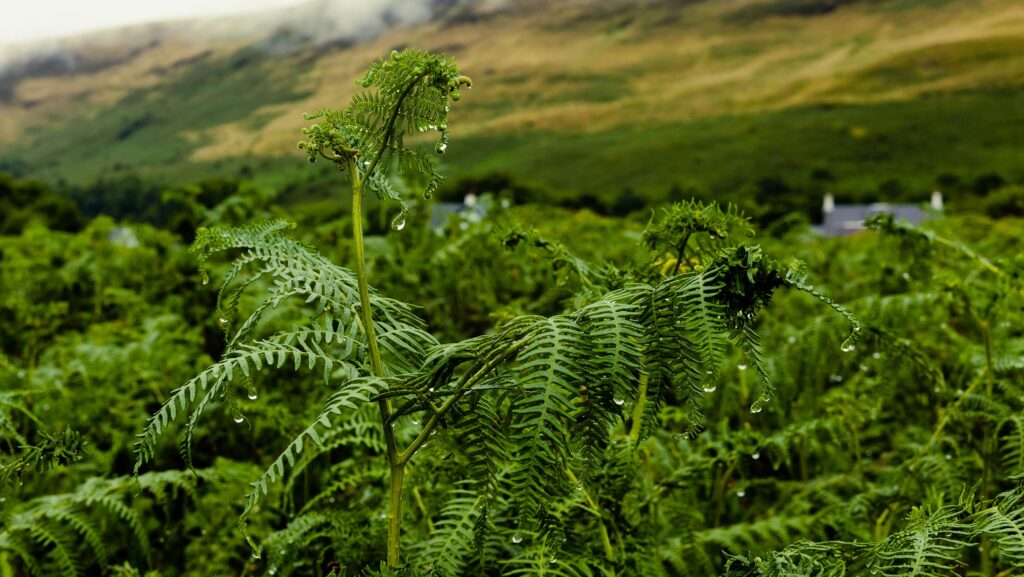 © Adobe Stock
 Following the tractor tracks until they stopped 100 yards from the road, we looked up at a gently rising hillside that disappeared into clammy mist south-east of the Red Cuillin.
Our wetproofs were already streaming with water on this summer afternoon, and the temperature was only 12C.
The muddy tractor ruts gave way to an expanse of verdant sphagnum moss splattered with hummocks of heather, rushes, and slim islands of close-cropped grass holding Blackface ewes and lambs.
“Don’t worry,” said the crofter, “the bog isn’t deep. This was all under cultivation not so long ago.”
See also: Opinion – our tradition al ‘culture’ jars with those in power
About the author

We squelched uphill towards our destination a mile off – several Tunnock’s teacake-shaped lumps of bright green bracken.
Everyone here says you can tell the best land, because that’s where the bracken is. Once, this “best land” was under arable, and it was worked hard.
On an island where harvests were often not in until November, and where the population teetered on the brink of starvation, there was every incentive – locally and in government – to have as much land as possible in calorific production.
But now, fewer people work on the land, food comes from the Co-op, and good soil has disappeared beneath second homes and bracken.
At least the latter problem is potentially reversible, though challenging.
The crofter I walked with uses cattle to bash bracken where vehicles can’t reach, and a bracken-bruising machine where they can.
But he’s doing that alongside all his other jobs, and he works a holding with just one other person where scores would have been kept busy 80 years ago.
It’s no coincidence that bracken infestations have taken hold in places where active crofter and cattle numbers have both shrunk.
And where bracken increases, biodiversity decreases. Its looming stems and acrid smell also oppress many a hiker during the Highland summer.
It takes years of consistent stem-bruising to subdue bracken rhizomes.
Bracken bruisers aren’t cheap, but they save time in comparison to thwacking stems with a stick as I’ve done in the past.
A more efficient method would be the application of asulam, but this herbicide is no longer lawful for bracken control due to government concerns about health and safety.
Without asulam or an equivalent alternative, bracken control is a tiring and persistent burden
Instead, we’re encouraged to “innovate”. I’ve heard of one crofter who drags a wooden pallet behind a quadbike as a makeshift bruiser.
And of a stalker who flattened an 8ft-high wall of bracken with his Argocat – bracken harbours ticks, no joke when Lyme disease is a workplace hazard.
Bracken can be carcinogenic to livestock and people, so we’re unlikely to see a mass return to the days when it was cut for livestock bedding.
There’s no shortage of reasons to manage bracken, but like muirburn, gathering, and many other crofting tasks, the job needs many hands to make it light work.
As we walked back to the road, a traditional Gaelic song came to mind: “I am tired and I am alone, Forever cutting the bracken”.
Without asulam or an equivalent alternative, bracken control is a tiring and persistent burden.
But if the government would only address seriously the socio-economic factors that cause so many problems for crofters, more people could again be working the land.
Then, though bracken management might remain tiring, it wouldn’t be lonely – and it would be much more effective.