

Opinion: Lab-grown meat may provide opportunities for farmers
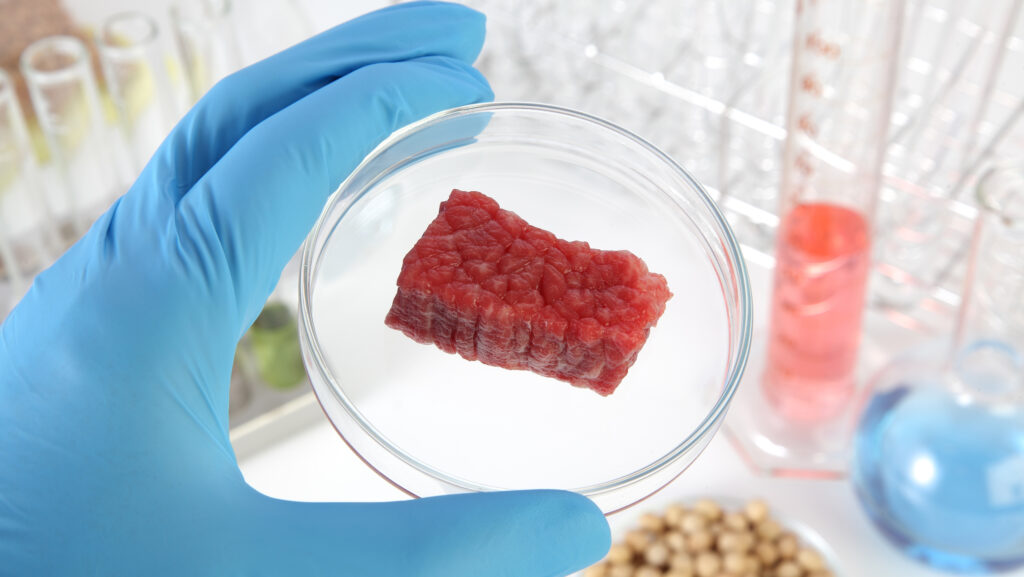 © studiocasper/iStockphoto
 Cultivated meat – sometimes called lab-grown or cultured meat – is moving from research into reality.
It involves taking a small sample of animal cells, feeding them with a nutrient-rich broth, and allowing them to multiply in vessels similar to those used in brewing.
See also: UK moves closer to approving lab-grown meat
Because it can be produced without raising and slaughtering animals, advocates see it as a solution to many environmental and ethical challenges associated with present food production.
They argue it will reduce animal suffering, help feed a growing population, and lessen the environmental impacts of diets.
About the author
 James Riley is a research fellow at the Royal Agricultural University.
Here he sets out why cultivated meat may not be just a threat to farmers.
However, key questions remain, including whether production can be scaled, whether costs can be reduced, whether energy use can be lowered or decarbonised, and, most importantly, whether people will choose to eat it.
Products have already been approved for sale in Singapore, Australia and the US, while Italy, Hungary and some US states have implemented restrictions or bans.
In the UK, the Food Standards Agency is exploring how cultivated meat might be assessed under food safety regulations, with the first safety assessments expected next year.
This is part of a broader government push to bolster biological engineering.
Buck the trend
Successive governments have looked to these high technologies to buck the trend of economic stagnation.
However, in the case of cultivated meat, the ongoing UK-EU sanitary and phytosanitary negotiations, which could bring novel food regulation back into alignment with the EU, may well scupper one of the few competitive advantages afforded by Brexit.
While the science is advancing, the way cultivated meat might be produced at scale is far from settled. Production could be highly centralised, with large companies operating mega-bioreactor facilities.
Alternatively, it could be more distributed, with smaller units closer to consumers. Some envision on-farm production as part of diversified farm businesses, while others imagine appliance-based systems in the home.
Incorporation into the food system could take many forms, each representing fundamentally different futures for farming, from addition to integration to replacement.
For some farmers, any of these futures may raise concerns. Cultivated meat is sometimes promoted as a direct solution to the moral ills of any type of livestock farming, as though there is a moral equivalence between intensive, industrialised poultry and fell-farmed lamb.
But not all farmers view cultivated meat purely as a threat. As one sheep farmer wryly put it: “If I could grow meat without it running away from me, then I would.”
Potential opportunities
Research at the Royal Agricultural University has also identified potential opportunities for UK farmers.
These include on-farm production, supplying inputs such as cells or feedstocks, and processing crops or by-products.
Furthermore, there may also be a growing market for high-value conventional meat if cultivated products become widespread.
Over the past year, the Royal Agricultural University has convened a Citizen Forum to explore how people view a future with cultivated meat.
Participants recognised that any transition in food production could have significant consequences for rural livelihoods, and emphasised that farmers should be supported if such a transition is to be fair.
The future of cultivated meat will not be determined by the technology alone. Economic conditions, regulatory decisions and public attitudes will shape whether, and how, it becomes part of the UK food system.
If it does, the critical issue will not simply be if it is economically viable, but who benefits from it. Whatever direction the technology takes, farmers need to be part of the conversation shaping that future.