

Opinion: New planning powers could solve farming’s ammonia issue
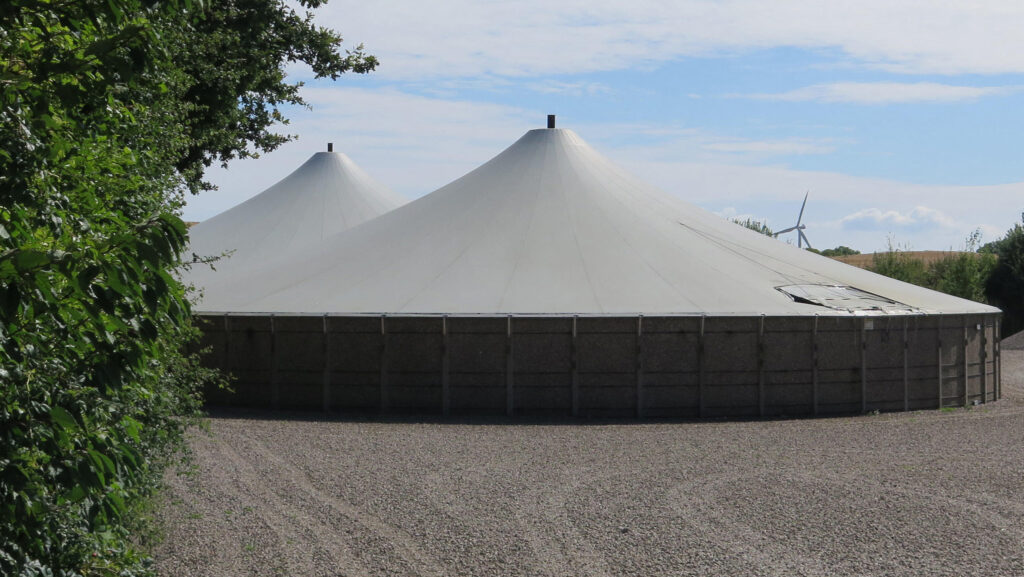 Covered slurry store © Johnny Walker/Alamy Stock Photo
 Ammonia is a significant source of air pollution in the UK and can have an impact on protected sites.
With agriculture representing 87% of total emissions, it is understandable that it receives a lot of focus.
But legacy EU laws such as the Habitats Regulations Act as a barrier to progress.
See also: Biostimulants held back by inadequate regulation
About the author

George Eustice is former Defra secretary and chairman of IFEAA, a think tank dedicated to reducing greenhouse gas emissions.
Here, he sets out how a change in planning laws could alleviate ammonia emissions from agriculture.
Ammonia is a highly mobile pollutant that mixes with other gases to create particulate matter which can travel long distances.
Much of the ammonia pollution affecting southern England actually originates in northern Europe.
Individual farms are not able to meaningfully address a national, and to some extent international, environmental challenge.
But that is what the current planning requirements as expressed through the Habitats Regulations demand.
The relevant duties are only engaged where there is a “plan or project” involved.
They only become relevant where there is a planning application or an application for an environmental permit.
Infrastructure
An existing dairy farm with poor infrastructure and high ammonia emissions is unaffected since they do not have a “plan or project”.
But a farm that submits a planning application to make improvements to reduce ammonia can face refusal.
This is because their application is not assessed by whether ammonia emissions are reduced, but instead against a more absolute baseline as if there were no current emissions from the holding.
The regulations therefore act as a significant barrier to changes that would actually reduce ammonia emissions. That makes no sense at all.
The Planning and Infrastructure Act, which passed late last year, creates an opportunity to fix this damaging feature of the Habitats Regulations.
Delivery plans
The secretary of state now has the power to create an environmental delivery plan (EDP) covering any area and any protected feature.
In exchange for a developer or applicant making a financial contribution (set out under a charging schedule), permissions or obligations implied under the Habitats Regulations would be deemed “satisfied” and Natural England would have new funds to address the challenge strategically.
The powers are designed with complex challenges such as ammonia pollution in mind.
Natural England should now create a number of regional EDPs covering ammonia for England based on advice from the Air Quality Expert Group.
An EDP could align with the targets the government has set for ammonia reduction under the Gothenburg Protocol and therefore choose to define an improvement in conservation status within a given EDP area as representing an ammonia reduction of, say, 16% where a change is made.
Obligations
A farm business submitting a planning application for slurry infrastructure that reduced ammonia pollution from their holding at the target rate would be deemed to have satisfied their obligations under the charging schedule for the Nature Recovery Fund.
Meanwhile, a farm business that sought planning permission for the construction of slurry infrastructure that would increase ammonia emissions over the current baseline, or fell short of the target reduction, could make a financial contribution to the Nature Restoration Fund.
Funds collected this way could then be used for options such as funding sealed lids on slurry lagoons on other holdings, or acidification technology to reduce ammonia emissions from stores, or funding machinery pools to support the deployment of direct slurry injectors into the soil to further reduce emissions.
An EDP for ammonia would unblock planning applications to improve slurry handling infrastructure on farms, benefit water quality and air quality, and would remove a barrier to the development of farm businesses.