

Opinion: Response to goose problem highlights crofting spirit
 © Adobe Stock
 On a bright winter morning, six little heads appeared over the lip of a grassy slope on our croft.
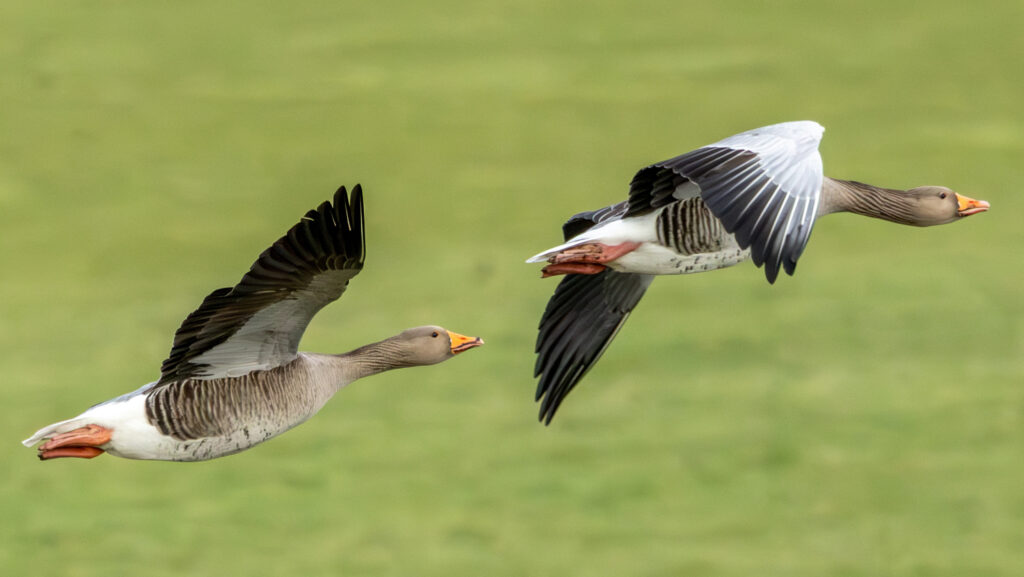
I watched the gaggle of greylag geese from my kitchen window as they began to graze.
I’m a lifelong bird watcher, so my reaction to seeing these newcomers was one of interest, along with a little concern.
See also: Opinion – farmers have a ‘bone-deep resilience’ to endure tough times
Things I know about greylags – they can eat a lot of grass, they’re large, heavy birds, they’re smart, and their population has exploded in recent decades.
I thought about our Outer Hebridean cousins, who’ve been defending their precious meadows against an exponential geese invasion for many years.
I can see South Uist from my front door – it’s only 30 miles away as the goose flies.
Grass destruction
There are estimated to be 10,000 geese over there, and the problem of grass destruction became so serious that ScotGov eventually intervened with a management scheme.
I called on an older crofter whose family have been here forever, and mentioned our visitors.
He was upset, telling me this is a relatively new issue – once, no geese could be seen in this township. We decided to monitor the situation.
Then the spring bite finally appeared – that first flush of new grass we all long for.
It signals the end of a long winter, and lush days ahead.
Walking our old runrigs, I noticed that the grass was growing well in the sheltered furrows. The geese noticed too, and the next day there were 12 on the croft.
I walked over with our terrier to scare them off, and they ignored me until I jumped the fence and shouted. Away they flew to our neighbour’s best hayfield.
The following afternoon, the number had increased to 18 and they were on another neighbour’s only decent field.
Two more days passed, and we awoke to 30 greylags on our 2-1/2-acre pasture – the only productive grassland we have – which is currently being rested ahead of lambing.
It was clarted with large dumps of goose faeces, looking like endless piles of dog poo.
Nearby fields were the same, neighbours reporting that the geese were making a ruthless daily tour of the township.
A single greylag can eat more than 1kg of fresh grass a day.
There’s a much-reduced acreage of good grass here anyway, due to the ongoing decline of traditional crofting, so the problem was now getting very serious.
Licensed cull
Consulting the appropriate General Licence, we decided to carry out a cull.
Lawful firearms ownership has also undergone decline in crofting areas, but several of us are trained hunters as well as crofters, so fortunately we have the ability to act. And we did.
As I write, a good number of greylags are being transformed into burgers and sausages for our families, and the rest of the gaggle has disappeared. For now, anyway.
Although we’d rather have kept the valuable grass for our livestock, it’s helpful to diversify our diets with home-grown goosemeat.
Life here once necessitated an intimate connection between people and place, one shaping the other over thousands of years.
In our corner of Skye, we’re working hard to keep that community connection alive.
We solved our goose problem through neighbour co-operation, pooling skills and experience to meet a shared need.
That’s the spirit of traditional crofting communities in the Gàidhealtachd – working together for the common good.