

Opinion: Tighter supplies will only drive more food inflation
 © Coldsnowstorm/Istockphoto
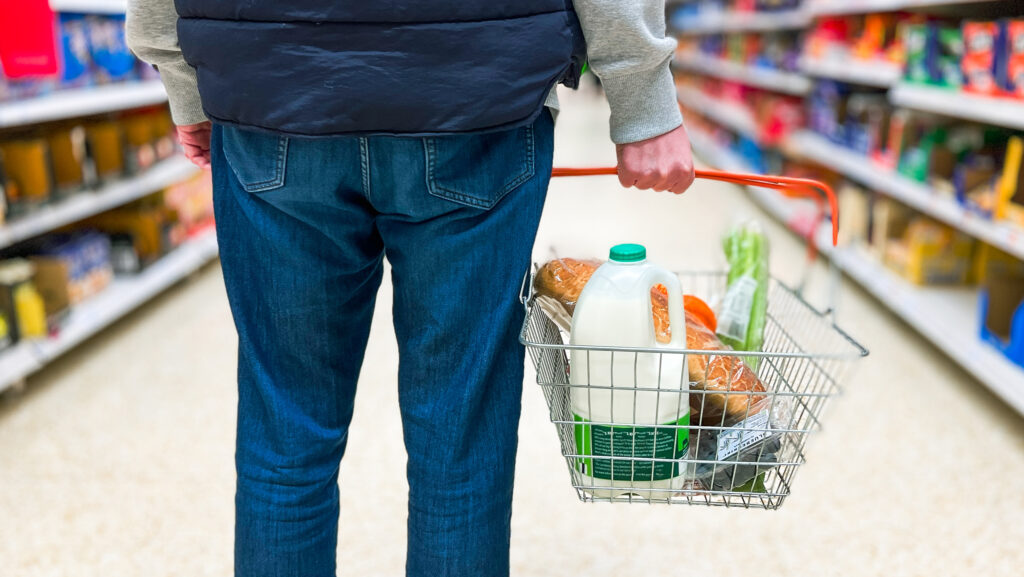
 Recent figures published by the government show that overall inflation may now be down to 3.4%, but also that food price inflation is markedly above that figure.
For the 75 years post-Second World War, food price inflation was consistently below the general level of inflation.
The proportion of a family’s income spent on food fell from 30-50% to 6-10%, thus releasing a large proportion of income for consumer durables and entertainment.
See also: Falling farmgate values fail to ease latest food inflation hike
About the author

Michael Raw is a retired agricultural economist and former college lecturer. Here he explains why contraction in farming due to government policy could have a disproportionate effect on food price.
This was a direct government policy implemented by the Ministry of Agriculture.
The essence was that “farm subsidies” actually amounted to “inducements to oversupply the market”, which had a disproportionate effect in bringing prices down.
Farmgate products face an inelastic demand curve because the quantity of food consumed in any given time period is relatively fixed.
This means that price changes are more related to the quantity supplied.
For example, if farmers supply 103% of what the market requires then the price doesn’t just decrease by 3%, it will fall by 10%, which leaves the farmer with only 93% of expected income.
Targeted strategy
The long-term effect of farm subsidies was a targeted strategy to ensure that the market was consistently oversupplied and the proportion of the family budget needed for food declined.
However, the reverse is also true. When a market is undersupplied, the price increases more than outweigh the shortfall, leading to a rise in farm incomes.
The current shortfall in the UK beef and sheepmeat markets demonstrate this, with prices up 50% due to a 15% reduction in livestock numbers.
On the other hand, the dairy sector ramped up production while prices were good in the past 12 months and are now facing savage cuts as a consequence.
Policy shift
The creation of Defra and the policy shift towards the environment, has divorced government from any strategy for food security in the UK.
“Public money for public goods” will have a very hollow ring if groceries become even more unaffordable than they are at the moment.
To not consider “food on the table” a public good is a complete abdication of responsibility by the government.
For many years farmers have been encouraged to diversify and seek an income outside the realm of food production – and many ingenious enterprises have emerged.
But this has created a section of farmers who are now only “part-time farmers” and they are not going to keep producing food as a loss-making enterprise.
We are harangued by government ministers to go for growth, while their policies are designed to do the complete opposite in one of our basic industries.
Upstream industries
There is a whole sector supplying farm businesses with equipment and products to facilitate their output.
Contraction in farm production means contraction in these upstream industries, and to some extent the downstream ones.
Reliance on imports will not benefit the consumer as importers will quickly learn to manage the flow of goods to create just enough of a shortage to maximise their margins.
The imposition of inheritance tax on agricultural assets will also make farmers cautious when it comes to expansion to spread rising fixed costs, leading to many farmers exiting the industry and land going to less intensive production, or out of production altogether.
The resultant shortages will mean much higher rates of food inflation in the near future.