Management Matters: positive outlook for joint venture
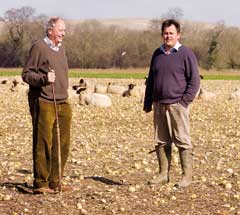
The arrival of spring always creates a rush of activity on arable farms, and with 8000 acres of fertiliser spreading on the arable and grass area and over 800 acres of spring drilling to do, HBH Farming partnership is no exception.
Neighbouring farmers Guy Hildred and Edward Bishop believe the joint venture – now in its sixth season – is still delivering real benefits to both farms, and their other partner Vaughan Williams. One look at the HBH fertiliser spreading team in action and you see their optimism is well-founded. The team of three – operating two Amazone spreaders and one loader – can cover over 1,000 acres a day (spreading Sulphur Gold at 135kg/ha).
 |
|---|
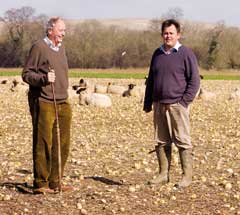
| Neighbouring farmers Guy Hildred and Edward Bishop say their joint venture delivers real benefits to both farms. |
“You do get days when two fields want something doing at the same time, but, generally, it works out alright,” says Mr Bishop. “We have such varied soils across the farms that it makes it easier to manage the workload – the chalk land goes first, while the heavy land is done last. Even on smaller areas, there’s a lot of natural variation.”
All the Fuego spring beans and Tipple malting barley has been sown, and, of the planned spring cropping, just 500 acres of medicinal-use poppies and some 300 acres spring oilseed rape remains. However, Mr Bishop says heavy pigeon damage to winter rape crops means around a quarter of the acres need to be re-drilled with spring rape – probably in a fortnight’s time. “Crops are a pretty mixed bag, but hopefully a dose of nitrogen will see them right.”
Mr Hildred remains optimistic the rape crop should turn a decent profit this harvest. “We sold a lot of the rape forward at June 2008 prices,” he says.
Selling forward
Indeed, across HBH most of the 2009 rape crop has been sold – and 5-10% of the wheat has been committed, most based on a feed price of £128/t plus milling premium. “We’ll hold fire on selling more as I think there’s still plenty of life left in the market,” says Mr Hildred. “I don’t think as much wheat’s been planted as some people think. And, with over a million tonnes due to go to the new Ensus plant this harvest, my guess is there won’t be much of an exportable surplus.”
As for the 2008 crop, about 80% of the HBH tonnage has been sold and moved off-farm and both partners are pleased with the prices achieved. Most milling wheat averaged around £150/t and spring barley a “fantastic” £180/t.
“HBH profits will definitely be up this financial year and I’m certainly very positive about the next six months,” says Mr Hildred. “We’ve got over the bump of buying fertiliser and sprays and there are only the fungicides to buy between now and harvest.”
However, having paid £300-350/t for this season’s fertiliser when it was bought early last year, and seen the price fall since, Mr Hildred says he will not rush into buying next year’s supplies. “We normally get most of the fertiliser delivered around harvest. But after what happened last year, I can’t see many people buying early.”
In an experiment to reduce the reliance on artificial fertiliser, around 2,000t of green waste compost from councils in west London has been bought this spring. Most will be spread ahead of the poppy drilling, but the organic matter, phosphate and potash it provides will be useful on any of the mix of light gravel, flint and chalky soil.
Lambing approaches
Meanwhile, at Streatley Farm, preparations are underway for lambing 1400 Suffolk mule-cross ewes, which is due to start on 5 April. The lambs are fattened on stubble turnips and sold through Thame market as 42kg hoggets. Mr Bishop says the farm’s late lambing fits in well with the arable system, as it uses existing labour and buildings either side of busier periods – plus it provides a use for the grassland.
With recent prices of £60-79 a head, they also provide a decent income stream. “They’re all export-grade lambs, so they’ve really been favoured by the recent pound-euro exchange rate,” Mr Bishops says. “The light land is ideal for fattening lambs on roots, and, if we take on more contracted land, they can use any grassland that’s included.”
He is keeping an open mind about whether more land will be added in the future. “If a nice block of 1000 acres comes up, we would consider taking it on. But we don’t have to, so we can afford to be a bit choosy. Generally we aim to run everything at 90% capacity, so, if a problem does occur, we can handle it. We don’t want to have to work all hours and try to do everything.”
Set-aside plans fail to impress 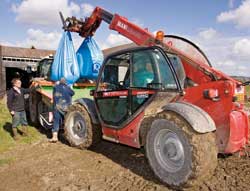
Sharing machinery and labour at busy times requires careful planning
Commenting on DEFRA‘s proposals for a replacement to set-aside (News, 6 March), Mr Hildred is sceptical about the plans. “1-2% set-aside would suit us nicely, as it takes out the marginal land around field edges, watercourses, etc. But, as farmers, we have a duty to fill the market with food and I can’t really see the point of 5% set-aside.”
He also feels it could add to the regulatory burden – something that dissuaded him from originally joining the Entry Level Scheme. “After an RPA inspection that lasted four days, we didn’t want to set ourselves up for even more,” he remarks.
Mr Bishop did go into the ELS at Streatley Farm, but with the existing five-year agreement due to expire next year, he is unsure whether he will continue. “I’m sure it is having a benefit on wildlife and the overwintered stubbles fit with our lamb fattening on turnips, but I’m not sure it’s worth all the extra hassle. I think we’ll wait and see what happens with set-aside, before making any decision about renewing.”