Exhaust gas injection drives establishment
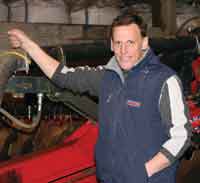
Steve Heard, the first person in Europe to trial a Canadian technique that claims to reduce the fertiliser requirement of crops by pumping exhaust gas into the seed–bed, reports that the crops drilled last autumn are looking greener and more advanced than those drilled normally.
“There is a definite line where the treated area begins and that continues across the whole treated area,” he says. “The root structure is also markedly larger.”
This view is shared by his agronomy consultant, who is also keeping watchful eye on developments.
“It’s not an easy concept to fully understand,” he says. “The exhaust gas is not the provider of the nutrients, but a means of stimulating microbial action within the soil. The carbon dioxide, for example, raises CO2 levels, which stimulates free-living nitrogen-fixing bacteria.”
Mr Heard treated 1400ha (3500 acres) of the land he farms at Illston on the Hill, Leicester, and a sizeable chunk of his customers’ cereal acreage last autumn.
The fields were worked so that there were alternate 30m-wide strips of treated and untreated areas. Two passes were made, one with a 5m Sumo cultivator, then a second with a 6m Vaderstad pneumatic drill.
On both machines, the exhaust gas leaving the engine passes first through a pressure control to ensure the engine back–pressure is not exceeded. It then goes through a front-mounted, fan-activated cooler unit to reduce the gas temperature from 450C to the 65C needed to ensure it stays in the ground.
On the Sumo it is piped to the nine suboiler legs, which place the gas at a depth of about 25cm. A bank of shallow tines then ensures the exhaust gas is mixed into the top few centimetres of soil.
On the Vaderstad pneumatic drill, gas is piped to the fan intake and then used to convey the seed to the coulters.
This spring he intends to provide the plots with four different rates of nitrogen fertiliser – zero, a third, two–thirds and full rate – to see how they respond.
“My longer–term idea is to use a two-third rate, which would save, at current fertiliser prices, about £35/acre. That means the cost of the cultivation and the injection would be well covered,” he says.
So optimistic is he about the technique, pioneered by Alberta farmer Gary Lewis and his NC Quest company, he plans have two exhaust injection units working this autumn. Each will consist of a 500hp John Deere tractor and a 5m Sumo cultivator/injector.

Staying sharp shouldn't be a chore