Making the switch to direct drilling

Anthony Reynolds, a tenant farmer of 1000ha of heavy land at Burton Lazars, near Melton Mowbray, Leicestershire, is committed to direct drilling.
He is in year three of direct drilling every crop on his farm and has sold his plough, power harrows and other cultivation equipment, along with four high-horsepower tractors. In their place are two direct drills – a 6m John Deere 750A and a 4m Bertini. A 200hp Case 915 CVX tractor now does most of the work, although other tractors are used for grain trailers and other operations.
The switch to direct drilling came from a combination of pressures, but not least because Mr Reynolds is in the River Eye catchment-sensitive farming area.
“We needed a way to stop phosphate from getting into the river, and no-till sprung forward as the best way to stop run-off.”
He was also concerned by increasing horsepower requirements, which seemed to knock “seven bells” out of the soil.
Organic matter had all but disappeared from his soils, he adds. The consequences of that were shown by the ploughing up of a grey mat of trash from previous years. “The soil bacteria weren’t working.”
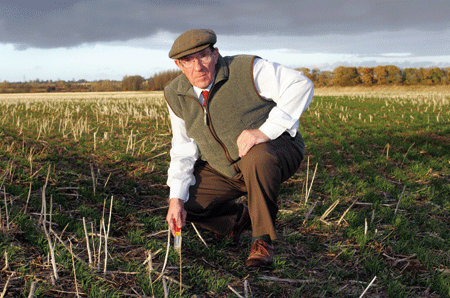
Before settling on the John Deere and Bertini drills Mr Reynolds trialled several other drills to establish his winter wheat, winter barley, oilseed rape, oats and winter and spring beans. “The target was that you had to get down on your knees to see whether it had been drilled or not – we wanted that little disturbance.”
But it is not an easy transition. Yields, for one, are hit quite hard, particularly in years two and three (see table). “There’s a serious bit in the middle when you wonder what you are doing.”
However, based on his experience from direct drilling some fields for six years now, yields begin to recover in year four, and “you are up and running in year five”, he says.
The switch has had a staggering effect on some of his costs. For example, across his 1000ha he used 56,000 litres of diesel from September through November 2005 establishing his crops, mostly by traditional means. In 2006, his first year of 100% direct drilling he used just 17,000 litres. Assuming a red diesel price of 38p/litre that’s a saving of £14,820.
Spare parts cost £14,267 in the same period in 2005 compared with just £2277 in 2006. And establishment costs dropped by over 80% (see table).
Those kinds of savings make it easier to hang in during the tough early years, he says. “You can stand a drop of 1t/acre in yield, particularly when wheat is £60/t, although it doesn’t look quite so clever when wheat is at £150/t.”
Like many other growers, Mr Reynolds first tried direct drilling back in the 1970s with a Bettinson drill. It didn’t work then, but he is convinced it will now. “We’re coming from a different view now – the style of drills has changed, the herbicide armoury is much better, and we know more about what we are trying to do,” he concludes.
Letting in herbicide sprays
Dealing with straw is a common problem when direct drilling – unmanaged it can cause big problems with establishment, slugs, and as Mr Reynolds found, efficacy of pre-emergence herbicide sprays.
“It was a game – the straw interrupts the spray.”
Fortunately, most of his straw is removed by local livestock farmers, but this year he is also trialling a system on 60ha where he used a stripper header to combine wheat, barley and oats.
It leaves the straw standing, stripped of the grain, which means the pre-emergence spray can hit the bare ground much better, he explains. “It is an expensive trial – the header cost in excess of £20,000 – and it looks quite bizarre. But the oilseed rape is well-sheltered and quite advanced.”
He plans to extend the system to about 200ha next season.
Yields (t/ha)
- Year 1: 8.75
- Year 2: 7.5
- Year 3: 7.5
- Year 4: 8.0
- Year 5: 10
(Traditional average: 10t/ha)
Traditional system | Direct drill | |
Sub-soil (1 in 3 years) | 13 | |
Plough | 43.75 | |
Disc | 30 | |
Carrier | 14 | |
Power harrow | 29 | |
Drill | 20.50 | 27.61 |
Roll x2 | 24 | |
Spray | 7.50 | 7.50 |
Total | 182.05 | 35.11 |
Source: Combination of Mr Reynolds’ costs & Nix for a medium soil. | ||