Farm commissioner defends CAP reform plan at NFU Conference
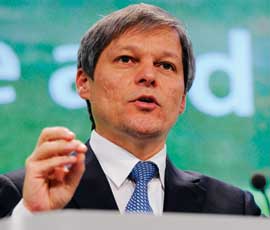
European farm commissioner Dacian Ciolos has launched a staunch defence of his proposals to reform the Common Agriculture Policy.
Brussels remained committed to market-orientated agriculture with decoupled subsidies at the core of a reformed CAP, he said.
“Production decisions have to be driven by markets, not by subsidies,” Mr Ciolos told the NFU annual conference in Birmingham on Tuesday (21 February).
The European Commission’s proposal to freeze to CAP budget at 2013 for the period 2014-2020 was a “decent approach” in the current economic climate.
Farmers needed to realise there was strong political pressure to reduce the CAP budget, Mr Ciolos told delegates at the ICC conference centre.
“If we want the CAP to be a forward-looking policy, we can no longer justify direct payments based on historic references that go back to 10 years ago.
“That is why we are looking to move towards a flat-rate payment per hectare in each region or member state.”
Farmers in England would benefit from the fact they had already moved to a flat-rate payment per hectare. But this was not the same for other countries, such as Wales.
“I am aware of your concerns,” said Mr Ciolos.
“We want to avoid any disruptive effects that could impact the viability of farms during the conversion from an historical to a regional model of flat rate payment.”
The new CAP would continue to support farmers’ income, but be better tailored to objective needs. This was why tighter rules were proposed on capping and subsidy recipients.
“For years, the CAP has been criticised for giving disproportionate subsidies from public money to economic operations that may not really need it.
“The economic crisis, with taxpayers shouldering heavy burdens throughout Europe, is making this argument even more sensitive.”
This criticism was even more acute today, said Mr Ciolos.
“It is publicly impossible to defend why the EU is giving large amounts of money, public subsidies, decoupled – meaning unconditional, for activities with no link whatsoever to farming.”
But CAP money would not be taken from big farms and redistributed to small farms.
“This is not a Robin Hood operation.”
Mr Ciolos also defended proposals that would see farmers required to maintain at least 7% of their farmland in “ecological focus areas”.
“This is not set-aside,” he said. “It is a measure aiming first of all to preserve biodiversity and to better use the existing landscape features.”
Ecological focus areas would exclude permanent grassland but include field margins, hedges, trees, fallow land, landscape features, watercourses, buffer strips and woodland.
It was impossible to talk about sustainability without taking responsibility for the protection of the environment and management of natural resources seriously.
This was another reason why 30% of direct payments received by farmers would be linked to implementing agricultural practices that benefited the climate and the environment.
See our special pages on the NFU Conference and elections 2012