

2010 FW Awards: Countryside Farmer of the Year finalist – Brian and Patrick Barker
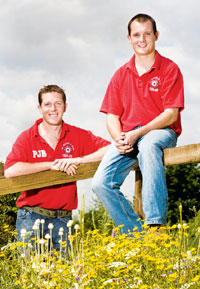
Cousins Brian and Patrick Barker say one of them is a farmer/conservationist and the other a conservationist/farmer. And they’ve used this mixture of farming and environmental nous to change how their family has farmed for generations.
Brian and Patrick came to the 513ha (1270-acre) family operation, Lodge and Kiln Farm at Westhorpe near Stowmarket in Suffolk, six years ago. They were fresh out of university with a plan to modernise their family’s traditional arable and pig farm.
Since then, they have reverted marginal areas to grassland – most notably a section to link together parcels of grasslands on their farm – planted wild bird mix, cleaned and restored ponds and altered the arable production and use of equipment.
“We did the ELS and HLS when we arrived on the farm because we wanted it to be how we put our stamp on the farm that we are taking on to inherit,” says Brian.
“It showed our parents we were serious about the way we wanted to take it.”
The whole farm is included in the HLS which has got Brian and Patrick clearing the 30 ponds across the farm at a rate of three a year for the next 10 years. A narrow central field, which according to the cousins was a nightmare to plant, spray and harvest, forms the core of a plan to tie together grassland in the area.
“I looked at the habitats we have got on the farm and they are all unique. We’ve got ponds, hedgerows, a little bit of grassland, the farm yard, the village green and then I looked at what the neighbours had,” says Patrick.
“When you look at it, it’s not very pulled together so I came up with this idea to connect the various areas with watercourses, fields being transformed back to grass and hedges.”
The Barkers weren’t comfortable buying seed “off the shelf” when returning sections of the farm to grasslands, wanting to keep local species on their farm, so they researched an innovative technique to spread local seeds.
They used the “green hay seed” technique, mowing and baling the grass from the village green and moving the bales on the same day to the fields, where it is rolled out and spread using a hay turner with a straw chopper used on wet areas.
“Everywhere we’ve taken it we’ve had really good take up. We have pretty much got all the species, with plenty of nectar for insect life to feed the chicks, such as grey partridge, early on,” says Patrick.
“We wanted to get species rich and diverse as quickly as possible and we already knew this grew on our soil type.
“Now we are looking at expanding it, but we don’t want to deplete the donor site so we do it once every two years,” says Brian.
“In the long run, we are looking at managing it for weeds and looking at grazing it.”
Brian and Patrick have also reduced the amount of machinery used on the farm from six tractors and a specialist crawler to two tractors and a crawler, which has led to a variety of savings in maintenance, labour and fuel.
“We know we are definitely more efficient than we were a few years ago and dare we say it, more efficient than our dads were,” says Brian.
Farm Facts
• 513ha (1270 acres)
• 30 ponds distributed across the farm
• Once home to Mary Tudor and Charles Brandon
The judges liked
• Young team with plenty of enthusiasm
• Good ideas for the future of their agri-business
• “Green hay” used to replace grassland with local species
• 43km of hedgerows on farm
• Detailed plans for wildlife and data collection
• For more on the 2010 Farmers Weekly Awards
• For more on the the 2010 finalists