

International agriculture: Prospects for Guinea
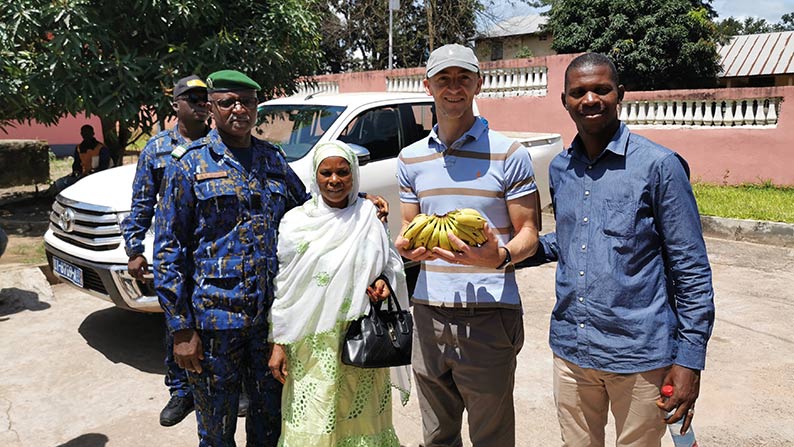 FW chief reporter Philip Case (centre right) and Guinean journalist Alpha Ousmane Souaré meet regional leaders in Kindia © MAG/Philip Case
 Guinea was once the major agricultural producer among the French colonies of western Africa. Over the past few decades, the sector has stagnated.
Agriculture remains below its potential, representing 24% of GDP in 2018.
The mining industry is the key driver of economic growth in Guinea, contributing roughly 35% to the country’s GDP.
Guinea underwent a regime change on 5 September, 2021, after a military coup deposed former president Alpha Conde amid accusations of large-scale fraud and embezzlement.
The president of Guinea’s transitional government, Colonel Mamadi Doumbouya, has realised that agriculture is a sleeping giant.
See also: Photos: FW visits farms in Guinea
Farmers Weekly’s Philip Case visited the country to find out more about the agriculture sector there.
His guide was Alpha Ousmane Souaré, a farming journalist, based in the capital city, Conakry.
Mr Souaré works at radio station FIM 95.3 in Conakry, where he presents La Guinée Rurale programme every Sunday morning.
He is also head of Amedar (Media and Agriculture Association on Rural Development), a network of Guinean agricultural journalists working to raise the profile of agriculture.
Agriculture in Guinea
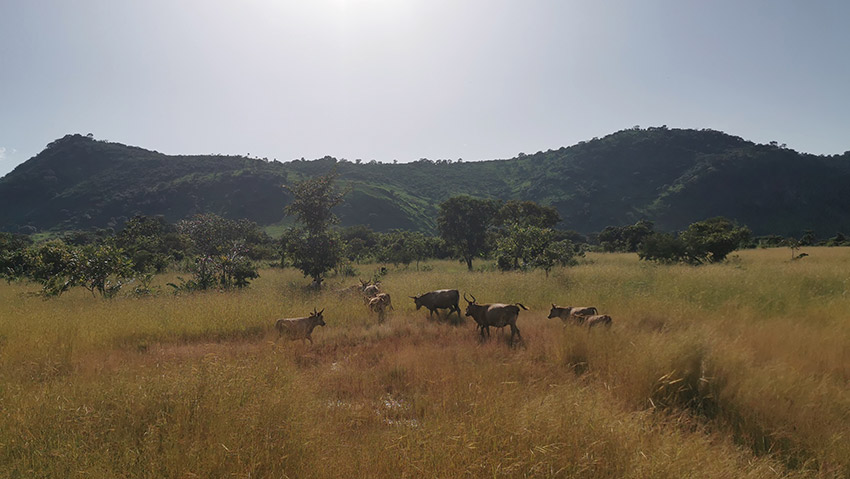
N’Dama cattle © MAG/Philip Case
- 24% of GDP attributed to agriculture in 2018
- 54% of the workforce employed in agriculture
- 1,100mm to 4,000mm of annual rainfall (depending on region)
- 15.5m hectares of arable land
- Just 10% of land is in regular cultivation
- 5% of crop land is irrigated
Sources: The World Bank in Guinea, ministry of agriculture (Guinea), International Fund for Agricultural Development
Guinea has an estimated 15.5m hectares of arable land, of which 3.85m hectares (25%) is farmed, and 10% is cultivated annually.
It also has 7m hectares of “rich and varied” natural pastures, according to a November 2020 report by the International Fund for Agricultural Development.
The country is subdivided into four natural zones: Lower Guinea, Middle Guinea, Upper Guinea and Forest Guinea.
Each region has its own challenges, including different climates and geographical characteristics such as temperate mountain areas.
About 85% of its population are smallholder/subsistence farmers. Two-thirds of their farms are less than 3ha.
A wide variety of crops are grown, including rice, maize, fonio, potatoes, vegetables, pineapples, bananas, mangos, palm oil, dried fruits and coffee beans.
Although soil testing is not common, soils are fertile, water is in abundance and the climate is good for farming – in general, six months of rainy season (June to November), followed by six months of drier weather (December to May).
Nitrogen fertilisers are used to promote plant growth, but many farmers practise “bio-farming” (organic farming).
Livestock farming, including cattle, sheep, goats, pigs and poultry, is Guinea’s second-largest activity in the rural sector after cropping.
Farm animals are the main source of income for around 30% of the rural population.
The N’Dama beef breed, which is believed to have originated from the Fouta-Djallon highlands of Guinea, is by far the most dominant cattle breed. It is a small, multipurpose breed, which is docile and disease-resistant.
Cows can calve up to 19 years old, but milk production is low and they are mainly bred for beef, which is of average quality.
Research is looking at crossbreeding using artificial insemination to produce better-performing cows.
Government plans
In May, Col Doumbouya launched the Fonds de Développement Agricole (FODA) to promote private investment in the agricultural sector, allow better exploitation of Guinea’s agricultural potential and contribute to better farm incomes and food security.
Speaking at a press briefing in Conakry, farm minister Mamadou Nagnalen Barry told how Guinea records around 30% of post-harvest losses due to bad systems, poor access to markets and inadequate storage.
Mr Barry says Guinea’s government doubled the funding for the agriculture sector this year to $30m (£26.12m), of which $4m (£3.48m) is already in farmers’ bank accounts.
“We are trying to win back trust [of farmers],” he adds.
In all regions, farmers have formed federations in their sectors to exchange technical support.
The private NGOs are recognised by government and members get together to apply for funding for equipment, which, once purchased can be borrowed or rented out.
On day two, we visit Entreprise Tidiane Agriculture, a company that, within the framework of the public-private partnership, works in close collaboration with the technical services of the ministry of agriculture.
The company has set up field schools. Director general Tidiane Diallo will build a training centre with dormitories to facilitate learning.
The plan is to teach young farmers the best techniques and strategies to succeed and have the biggest impact.
Mr Diallo says he imports and distributes all kinds of agricultural inputs, including chemicals, seeds and fertilisers, from countries across the world and he is open to collaboration with more companies, especially in the UK.
Guinea’s four-point plan to improve agriculture
© MAG/Philip Case
Guinea’s agriculture ministry has announced a four-point plan for more investment in its agricultural industry.
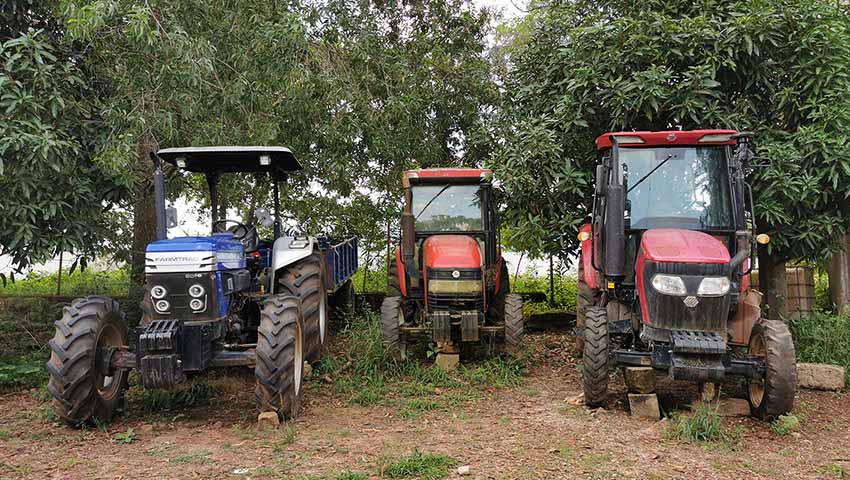
- The focus on machinery and technology (mechanisation of agricultural vehicles) sees 500 state-owned tractors being made available for farmers to buy, paying 35% up front and the remaining 65% over five years to own the vehicle outright
- Between 400 and 500 people are being recruited from the capital to provide advisory services to farmers in rural areas
- Access to finance (both public and help for private) is the third goal
- The fourth focus point is improving access for farmers to credit, support grants and agricultural inputs
Infrastructure
A trip to the Kindia prefecture on day three, 70 miles north-east of Conakry, and one of the of the best regions to grow pineapples and bananas, was a key part of our visit.
Our delegation faces horrendous “bouchons” (traffic jams) on roads that are in shocking condition.
Our 4×4 vehicle is bounced around like a beach ball as we tackle the large craters, or “pattes d’éléphant” (elephant’s feet) – a suitable metaphor.
Mr Souaré says poor infrastructure is one reason why Guinea does not export much agri-produce. Chinese companies are building new roads to link urban to rural areas, but it will take many years before completion.
No cold storage transportation network means agri-produce is at serious risk of rotting en route. An absence of grain stores on farms is also a big constraint.
After several long hours on the road, we arrive at Kindia’s prefectural directorate of agriculture, which houses the agricultural mechanisation centre, for a meeting with local farmers and agronomists.
In the yard, there are two ageing Chinese combine harvesters and three tractors, including a blue Farmtrac, imported from India and purchased by the Guinean government.
During the meeting, farmers express frustration over the many obstacles they are experiencing in their daily work.
Mechanisation
One farmer says mechanisation is the key to unlocking Guinea’s agricultural sector.
He notes western countries, such as the US, have introduced mechanisation and new technologies, which translates to just 2% of the workforce being required for farming.
This year, farmers in Kindia drilled many crops, but struggled at harvest with a lack of combine harvesters. Mechanics are in short supply and if machines break down, it can take time before they are back up and running.
Kindia has between 2,500mm and 3,000mm of rainfall a year – arguably too much.
It is a productive area, but poor infrastructure, including a lack of crop irrigation systems in the dry season, is stopping it from reaching its full potential, say farmers.
Farmers say another big headache is a lack of subsoilers/cultivators to prepare the ground for following crops.
In Guinea, efforts are being made to tackle poor forest governance and land clearing for “slash and burn” agriculture.
Tree felling is not allowed in Kindia in July, August and September for soil and water conservation. During this period, farmers are encouraged to plant new trees.
They are not allowed to fell trees on high summits at any time of the year.
Investment
In summary, Guinea’s agriculture sector needs major investment – both public and private – to create jobs, boost food security in the region and kickstart exports.
This will require greater use of new technology and mechanisation, sharing of expertise, upskilling the existing workforce and new recruitment, better access to information and high-speed broadband in rural areas.
Mr Souaré says the availability of land and access to water means there are big opportunities to start farming partnerships in Guinea.
But it is rare to see an individual tenant farmer farming more than 100ha due to a lack of workforce and machinery, especially at harvest.
Guineans have good ideas, but many don’t have the financial means to realise them, Mr Souaré says. There are big opportunities to add value to Guinea’s raw agricultural products.
There is a lack of processing units for agricultural food products. The irony of drinking mango juice imported from Vietnam, while sat in a restaurant in a country that has significant mango production was not lost on us.
“There are always opportunities in Guinea for someone who comes from Europe, the Americas or elsewhere and who has got the means to invest, help the community and make good returns.” Mr Souaré says.
Farmers Weekly thanks Amedar and the British Guild of Agricultural Journalists for making this press trip possible.
Bah Mohamed, pineapple and tomato producer, based in Kindia

Bah Mohamed © MAG/Philip Case
Young farmer Bah Mohamed has been producing pineapples since 2018 and tomatoes for more than three years in Kindia.
He would like to see more support for young farmers and women from the transitional government.
Mr Mohamed says it is not easy for young farmers to get on the land, and when they do, many struggle to obtain organic or chemical fertiliser.
This causes a major problem for those who want to increase their productivity.
Because there is no cold storage, he says farmers are in a rush to sell their produce as a lot of products are perishable within two, three or four days.
But farmers are limited in the availability of markets for their produce and sometimes must go out of their way to make a sale.
Off-farm, the roads are not good and there are traffic jams everywhere.
Mr Mohamed has followed lessons online to be able to produce food using natural inputs – “nothing but clean organic farming.”
He says the agriculture minister should approach farmers like him to help share his experiences of growing crops with other young farmers.
Mr Mohamed wants the agriculture minister to make crop technicians available to young farmers and help them sell their goods at a minimum price.
Asked about the future, he is somewhere between neutral and optimistic.
“It’s true there is good talk. The engagement that the president and the minister talk about is reassuring. But on the ground, we don’t see it.”
Podcast
Bah Mohamed and Philip Case discuss the challenges faced by young farmers in Guinea in the Farmers Weekly podcast.