

Advertiser content
4 ways to get the best return from T1 fungicides this spring
With many winter wheat crops coming into spring both forward and lush, the 2026 spraying season has begun with higher potential for both yield, and disease development.
However, perhaps more so than ever, disease control decisions are far from simple.
As T1 fungicide applications rapidly approach, and with cashflow and profitability a top priority, we explore four key considerations for T1 fungicide decision making this spring.

© BASF
1. Rusts require a resilient approach
The breakdown of YR15 has garnered a lot of attention since harvest and with 43% of the top 21 sown winter wheat varieties now having a yellow rust score of 5 or below – rightly so.
This, coupled with carryover inoculum from 2025 means yellow rust is a real threat this year.
“In the right conditions, yellow rust can cycle in 10 days or less” advises Jared Bonner, Business Development Manager at BASF.
“Thankfully we have tools available to keep yellow rust at bay, but it requires a different approach to septoria.”
“Ultimately, it comes down to being vigilant, particularly on susceptible varieties. Where active yellow rust is seen ahead of T0 or T1, consider inclusion of a yellow rust eradicant in the tank. T0.5 or T1.5 top ups can also be an option if conditions are particularly favourable for rusts.”
Recent reports also suggest the incidence of brown rust.
With the pathogen infecting wheat 8 times more efficiently than yellow rust, and 10 of the most widely grown wheat varieties having a brown rust score of 5 or less, growers are encouraged to remain wary of its presence.
“Revystar XE is a strong choice when it comes to rust control, even versus newer options,” advises Jared. “Both the Revysol and Xemium components deliver robust protection against yellow rust, whilst also being two of the market leading active substances against brown rust.”
Across three yellow rust trials in the latest AHDB fungicide performance curves, Revysol® delivered a 0.1t/ha yield uplift compared to Iblon, at 50% full rate of each.
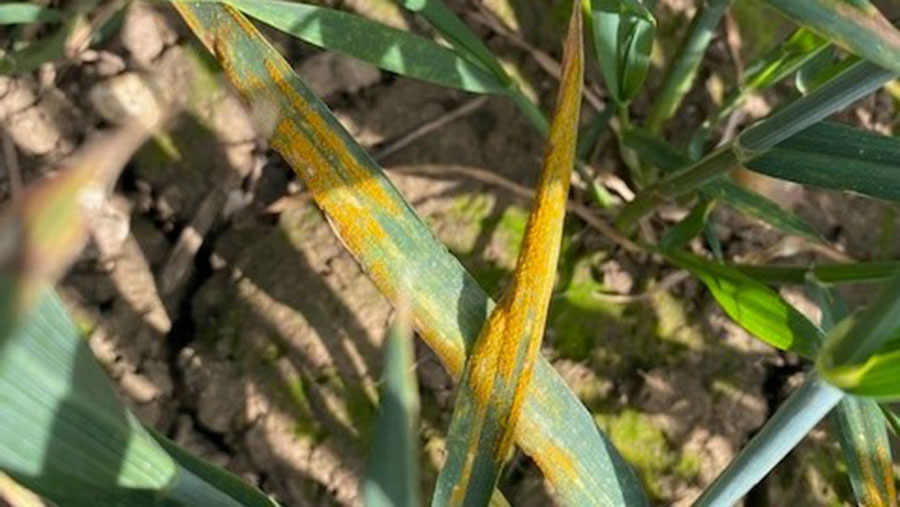
Yellow rust © BASF
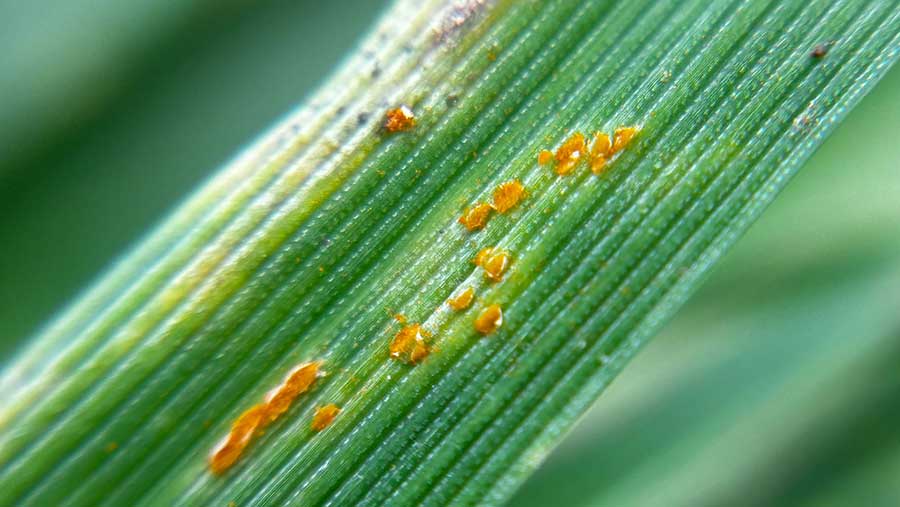
Brown rust © BASF
2. Navigating the options
Despite the risk of rust, current conditions also favour septoria development and if wet conditions persist, eyespot is also a potential threat.
“There’s an almost bewildering level of choice out there in terms of the number of fungicide brands available” advises Steve Dennis, head of business and technical development at BASF.
“But when we look at what we’re trying to do in terms of achieving good septoria control, there’s only three modes of action that are relevant. We’ve got the QiIs, the SDHIs, and the azoles, and the important thing is to employ all those modes of action as you’re trying to achieve a sustainable level of performance.
“Within the azole group, we now only have one active ingredient that’s really giving us significant control of septoria, which is Revysol.”
Revysol® is also performing strongly against new actives like Iblon.
Across 12 septoria trials between 2023 and 2025 in the AHDB data, Revysol® (Myresa®) delivered a 0.2t/ha yield uplift compared to Iblon® (Vimoy®), at 50% full rate of each.
Jared adds that at T1 growers need to cover all the bases, especially if current conditions persist, adding that “Revystar XE meets this brief because of its consistent strength against septoria and rusts, as well as eyespot activity, as seen in trials by Nottingham University.”
“Perhaps most notably, opting for Revystar at T1 keeps your options open for T2,” advises Jared.
“Given that Inatreq and Iblon can each only be used once within a programme, coupled with the current geopolitical uncertainty around market dynamics, and of course not knowing how the season will unfold, a robust and cost-effective T1 of Revystar XE enables a number of options to be considered at T2.”
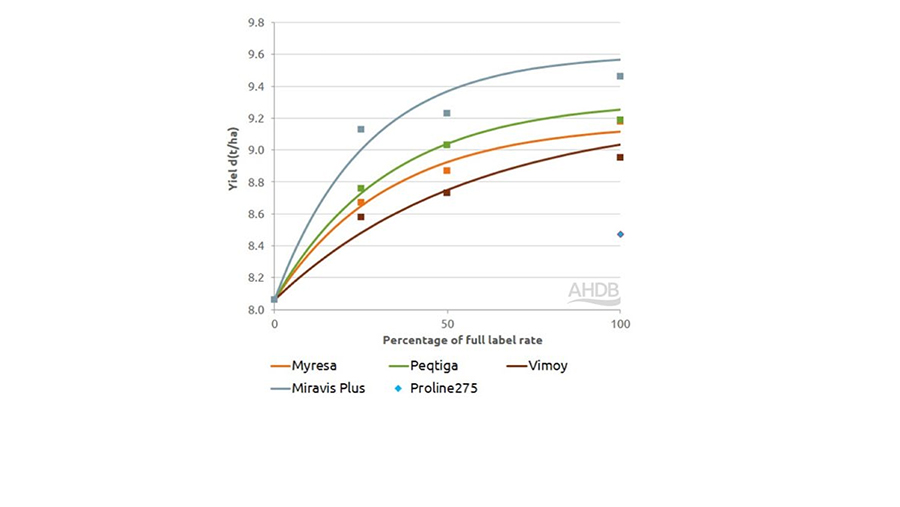
AHDB Fungicide performance trials. Septoria Yields 2025 (4 trials)
3. Revystar® XE delivers £51/ha margin over Ascra® Xpro
Arguably, one of the most fundamental decision-making factors for fungicide programmes comes down to profitability. After three challenging years, crop and input prices continue to be challenging, with every penny spent under close scrutiny.
Across 16 comparisons based on independent trials data, Revystar® XE delivered a +£51/ha margin benefit over Ascra® Xpro, following a 0.26 t/ha yield uplift.
Based on 2025 pricing in Kynetec panel data, Revystar® XE offered a £4.09/ha input cost saving versus Ascra® Xpro, combined with a £46.80/ha yield benefit, making it a robust and cost effective T1 solution.
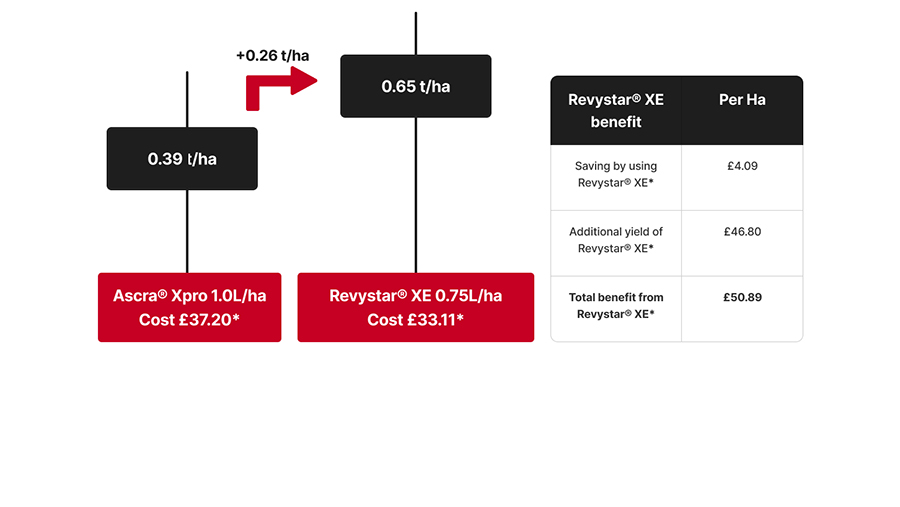
16 Independent comparisons – 2025
Mean untreated yield 10.85t/ha
Applications at T1 and orthogonal T2
*ROI Calculated using 2025 Kynetec panel price and Wheat price of £180t
4. Protecting chemistry
A final key factor that has recently come into the spotlight is designing fungicide programmes that take resistance management firmly into consideration.
“With the new SDHIs, Iblon and Adepidyn, we can get high levels of septoria performance,” explains Steve, “but what the AHDB data has shown us is that a single application relying on either Adepidyn or Iblon is sufficient to drive a reduction in sensitivity, with representatives from both ADAS and Niab now cautioning against the use of both Iblon and Adepidyn within a programme.”
“We’re not seeing that with Revysol and we’re not seeing that with fenpicoxamid but we need to consider that fenpicoxamid is also a higher resistance risk active substance and learn the lessons that we’re seeing from those higher activity SDHIs by not leaving that active exposed either.
The AHDB findings emphasise the need to tread carefully when choosing products this season.
Revysol® adds invaluable diversity to programmes.
“Given that the septoria control is largely being driven by Revysol, a triazole, and a lower resistance risk mode of action,” advises Jared, “it alleviates selection pressure and protects higher resistance risk solutions in your programme, like Univoq, Plaxium and Miravis Plus, where QiIs and SDHIs are doing the ‘heavy lifting’ in control of septoria”.
Summary
Revystar® XE is Everything you need:
- Broad spectrum disease control including strong control on yellow rust and septoria
- Excellent efficacy
- Long lasting protection
- Rainfastness
- Outstanding flexibility with no restrictions of use across the programme
- Fantastic value
Provided by
BASF offers renowned and innovative fungicides, herbicides, insecticides and growth regulators for agriculture. Our products and services help farmers increase their yields and optimize the quality of their products.