

Advertiser content
Advice on managing costs and yield in another tricky season
With margins under pressure, growers are taking a far more nuanced approach to crop investment this season.
Ongoing concerns around fuel and fertiliser costs continue to sharpen focus on input spend. In the field, variable weather, yield potential and yellow rust are dominating decision-making.
Septoria pressure, meanwhile, remains ever‑present and firmly on growers’ minds.
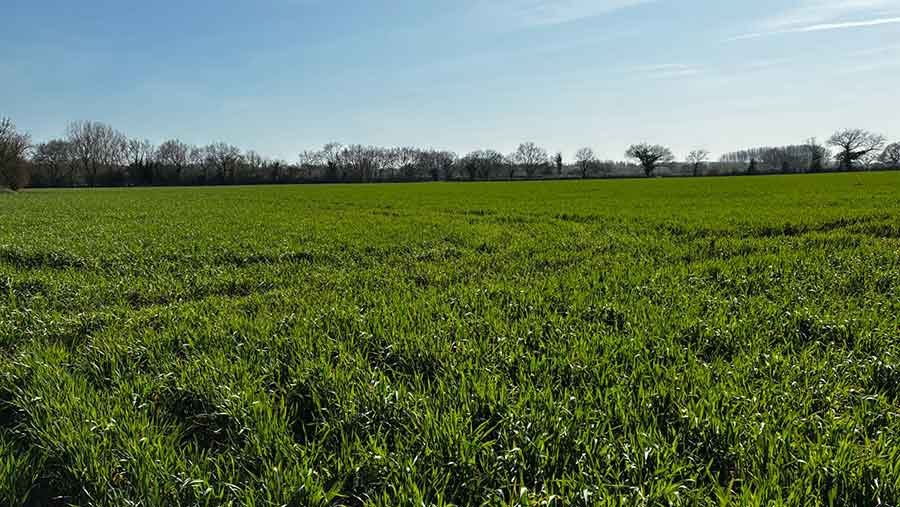
© BASF
“Where there is yield potential, most feel it is worth investing and seeing the crop through – a ‘yield is king’ type approach.
Where growers aren’t likely to get the returns they had hoped for, they are cutting their cloth,” explains independent agronomist Chris Taylor.
We caught up with Chris, alongside Lincolnshire grower George Atkinson, BASF independent field sales manager Matt Keane and Scottish grower Chris Leslie, to explore how the season is shaping up and how different businesses are adapting to the changing conditions.
George Atkinson, grower in South Lincolnshire
George Atkinson © BASF
George, along with his wife Clare and son Harry, manages 700ha under contract alongside his 1,100ha home farm. He grows winter wheat, winter barley, spring barley, oats, vining peas and beans.
“Worryingly this spring is starting to look a lot like the last one. We had 2mm on 14th April and that was the first in weeks. The ground is dry and cracked open. It’s looking a bit desperate,” he says.
Despite the conditions, his winter crops are not yet suffering and spring crops have established well.
“We’re having a bit of a battle with yellow rust on some varieties. It is the headline of the season and proving quite tricky to manage.”
Champion is George’s biggest wheat crop variety by area.
“We knew of its vulnerabilities, and we were always going to be putting a T0 on it. Beowulf has caught us out a little bit.
“For the first time, we have an area of Scope which is also proving quite rusty. The Cranium and Arnie seem to be clean so far though.”
Unlike last year, disease has been evident from the beginning of the season, meaning that George was inevitably going to have a more robust fungicide programme.
“T0 was tebuconazole and at T1, we’re using Revystar. Having looked at all the options, we concluded that it is reasonably priced for how effective it is. We’ve used it for several years and know it will do a good job.”
George will wait and see how the season plays out before deciding on T2s. For now, he is focused on crop nutrition.
“There seems to be plenty to worry about at the moment, but fuel and fertiliser prices are maybe the most concerning.
“We apply chicken muck and biosolids in the autumn and, with the current situation, we will be tailoring applications as much as possible. The aim is to leave some liquid fertiliser in the tank for next year.”
George is already looking ahead to harvest.
“We use up to 18,000 litres of fuel a week during harvest, and our suppliers have currently got orders capped to 8,000 litres per delivery.
“We desperately hope that fuel prices and supply will have normalised a little by the busy season. Though hoping that prices will return to where they were feels a little optimistic.”
Matt Keane, BASF Independent Field Sales Manager, East Anglia
Matt Keane © BASF
Matt is an experienced agronomist who provides technical advice and crop management strategies to farmers across the East of England.
“With good ground conditions last autumn, there are more winter crops in East Anglia than usual. They are, in the main, looking good though they could do with a little moisture.”
According to Anglian Water and the Environment Agency, rainfall across the region ranged from 51% to 74% of the long-term average for March. The soil deficit increased by around 17mm during the month.
“In recent weeks there has been a large diurnal temperature range, which crops don’t like either,” adds Matt.
Despite the dry conditions and cold nights, winter wheat crops have continued to grow on. T1s are now starting to be applied.
“In January and February, we had 200ml of rain so there was quite a lot of septoria about.
“That changed in March and while septoria is not expressing again just yet, I don’t doubt that it is in leaves four and five waiting for a bit of wet weather to spread it up to the top leaves.”
Although Matt has heard many reports of yellow rust, he hasn’t seen much himself. Still, he is keeping a close eye on crops, particularly those vulnerable varieties.
“I have seen brown rust in some KWS Vibe,” he notes. “The T0 has dampened it down but I’m sure there is some inoculum present and it will keep going throughout the season as long as conditions favour it.”
With all three diseases potentially ready to strike, and long-term weather predictions indicating we may be in for a dry end of April and start of May. Matt is advising growers to opt for a trusted fungicide with broad-spectrum control.
“Revystar does a very good job on septoria, is good on yellow rust and class-leading on brown rust.
“Tebuconazole or F500 can always be added to the tank where the yellow rust is a problem and the variety is vulnerable,” he says.
“Revystar is a good option at T1 or at the upcoming T2 timing, especially considering the current disease pressure and anticipated long term weather forecasts.
“Also, with a squeeze on margins, it offers value for money while also contributing to resistance management.”
Matt explains that in Revystar, it is Revysol that is ‘doing the heavy lifting’, in other products, the azole, usually prothioconazole, is in a supporting role, putting pressure and exposure on the higher resistance risk actives that they are partnered with.
“Revystar is different and will be a good choice this year,” he says.
Chris Leslie, Director of Cloud Farming, Central and Southern Scotland.
Since 2017 Cloud Farming has helped farms across South and Central Scotland—from small East Lothian family holdings to 1,300ha Angus enterprises—deliver regenerative, soil‑health‑focused strategies that keep their land profitable in a challenging market.
“So far, the season has been kind. We have had more normal conditions in comparison with the really dry springs of recent years,” explains Chris.
With over 700ha of cover crops, Chris and his team have a quarter of their spring cereal crops to drill but notes that soil conditions are great.
“In our winter wheat, we’ve completed the post-emergence weed control and applied Amistar as our T0.
“We’re not seeing much disease. While there’s lots of talk about yellow rust, we’re on top of it and with plenty of days under 5°C it won’t be cycling. It’s just nice to be able to get on and get the field work done.”
Chris’ winter wheat is all group 1 milling wheat and his current focus is optimising nutrition to maintain tillers and maximise yield potential.
“Although, the crops’ growth stage isn’t there yet, T1s are on my mind. We know that septoria inoculation is quite high at this timing so I tend to see if disease is present.
“If so, I will invest to take it out. The latest trials results and, of course, price are the final decision-makers.”
Chris Taylor, Down to Earth agronomy, Monmouthshire
Chris Taylor © BASF
Chris offers independent agronomy services giving expert advice for sustainable and regenerative farming consultancy in Wales and the West of England.
“On the whole, crops are looking well. Despite the wet conditions, they have overwintered better than the last couple of years,” he says.
“Last autumn, growers wanted to get crops in early in case the weather broke, but it stayed quite open so crops are pretty forward in terms of growth stage.”
The breakdown of the YR15 gene has been a game-changer in the region. Historically, yellow rust hasn’t been an issue but that’s all changed in the last 12 months.
“We have had high rainfall here, so most of the varieties are chosen for their septoria resistance. Extase, Champion and Graham are all still prevalent,” he explains.
With resistance management firmly in mind, Chris says that Revystar will feature in his fungicide programmes.
“I’m not yet sure whether it’ll be at T1 or T2 but as a different azole, it offers diversity which is a good anti-resistance strategy. It seems to be holding up well compared to some of the other older chemistry.”
Provided by
BASF offers renowned and innovative fungicides, herbicides, insecticides and growth regulators for agriculture. Our products and services help farmers increase their yields and optimize the quality of their products.