Farmer tackles arable slump with push for more hectares
 © Robert Scott
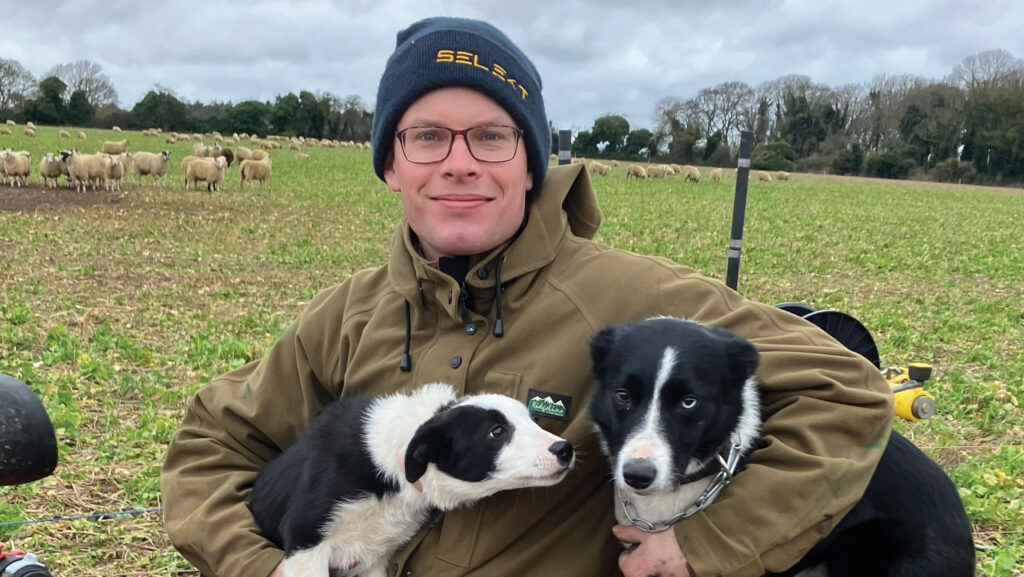
 Norfolk farmer Robert Scott is seeking to take on more land for his contract farming business to maximise machinery and make resources go further.
Over the past three years, the business has lost nearly 400ha due to landowner clients shifting away from arable farming in favour of environmental schemes amid falling grain prices.
See also: Young farmers bold move to take on council tenancy pays off
“Environmental schemes have put a bottom in arable farming. On poor land, crops must financially compete with field scale environmental options, or it is simply not worth the risk of cropping,” explains Robert.
“Most landowners have looked to reduce risk, and put say 10-20% of their farms into schemes. The cumulative effect is we’re farming less land for each customer.
“The difficulty for me, as the contractor providing machinery and labour, is we carry those fixed costs irrespective of annual cropping decisions,” he adds.
As a result, the cropped area of the family business fell across each of the seven farms they manage.
In fact, an entire farm fell from their management, which meant a drop in total crop area from 1,850ha to 1,450ha.
“This had a significant impact on our business. In the short term we reduced our staffing by one full-time operator.
“Our main objectives to stay afloat have been keeping a tight control on input costs and making resources go further in a regenerative approach,” says Robert.
Robert Scott © Robert Scott
The business is now looking to increase its farmed area to optimise machinery outlay and make every unit of labour count.
Machinery efficiency
The arable operation is based on combinable crops and sugar beet, alongside cover crops and grass leys, on which Robert finishes upwards of 2,000 lambs a year.
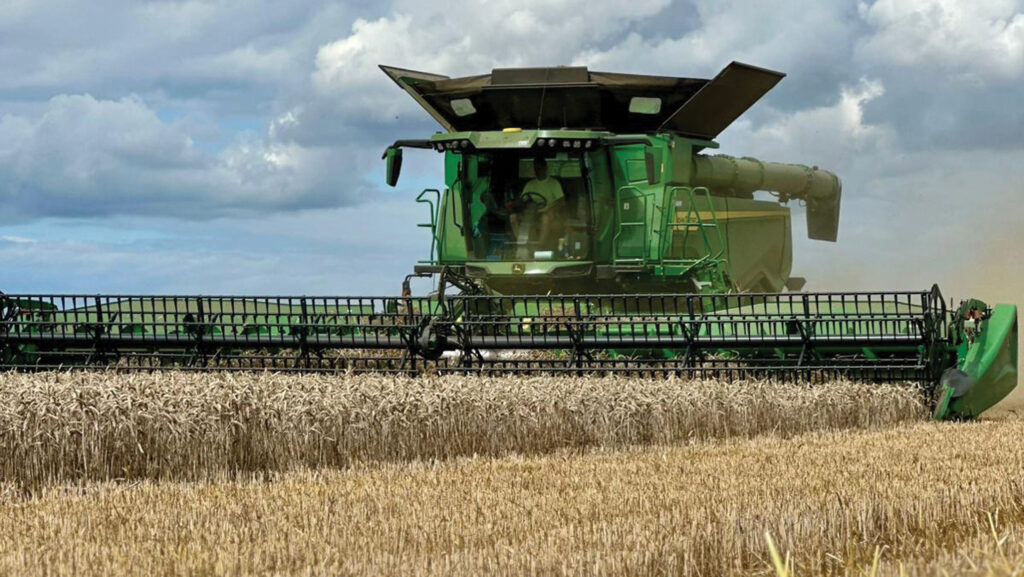
The farm runs a John Deere X9 1100 combine, which currently harvests about 1,000ha of cereals each year.
As arable margins continue to squeeze, such a large machinery investment means the figures aren’t stacking up like they previously were.
“To make such a big machine pay for itself, we need to be cutting upwards of 1,200ha of cereals. This is why we want to take on more land,” he says.
Sustainable machinery financing is a key focus of the business. Robert runs a fleet of five John Deere tractors.
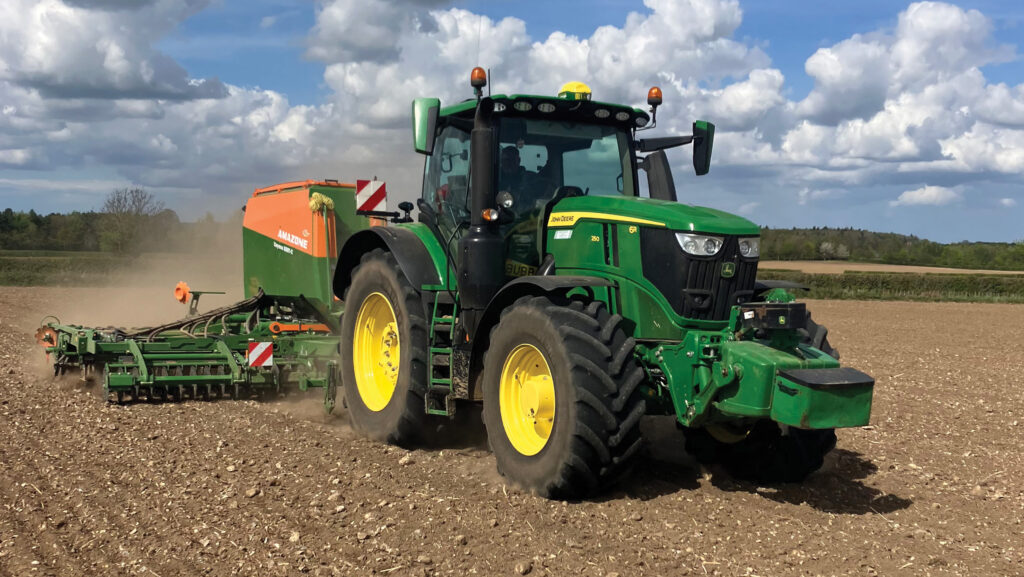
Robert decided to trade in the large 300hp tractors and replace them with smaller, more flexible 200-250hp machines to benefit not just finances, but wider travel windows with reduced risks of soil compaction.
© Robert Scott
Each tractor in the fleet will be taken to 8,000 hours before being traded in, rather than 5,000 hours as was previously the case.
“The aim is to make every hour on the clock and every labour unit count. During peak periods such as harvest and drilling, we also hire in an extra tractor,” he says.
In 2020 the Sands self-propelled sprayer was traded in for a Horsch trailed sprayer.
“We’re more flexible. Each tractor can work on each job. We can swap out a tractor where needed, which covers any potential breakdowns,” explains Robert.
“If we lose a contract, we can simply sell a tractor and not be left with a large finance bill for a self-propelled sprayer which may not be able to pay for itself.”
Competitive offering
Furthermore, the payment structure of some of the contract farming agreements has been reshaped.
“We run a tighter payment schedule with a pay-as-you-go model for each operation, plus a fixed management fee, rather than a profit share at the end of 18 months,” says Robert.
This has helped even out cashflow and keeps customers transparent with the business.
“It works well for all parties, with smaller amounts paid more regularly.”
Robert offers customers a holistic farming approach which prioritises soil health.
The rotation benefits from sheep integration, cover cropping and a haylage-making business, which helps culturally control grassweeds and bring diversity to the operation.
“We diversified into selling 20kg bags of haylage for horse feed to pet owners across the UK and export markets.”
This added real value to the farm’s grass crop, which plays an important role in the rotation.
Cutting costs
A regenerative system was introduced in 2019, with a continued focus on cutting costs where possible. Previously, the system relied on heavy cultivations and high horsepower.
With gross margins dwindling, reducing costs and prioritising soils were key to a profitable business.
“It all comes down to these fine details – that is where the margin is. We’ve got to have slick operations,” says Robert.
Environmental schemes were strategically implemented, including cover cropping and taking awkward field corners out of production to streamline machinery passes.
Insecticide-free crops are also grown across most of the farming area.
Introducing livestock has helped the business maintain labour, too.
“We struggled to retain people over the winter as our arable workload was very spring and summer dominated.
“Now, with the sheep enterprise we can employ full-time, quality staff, which has been brilliant.”
The plan is to increase annual store lamb numbers, as well as grow the home ewe flock to 500 head by 2027.
Nutrition
Fertiliser use on winter wheat has been reduced to 180kg N/ha, down from the previous farm standard of 225kg N/ha, with some as low as 150kg N/ha.
Variety selection is geared around strong disease resistance and early vigour to help cut fungicide use.
“We have the advantage of sheep to graze forward cereals, which can help eliminate an early fungicide pass. We graze in batches of 500, avoiding grassweed-prone areas which can otherwise increase weed germination.”
Robert is growing one block of winter wheat as a fungicide-free trial this year, applying a range of silicon and biostimulants instead.
Variety blends combining barley yellow dwarf virus-resistant and disease-hardy varieties have proved to be an effective tool, particularly with the insecticide-free Sustainable Farming Incentive option.
“It’s good to think about the entire rotation. We’ve introduced more nitrogen-fixing crops to preload land before winter wheat is sown.”
Industry optimism
Arable farming is certainly going through a turbulent time, but Robert is adamant there are opportunities out there.
“Hopefully, we can all come out the other side stronger for it,” he says.
After recently having his first child, Robert is feeling optimistic and looking forward to the future, continuing his passion of farming for the next generation.