Arable Insights farmers’ differing tactics for wheat disease
 © Tim Scrivener
 The six farmers on the Arable Insights panel have adopted very different strategies for disease control in wheat.
Strategies include more conventional approaches such as fungicides and variety choice, as well as more novel techniques like sheep grazing and applying biological brews.
Farmers Weekly catches up with each of them.
See also: Arable Insights farmers doubtful about Profitability Review
East Midlands: Tess Lincoln, Burton Lazars Farm, Leicestershire

© Tess Lincoln
Sheep have already started disease control programmes on Tess Lincoln’s two wheat varieties, Blackstone and Redwald. Mob-grazing virtually to bare ground through January and February removes all the overwintered diseased leaves, as well as acting as a growth regulator.
“It means we don’t need a T0 and often don’t apply a T1 either, depending on the year,” Tess says.
That might not be possible this season, she suggests. “They’re some of the best wheats we’ve ever grown. But looking at them, we might need to apply a T1 as they are thicker than we’re used to.”
The decision will be made with independent agronomist Sally Gray, based on what’s seen on her weekly scouting visits. “If we don’t spot disease, we won’t put a T1 on.”
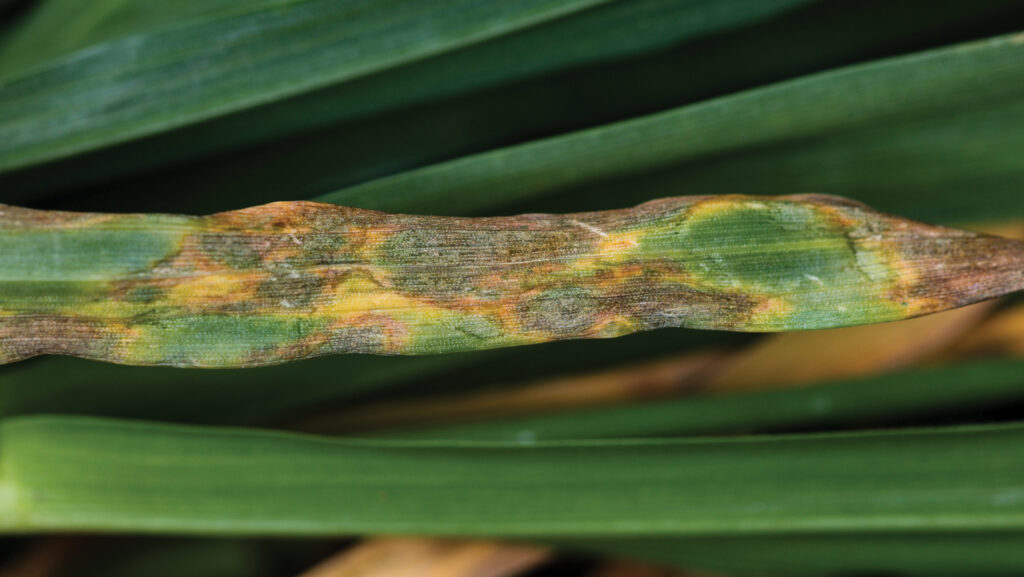
Septoria is a key concern for wheat, especially in wetter areas © Blackthorn Arable
Septoria and yellow rust are the main concerns. Tess tries to minimise disease risk through variety choice, although both Redwald and especially Blackstone’s yellow rust resistance have slipped following last season’s strain changes.
Flag leaf sprays are likely to be based on an SDHI fungicide. “We’ll assess the weather forecast and what the field looks like, but I think there is a massive benefit from the greening boost from an SDHI at that stage.”
In last season’s dry conditions, Aviator (bixafen + prothioconazole) was the choice. “I was pleased with the results, but we are open-minded to spending more if it turns out to be a higher disease pressure year.”
Tess is also going to trial the use of sap and tissue testing to assess the nutritional needs of the crop across part of the farm.
“I want to see if we can target specific nutrients to keep the plant healthy and avoid the use of fungicides altogether.
“It’s very much a trial, but I’m keen to experiment a bit more with using nutrition rather than reaching for the fungicide can.
“I have concerns about what fungicides are doing to soil biology. We’re very careful with our cultivations to protect soil, earthworms and microorganisms, but that gets forgotten when using a fungicide.”
Scotland: David Aglen, Inverarity Farms, Angus

© David Aglen
Around one-third of David Aglen’s 200ha of winter wheat has been grazed with sheep this winter, along with two-thirds of the oats, with early September drilled wheats prioritised.
“There was a lot of biomass, so it took longer, which is why not all were grazed,” he says.
“There are lots of other little things that are beneficial with grazing,” he adds.
“It firms up the soil around the roots, we might be able to save a little on fertiliser, and we get some income from the sheep farmer – around £30-£40/ha.”
Grazed fields are very clean, but the fields that were missed have lots of septoria and some mildew. Higher soil fertility resulting from regular applications of chicken manure across the farm could be driving some of that disease, he suggests.
Having used biological products and trace elements to good effect for disease control on his previous farm, he’s hoping to have similar success at Inverarity Farms.
“I don’t know if it will be possible, because some of the fields are as filthy with septoria as I’ve seen since using biological products,” he admits. “It might be a challenge.”
Applications with Nutri-Tech Solutions’ BAM (beneficial anaerobic microbes) plus seaweed extract and trace elements started in mid-March.
“You can’t wait for the crop to look unhealthy before you try to make it healthy,” he points out.
The bought-in product contains a probiotic blend of lactic acid and purple non-sulphur bacteria, plus beneficial yeasts and microbial exudates, as developed by Australian soil expert Graeme Sait.
David brews that in an IBC with molasses to make it go further, with applications of about 2 litres/ha in 100-200 litres/ha of water, eventually costing around £1/ha.
Weather-permitting, applications will be made every 10-14 days, with the plan to not use fungicides unless necessary.
“Yellow rust is the one that’s most likely to catch us out, with our blends chosen before the Yr15 problem arose,” he admits.
“But I’m not such a zealot that if I see the biological approach struggling that I won’t reach for a fungicide, if necessary.”
North: Richard Bramley, Manor Farm, Yorkshire
© Richard Bramley
Other than some later drilled wheat after sugar beet that’s suffered in the subsequent wet weather, Richard Bramley is pleased with how his winter wheat has come through winter.
Growing older milling wheats, Skyfall and Crusoe, purely because of market acceptance and yield and quality consistency, Richard has no thoughts about not trying to make the milling wheat grade despite higher fertiliser prices.
In fact, he has already bought some Nitram for next season as a hedge against further price rises. “It would grate to have put in a lower yielding older variety, and then not try to get the premium,” he says.
With disease control, fungicide timing is his key focus. “We want to make sure we’re in a position to get T1 and flag leaf sprays on at the right time,” he says.
“So we use T0s as a tool to help guarantee flexibility to hit the right timing with T1 and T2.”
While Skyfall is susceptible to yellow rust and Crusoe to brown rust neither has been spotted as yet, but there is septoria on the older leaves.
“We’ll spray folpet and tebuconazole around the Easter weekend, depending on weather and potato planting.”
Later sprays will be determined the monitoring of the crop and weather. “It’s likely to be a fairly robust T1 as I can’t see things dramatically changing,” Richard says.
“But if disease pressure eases off like with the dry spell last year, we might be able to make some savings at T2.”
Price and disease pressure will play a part in product choice. Last year he used Myresa (mefentrifluconazole) and Priaxor (fluxapyroxad + pyraclostrobin) with folpet rather than the newest, more expensive active ingredients.
“I haven’t started looking at prices to know if the prices have dropped on any products as they’ve become more established, but if it is very high pressure, I’d be open to using them,” he says.
Programmes will be completed with a T3 to make a four-spray programme, with combinations of azoxystrobin, prothioconazole and tebuconazole most likely.
East Anglia: James Porter, Porters Farm (Walpole), Suffolk

© James Porter
In a high input, high output wheat growing system where yields of at least 10t/ha are budgeted for, with 14t/ha possible in good seasons, spending on fungicides is affordable and necessary to achieve the yields for Suffolk farmer James Porter.
Yield is the main driver for variety choice, with only half an eye on disease resistance.
That’s part of the reason for growing Aintree on a seed contract, which was added to the latest AHDB Recommended List with a yield 4% above previous highest yielding varieties Scope and Champion. But it has a yellow rust rating of just 3.
Dawsum, whose yellow rust resistance has dropped to a 5 following the Yr15 resistance gene breakdown, is the other main variety on the farm.
A first spray of tebuconazole for yellow rust has already been applied before the end of March, James reports.
This was in combination with chlormequat and manganese to help manage the disease. “We’re not seeing much rust in the crops at the moment. I think the cold weather has slowed it down.”
The rest of the programme is still to be decided. Tebuconazole is likely to feature again, with what other diseases appear driving product choices.
“I have some Miravis Plus left over from last year, so if we need it, we can use it this year, probably with the tebuconazole.”
Univoq is another option for either T1 or T2, again with tebuconazole, he says. “I know some people have had sprayer problems with it, but that hasn’t been an issue for us.”
He’s conscious not to set an exact budget for fungicide spend. “Once the crop is in the ground, you have to look after it. You can do a budget, but you’re not going to not spray for a disease just because you’ve gone over budget,” he points out.
South: Andy Meecham, St Giles Farm, Dorset

© Andy Meecham
Three new winter wheat varieties are being grown by Andy Meecham at St Giles Farm, part of the Shaftesbury Estate in Dorset. Milling wheats Vibe and Cheer have replaced Crusoe, while Group 3 Bamford is the other newcomer.
“I did like Crusoe because it was very good at converting nitrogen to protein,” Andy says. “But brown rust was becoming a major concern and its yield was plateauing.”
The only older variety still being grown is Extase. “It used to have good yellow rust resistance, which helped not having to apply a T0, but that’s something that’s changing and it will need one now,” Andy says.
In fact, Andy thinks all the wheat will now receive a cheap T0 spray of tebuconazole and folpet.
“There’s the occasional plant with yellow rust – you have to work quite hard to find it, and septoria on the older leaves, which will transfer with rain splash up the plant.”
Septoria is usually the key disease concern on the farm, but Andy doesn’t tend to budget or make early decisions about programmes.
“We will take a decision at the time once we know how the T0 has done, and what the weather has been between T0 and T1.
“Ideally we will use the cheapest chemistry we can get away with, but we’re not adverse to using SDHIs or anything that is needed to control what’s in front of us.”
Higher pressure septoria would push Andy towards using one of the newer products, combined with lower prices.
“It’s also checking the potential of making milling wheat specs and whether we need the extra spend to secure that grade.”
As well as close monitoring of fields, Andy will also use industry alerts and models, particularly those in the south of England for signs of increasing disease risk, especially from septoria.
North West: Martin Caunce, Brow Farm, Lancashire

Fungicides are unlikely to play any part in the disease control strategy at Brow Farm in Lancashire this season, following a decision this season by Martin Caunce to not use either fungicides or pesticides.
“If I need herbicides I will use them, as I can’t have a field smothered in weeds, but this year, I’m going to stick to not using fungicides.
In the past, I’ve realised, we keep drifting back to using them if we have a problem, and then we seem to have the same problem the year after.”
Instead, he’s investing in the power of biology, and particularly Johnson-Su compost extracts, in combination with micronutrients, fish hydrolysate and molasses.
Made from base materials including sawdust, woodchips, poultry manure, woodland soil and mature compost, Martin is scaling up production from single pallet batches in 2m tall square crates to 40-pallet batches in dedicated bays. “That’s going to make about 45cu m of compost.”
Scaling up both production and use has also required some investment in processing capability.
Previously it was a manual process of washing finished product in a mesh bag to create the extract, but at the cost of around £12,000, he’s imported a compost extractor made by US firm Hiwassee Products – a firm he’s now acting as a dealer for in the UK.
The extractor has a spiral mechanism in a hopper that pulls the compost up through a mesh tube while jets of water rinse the material, he explains.
“When it first starts the extract is brown, but by the time it’s reached the top of the tube it is rinsing clear.”
The extract is then through a finer sieve to remove any remaining bits before being applied to seed, in-furrow or as foliar sprays, which will be applied at regular intervals during the spring.
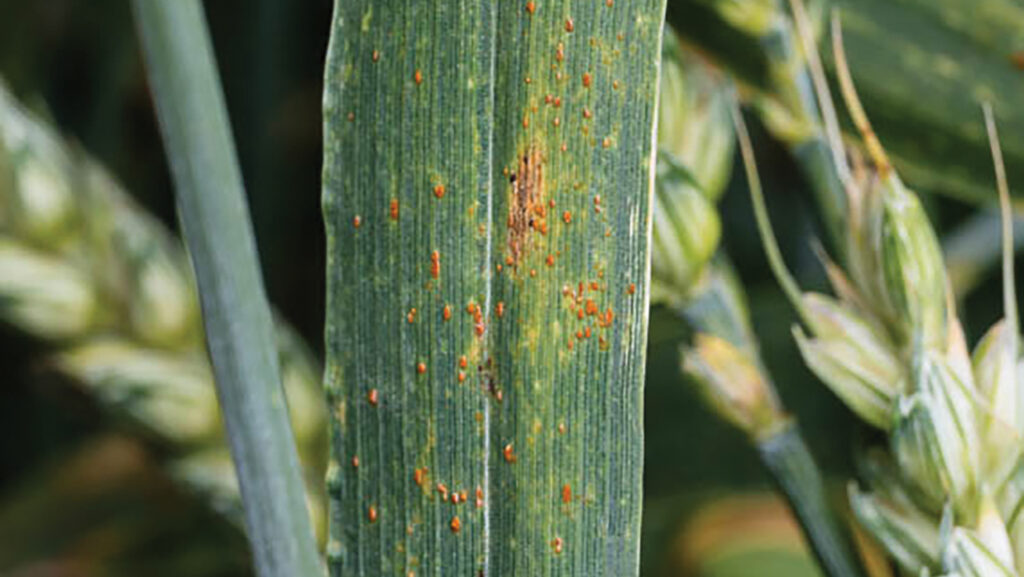
Late brown rust has been the biggest challenge in previous years at Brow Farm © Blackthorn Arable
“I’d rather than have good biology on the leaves, which hopefully leaves less room for damaging biology,” he says.
Applied at about 200 litres/ha at less than 3bar to avoid damaging the microbiology as it is sprayed, he mixes in “a couple of millilitres” of various nutrients, plus fish hydrolysate for the microbes to feed off and molasses, as determined by regular sap tests.
Late brown rust has been the biggest challenge in previous years on his wheat.
“It was in two fields that had grown lettuce for about 20 years, but not in the fields where we have been using the biology for longer,” says Martin.
Active ingredients
- Myresa – mefentrifluconazole
- Priaxor – fluxapyroxad + pyraclostrobin
- Miravis Plus – pydiflumetofen
- Univoq – fenpicoxamid + prothioconazole