Integrating sheep into arable rotations – how to get started
 © imageBROKER.com/Alamy Stock Photo
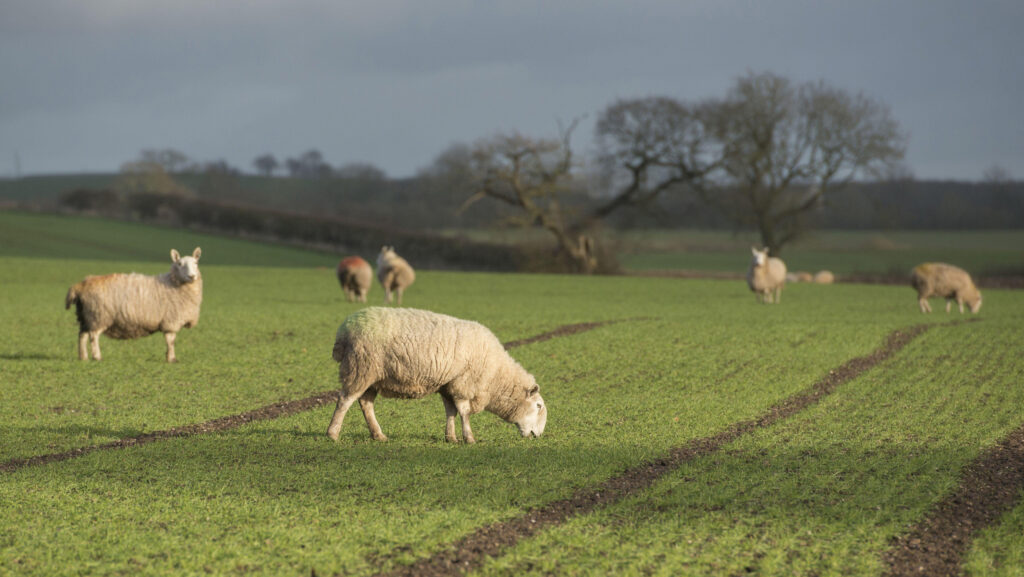
 The return of the “golden hoof” to arable rotations has gained momentum as more farmers embrace livestock integration as one of the key principles in a “regenerative” system.
Potential benefits include enhanced soil health and fertility, improved crop management leading to a reduction of chemical inputs, as well as an alternative income stream.
Sheep farmers benefit from being able to give permanent pasture a break while accessing clean grazing that can help break parasite cycles.
See also: Wilts OSR grower reveals lessons from sheep grazing trials
It also has the potential for quicker finishing grazing on diverse crops.
There are many benefits, including the opportunity to help young shepherds expand their business by providing grazing land.
Skills
However, there are also significant challenges and considerations for arable farmers that require careful planning, investment and management.
Those who have taken the jump use models ranging from taking on the sheep enterprise in-house to various forms of collaboration with specialist graziers or shepherds.
In-house demands the biggest commitment, not least because of the likely skills gap, says Dr Liz Genever, a sheep consultant and farmer in Lincolnshire.
“In intensive arable areas, it might be two or three generations since the last time the farm kept sheep.”
Those skills are learnable, but it’s important to have support, she stresses.
Employing a contract shepherd is one possible way to delegate the specialised day-to-day management.
Connecting arable farmers with graziers
The National Sheep Association, in collaboration with Niab and Liz Genever, has developed a Graziers List to connect arable and sheep farmers.
The service allows arable farmers seeking sheep to graze cover crops and other land to find potential sheep farmers seeking grazing in their region.
Start-up costs
Another potential hurdle is the start-up cost for essential kit.
Most arable farms typically lack permanent livestock handling systems, sufficient fencing, weigh scales and good working dogs, notes Jack McNulty.
He jointly runs a sheep enterprise on a 600ha mixed farm on the Wiltshire/Hampshire border.
“That all costs money, so if you’re thinking of just dipping your toe in, it might not necessarily be for you,” he says.
On the plus side, in-house management gives full control over grazing intensity and objectives, as well as direct access to the income from the sheep enterprise.
A popular alternative model is to employ a specialist grazier, who own their own sheep and take on grazing agreements on a number of farms.
Trust and communication are crucial, says Jack. “Regardless of farming specifics, you need to be able to trust the person you’re working with to do their job.
“And communicate from the start about what’s you’re expecting from the relationship.”
That’s particularly important around movement of sheep and how hard to graze crops.
“There are two ends to the spectrum. When you put sheep on a cover crop there’s the benefit to your crops, and the benefit to produce fat lambs to make money.
“As a shepherd, you’d be looking to manage to one end, and the arable farmer the other.
“Somewhere in the middle is ideal. For example, one farmer told me he wanted cover crops grazed right down to make cultivation easier.
“But keeping the lambs on those crops three or four days longer than ideal will compromise [lamb] growth.”
Agreements
Agreements can be as simple as a written list of clear roles and responsibilities, Liz says.
“It doesn’t have to involve hours of a solicitor’s time. Start with allocating jobs, roles and responsibilities.
“In particular, be very clear about winter management because sheep, as well as playing a brilliant role, can also cause compaction if they are not managed well, especially when soils are wet.”
Fees are usually bespoke, negotiated on a per acre or per head basis, with some costs such as seed sometimes paid by the grazier, for example.
A deeper version of this model is a joint venture between sheep and arable farmer, which is how Jack runs his business.
This gives everyone a bit of skin in the game, he says, helping to align interests with both parties invested in the success of the sheep enterprise and its integration into the arable system.
There’s no shortage of options for what to graze. Cover crops are widely seen as the primary option in arable rotations.
But cash crops such as winter cereals and oilseed rape can also be grazed, along with more specialist options such as stubble turnips and herbal leys.
One challenge with cover crops is that yields can be variable, Liz notes.
“As summers become drier, the ability to get cover crops drilled when we want, isn’t there.”
That can mean sheep farmers are making decisions where their sheep are going, before the arable farmer can tell them how much yield they are going to have.
Back-up plans
Have multiple options or back up plans for where sheep will go after the feed from cover crops runs out, she advises.
Most farms, somewhere, will have some permanent pasture, for example, which could be integrated into the system to act as a buffer.
Permanent pasture can also help transition sheep from diets consisting of more lignified material to greener arable or cover crops, Liz says.
“We can sometimes be asking the rumen to adapt quite quickly, so having permanent pasture to transition on for a couple of weeks can be helpful.”
On the arable farm where Jack grazes his sheep, a number of different crops are used through the winter.
This starts with regrowth of herbage seed crops in early September, once the lambs are weaned and settled.
“Herbage seed can be grazed tight to increase tillering and remove weeds,” he says.
Next can be regrowth from oilseed rape crops, before moving onto cover crops.
“With these we use the rule of thirds – eat a third, leave a third and trample a third in.”
In January and February, the sheep move onto wheat.
“The idea is to graze the diseased leaves so you have to graze much tighter than you would think – that’s quite scary to begin with.
“But the crop comes back quickly and within a week or two, to my untrained eye, looks fantastic – nice and clean.”
With wheat, one year’s grazing trials produced a 0.3t/ha yield advantage from the grazed side, and a reduction in fungicide and growth regulator use.
“In that year, that led to an increased gross margin of £120/ha, although it was just one year’s trials.”
Arable farmer’s view
Jake Freestone, Overbury Estate, Worcestershire
Jake Freestone © Richard Stanton
Overbury Enterprises has chosen to use the in-hand model for its sheep integration.
“The estate owns the sheep and then we use two contract shepherds for the day-to-day management,” explains farm manager Jake Freestone.
“I’m involved in setting the strategy, but the day-to-day movement and management, for example, is up to them.”
Integrating sheep into the arable rotation is a key part of the implementation of regenerative farming principles by Overbury Enterprises on the Worcestershire/Gloucestershire border.
The estate has a laser focus on soil health, Jake says.
The farm has nearly 1,600ha of soil types varying from Cotwold brash sitting on limestone at 300m above sea level to Evesham series clay, with areas of sand and gravel in between.
The focus on soil is vital to improving soil water holding capacity on the lighter soils and increasing infiltration on heavier land.
“The sheep are a key part to achieving that,” Jake says.
The farm grows about 900ha of wheat, barley, oilseed rape, peas, beans and linseed in-house and lets another 40ha for beetroot and tenderstem broccoli production.
The sheep graze most cropped fields every couple of years whether when growing cover crops or herbal leys grown specifically for the sheep.
About 300ha are cover cropped overwinter each year ahead of spring crops, with cover crops also grown in the summer following oilseed rape before planting wheat.
A further 70ha is in herbal leys in a Sustainable Farming Incentive, plus 40ha in a Higher Tier Countryside Stewardship scheme.
Herbal leys have proved a more-than-useful arable break crop in helping with weed control, Jake explains.
“We put the ley down for four or five years, as two years isn’t enough to get on top of blackgrass, and then drill into that with minimal disturbance.”
In addition, the legumes in the herbal ley help with improving soil health by putting organic nitrogen into the soil, increasing earthworm populations and helping with drainage.
The combined area of cover cropping and herbal leys is used to keep the sheep off the 307ha of permanent pasture for around 90-100 days each year, Jake says.
Cover crop mix
A typical overwintered cover crop includes species such as berseem clover, mustard, buckwheat, phacelia, turnips and forage rape costs around £27/ha plus drilling costs.
“We get about 650 lamb grazing days a hectare from a cover crop, which is an efficient way of fattening lambs,” he says.
“We’re targeting lambs at 20-22kg deadweight with R3L quality supermarket classification.”
The aim is to graze about 50% of the above-ground material with the other 50% trampled.
Wet weather can cause some poaching, he admits.
He tries to manage that risk by grazing only 1-2ha blocks, and moving on when rain is forecast the day before, so they are on as much cover as possible.
As with any overwintered cover crop, drilling date makes a big difference.
“It’s hugely important in achieving the maximum return for the seed cost,” Jake says.
“Covers planted at the beginning of August can have four times the carbon capture and biomass growth as something that’s planted four weeks later for the same amount of investment in the drilling operation and seed costs.”
Stubble turnips are drilled with vetch to add diversity and grazed over the winter months before being direct-drilled, if conditions allow, with spring barley, spring oats or veg crops.
“That can be tricky,” Jake says. “This year, we did use some light discs across the top.”
Wheat and barley grazing
Where growth allows, the farm will also graze both wheat and barley, getting in the region of 350 grazing days a hectare on winter barley.
“The sheep take away a lot of dead and diseased material, reducing disease pressure,” Jake explains.
“There’s also a fantastic relationship between ruminant saliva and plants, which triggers root development – helping with establishment so we don’t need any growth regulation.”
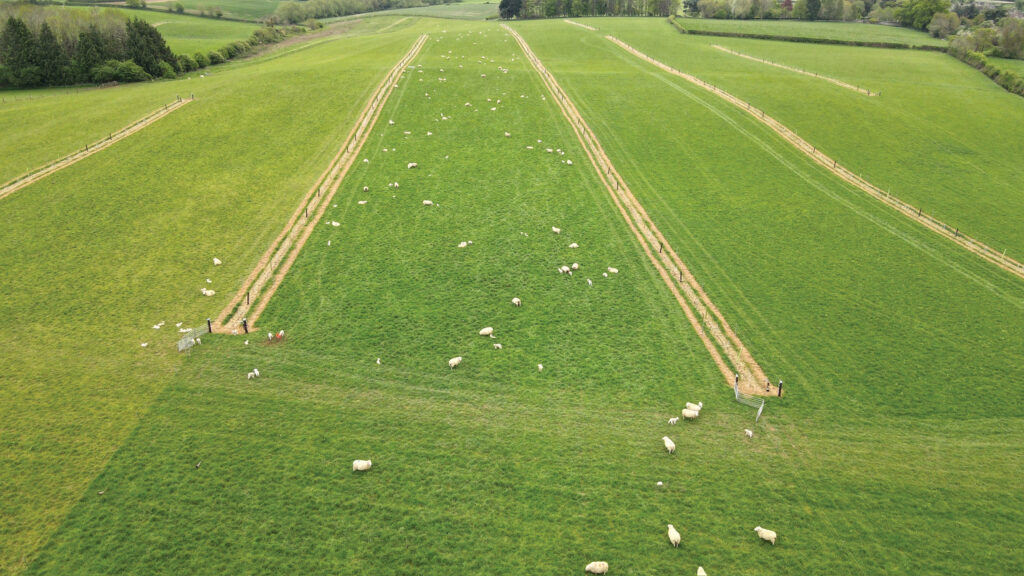
The latest development is to incorporate sheep into an arable-based agroforestry scheme.
© jake Freestone
Trees funded by the Woodland Trust have been planted in individual rows 42m apart in a 6m-wide strip of grass.
“It’s planted slightly off north-south, so north, north-west to south, south-east to provide shading, with the trees 3m apart.
“Every 9m we have a ‘big’ tree – walnuts, sweet chestnuts, oaks and apple trees – while in the intermediate spaces at 3m we have alder, goat willow and hazel.”
Fencing paid for using Farming in the Protected Landscape funding is currently protecting the establishing trees from deer.
But the plan is for the fencing to be removed to allow the sheep to browse on the smaller trees, with fruit and nuts being harvested from the other trees, Jake says.
Sheep grazier’s view
Rollo Deutsch, Chipping Campbden, Gloucestershire
Rollo Deutsch’s flock of just over 1,000 ewes grazes permanent pasture and crops grown on arable land from six main landlords on grazier licences and 11-month agreements.
“I take on the grass for the spring and summer keep, paying a rent per acre. I stock at a low rate of 2.5-3 ewes an acre.
“And then through the winter I work with these estates and other farmers within a 10-mile radius of home.
“They’re growing cover crops, stubble turnips and forage crops, and my business model, which aims to rear everything from forage, fits what they want.”
Using 11-month agreements, where the land has to be empty for one month, creates some risk, he admits.
“There are times when you are living on the edge, but with multiple landowners, if one lets you down, you are often able to go somewhere else. It’s important to be flexible and trustworthy.”
For specialist crops, such as fodder beet, he usually prices on a per acre basis, or pays for the seed, most of the cost and a rent on top, he says, while for cover crops it will depend on the quality of forage.
“Ideally, I would prefer to pay on a per head of sheep because that’s the safest bet as you don’t know how long the crop is going to hold them and what the weather will do,” he says.