New biopesticide could control flea beetles in OSR
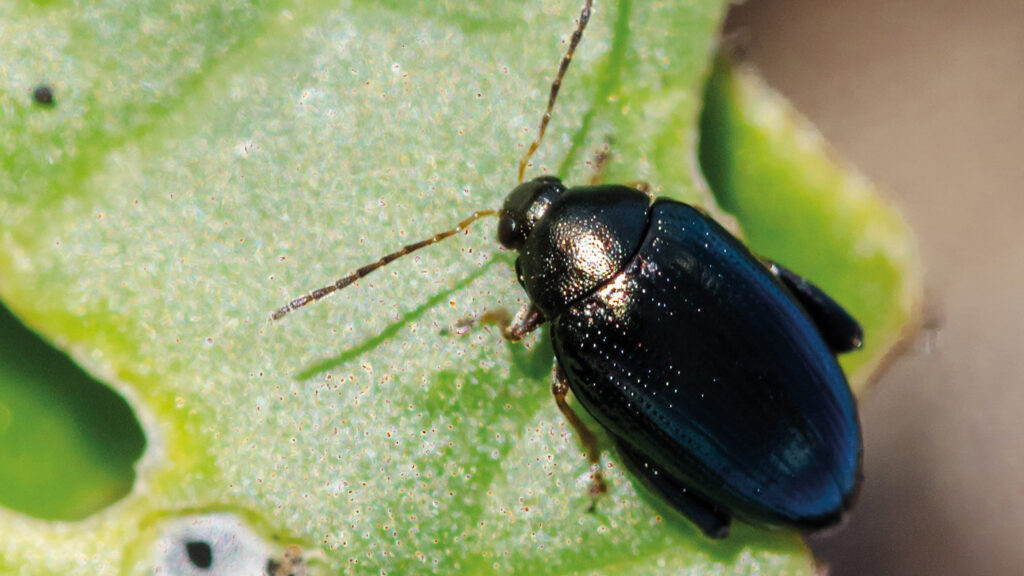 Cabbage stem flea beetle © Blackthorn Arable
 A new biopesticide that could be used to control cabbage stem flea beetles in oilseed rape is set to be tested in the field in the next two years, which could lead to non-chemical control of the pest.
The biopesticide known as RNA interference (RNAi) is set to be tested at the John Innes Centre, and could give 100% efficacy by interfering with the pest’s genetics to control it.
The RNAi could be used as a spray and targeted at a particular insect, and the biopesticide is already being used in the US for the control of Colorado beetles in potatoes since 2023.
See also: How harvest cultivations can help beat flea beetle in OSR
Rachel Wells, senior scientist at the Norwich-based research institute, is focused on brassicas and, in particular, the control of flea beetles in oilseed rape, and is optimistic about the technique’s success, although regulations may delay its use on UK farms.
“It is highly targeted on the species you want to control, and it can give 100% mortality depending on the target gene in the insect and the particular insect itself,” she said at Groundswell 2026, held at John and Paul Cherry’s Lannock Farm, Hitchin in Hertfordshire
The technique centres on producing synthetic RNAi as a spray, and the RNAi can be used to turn off any gene.
The RNAi could be targeted on an essential gut protein in the target insect and cause its death.
As a natural product it is a seen to be safe, and since its use in the US, the cost is starting to come down and make its use more competitive.
Rachel pointed out that more work is needed in UK conditions to see if its efficacy and stability in the field is as good as in the laboratory.
But she warned that getting an RNAi product approved in the UK may take some time.
The biopesticide has contact activity, and so would not have residual activity to control flea beetles and also their resultant larvae.
Instead of a spray, the RNAi could be bred into a plant, but this could be problematic as it would involve genetic modification breeding.