Growers advised to tackle grassweeds on dry sunny February days
 © Tim Scrivener
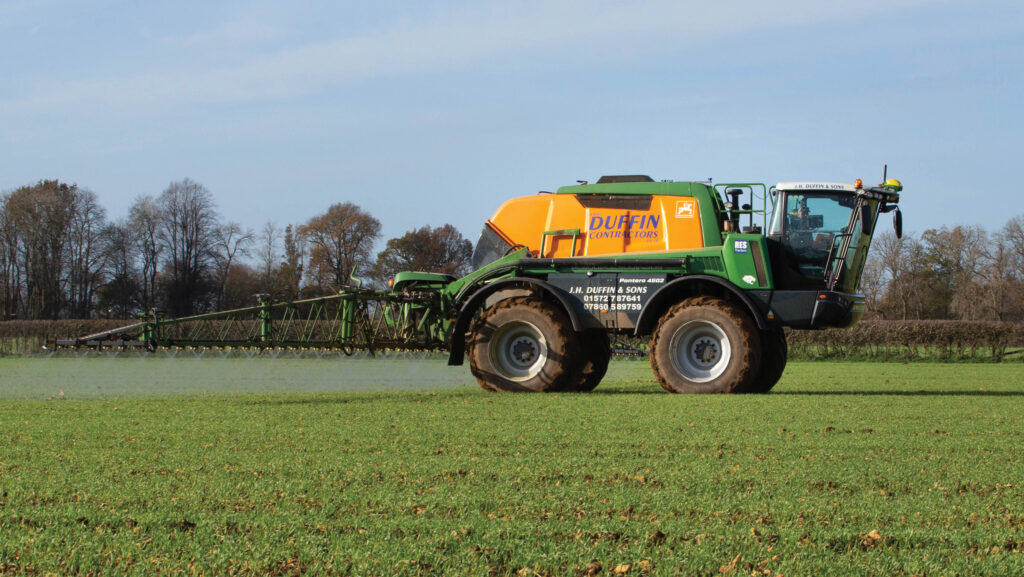
 With residual herbicides running out of steam, growers are advised to check wheat crops for any emerging weeds and consider applying a February contact herbicide spray where needed.
Last autumn saw good drilling conditions with pre-emergence herbicides going on in ideal conditions.
The open autumn also meant many farmers were able to top-up with a second residual herbicide spray.
See also: The role of cover crops in nitrogen management for potatoes
However, because of the earlier drilling coming after one of the earliest harvests in living memory, some of these top-ups are now running out of steam.
“Some second sprays went on around the time farmers would have applied the first in a more normal season, says Agrovista agronomist Chris Martin.
Ellie Borthwick-North, Bayer’s technical manager (East), adds that the earlier drilling means they have lost about four weeks of residual activity and farmers will need to consider going a bit earlier with post-emergence contacts if needed.
Chris says he is already seeing grassweeds emerging in some crops and they will receive a February treatment.
“I have growers that managed to get one or two residual sprays on and they have worked well.
“However, those who drilled a little earlier are now seeing a lot of grassweeds starting to come through, so we will be looking to apply a herbicide on a bright, sunny day in February.”
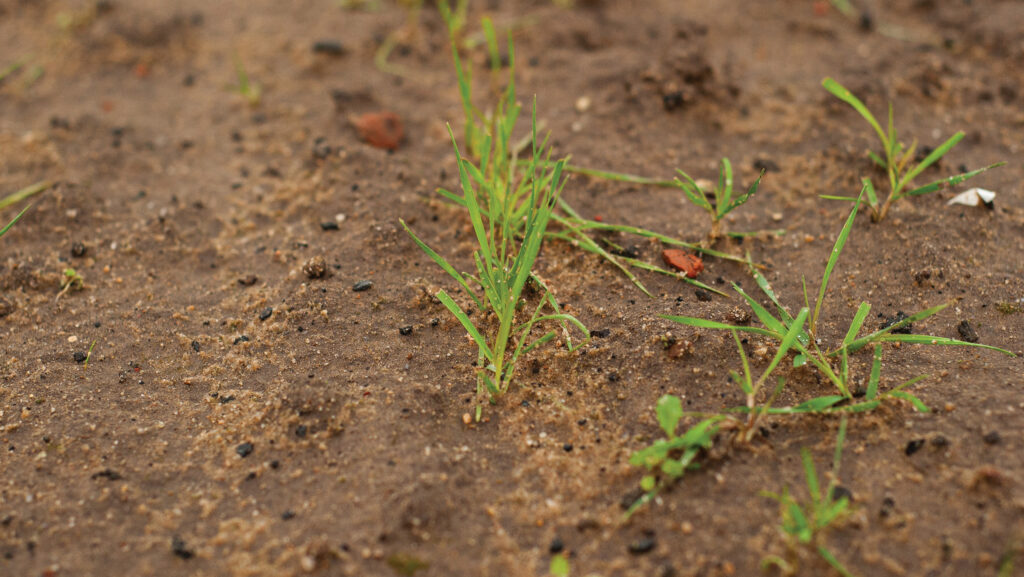
Weeds will get too big if farmers delay treatment until the T0 timing © Bayer
Why choose February to tackle grassweeds?
Chris says the weeds will get too big if farmers wait until a more settled period of weather in March.
Therefore, he advises farmers to check fields and if they need a post-emergence spray, target weeds when smaller.
“You often get the odd sunny day in February and you can target weeds while at the two-leaf stage.”
It may only be one tankful by the time the dew has dried, but its worth taking advantage and prioritise the worst fields first, says Chris.
Likewise, Ellie advises against waiting until the T0 timing in March.
“Focus on the right approach at the right time. Air inclusion nozzles typically used at the T0 not ideal for hitting small weeds.
“Complex tank mixes with a herbicide, fungicide, manganese and plant growth regulators are difficult to manage.”
Crops can also recover before applying the early fungicide.
Bayer recommends observing a minimum 7-14 day gap between applications of products containing mesosulfuron and products containing tebuconazole.
This is also the case with liquid fertilisers to avoid crop damage.
Why farmers need to remain vigilant
Adas weed expert John Cussans says last year was generally a good year for weed control, and consequently there have been lower levels of weeds and seed return.
Crops generally look good, are competitive and residuals have performed well. “It’s not shaping up to be a meltdown this spring.”
Field management
However, he warns that it doesn’t mean there won’t be fields that will need managing. “The priority is to get out and look at what worked and what didn’t.”
Each year there is a switch when the attention moves from weed control to fungicides and disease control. he says.
But farmers need to do both as you can get flushes later in spring, such as meadow brome and wild oats.
John recalls farmers saw a late emergence of wild oats last year, and this, combined with the poor, uncompetitive crops resulting from the wet autumn of 2024, meant they got going.
Agrovista’s Chris Martin says that where farmers were concerned about ryegrass, they used a two-spray residual programme, rather than including Avadex (tri-allate).
“So in these situations, we are starting to see wild oats causing problems because there is no Avadex to control them.”
Diverse weed problems
And it’s not familiar weeds – John warns that farmers are seeing more diverse weed problems.
“For example, you could have rough-stalked meadowgrass emerging, which is being seen more as cover crops become more popular.”
The reason for opting for bright days is because research carried out by Bayer showed better herbicide activity on a bright, sunny day – compared with a dull day – across several grassweed species (Italian ryegrass, rye brome and sterile brome).
One concern, however, with February applications is that many actives are impacted by temperature variations.
But Ellie says Atlantis Star (iodosulfuron + mesosulfuron + thiencarbazone) is affected less by colder air temperatures, and this allows effective applications to be made from 1 February.
Chris says there were two weeks last February when they had some sunny days, and his clients achieved good results on grassweeds with contact herbicides.
Application and testing
Decent application is key to getting the best results. Chris says: “Farmers need to aim for good coverage with a good quality spray.”
Air inclusion nozzles, as used at the T0 timing, are not ideal for tackling small grassweeds.
He suggests using a lower water volume, a finer nozzle (such as a flat fan) and including a drift retardant when applying products such as Atlantis Star/Proverb.
“This will allow farmers to achieve the spray quality needed to achieve a good coverage and maximise efficacy,” says Chris.
Ideally, farmers should have already carried out resistance-testing in their fields says John. There is potentially a mixture of resistant and susceptible populations, even in adjacent fields.
“If you haven’t done testing in your own fields, you won’t have confidence to know how much control you will get with a post-emergence spray.” n
Glyphosate resistance update
To date, there are three confirmed cases of glyphosate resistance in Italian ryegrass across the UK and experts say there is still an opportunity to act and avoid the problem becoming widespread.
Speaking at a Bayer organised briefing, Adas weed expert John Cussans says the small number of cases and geographical distribution (Kent, North Yorkshire and Gloucestershire) tells us that it isn’t a case of it happening in one place and then spreading to other farms.
Instead, glyphosate resistance is being selected in multiple locations where there is high pressure.
What situations are a concern?
What the cases have in common is a high reliance on glyphosate, says John.
Typically, there is a low-level mechanical weeding (that is, either very few or no cultivations) combined with the use of a low disturbance drill.
“All the pressure is, therefore, on glyphosate pre-drilling,” he says.
In addition, the rotation has a lot of crop stubble post-harvest, where there is little or no weed control, and by the following spring, weeds are well developed.
Crops are drilled with a low-disturbance drill and, again, with a high reliance on glyphosate.
What is the solution?
Bayer agronomist Roger Bradbury says the key is to be quick to identify a problem.
“If you catch it early enough, there are things that can be done on farm to control and ring-fence the problem. For example, stop straw movements to limit the chance of spread.”
In conclusion, John says if farmers and agronomists are seeing a pattern of failures with glyphosate and are worried about Italian ryegrass control when using appropriate doses, they can access free weed testing.
“All testing will be treated in confidence,” he says.

Staying sharp shouldn't be a chore