Nutsedge findings point to gap in invasive weed defences
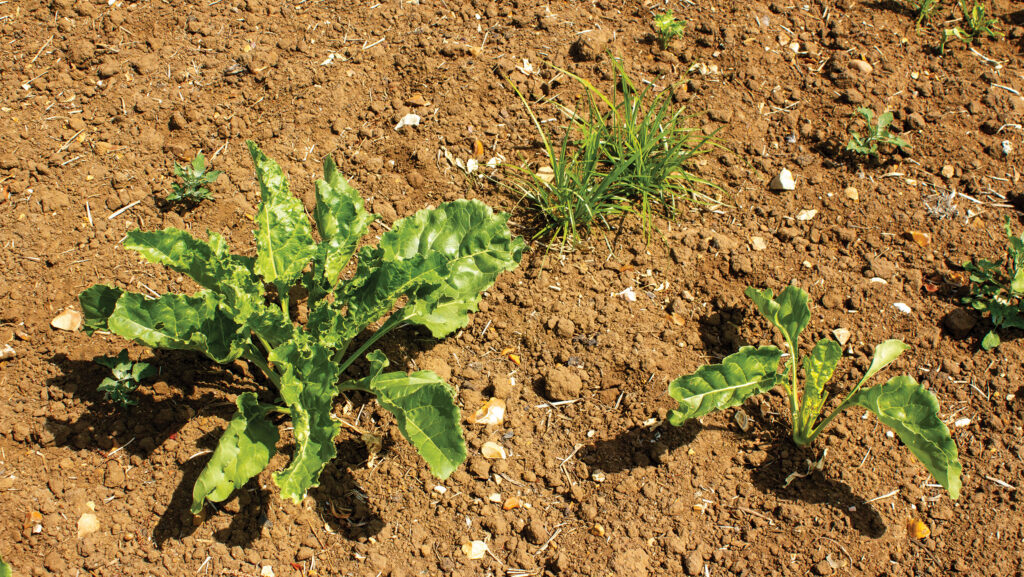 Nutsedge plant © MAG/Richard Allison
 Yellow nutsedge may still be a relatively unknown weed, but its appearance on a handful of farms is highlighting a much bigger problem: the UK has no coordinated system for identifying, monitoring and responding to invasive agricultural weeds.
That was the conclusion from a recent industry discussion involving researchers, agronomists and crop-sector organisations, prompted by the discovery of new nutsedge infestations in East Anglia.
European experience presented at the meeting showed how quickly an initially localised problem can become difficult and expensive to contain.
See also: How new herbicide is helping tackle Italian ryegrass
Yellow nutsedge can also be very damaging to crop yield; Swiss field studies have recorded average yield losses of 67% in sugar beet at 68% nutsedge cover and 34% in potatoes at 44% cover.
Its rhizomes can also penetrate and grow through potato tubers, reducing crop quality and creating waste.
The immediate priority for Adas weed scientist John Cussans is to raise awareness of yellow nutsedge and its identification, and then to establish how widespread it already is in the UK.
“Given that we are seeing just a few significant local problems with this weed at the moment, we don’t want to over-egg it, but you should be worried about weeds like nutsedge becoming established on your farm,” warns John.
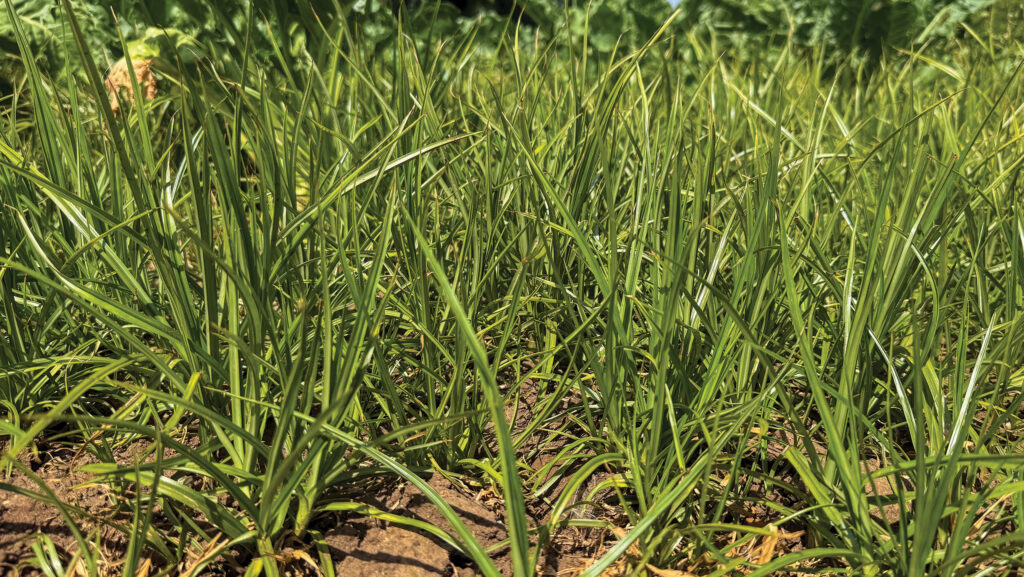
Close up of nutsedge patch © MAG/Richard Allison
Nutsedge identification – what to look for
- Yellow green, relatively shiny leaves arranged in three ranks around the stem
- A triangular stem, remembered by the saying “sedges have edges”
- Rhizomes, basal bulbs and rounded brown tubers, generally 2-18mm across
- Yellow-green crop patches and, when flowering, a yellow-brown sedge inflorescence
- It can be confused with sea club-rush, galingale, tall flatsedge and common sedge
- Check gateways, headlands, moved soil, root-crop and maize fields, watercourses, rented land and contractor-worked fields
- Do not rely on foliage removal alone: carefully excavate suspicious plants and seek expert identification
Grass lookalike
So, what is yellow nutsedge? With the Latin name Cyperus esculentus, it is a perennial that resembles grass, but belongs to the cyperaceae or sedge family.
It spreads principally through underground tubers connected to plants by rhizomes, although European research shows viable seed can also contribute to its spread.
As a warm-season C4 plant, it grows rapidly in high temperatures and tends to emerge later than many current UK crops.
Its tubers or nutlets are 2-18mm in diameter and each plant can produce hundreds each year.
Belgian work suggests one tuber can produce 750 daughter tubers in a season, and densities of 1,100-5,000 tubers/sq m have been recorded, with about 85% in the top 15cm of soil.
Tubers can remain viable for more than 10 years and established plants can repeatedly regenerate after above-ground control. Management must, therefore, reduce the underground tuber bank while preventing new tubers from being formed.
Surviving underground material, namely rhizomes, can also grow laterally to produce a dense mat of the weed.
At the high densities described in Belgian studies, the assessment of Sjef van der Heijden, researcher at the Institute for Sugar Beet Research in the Netherlands, is blunt.
“When you find nutsedge like this, you’re already losing the game.”
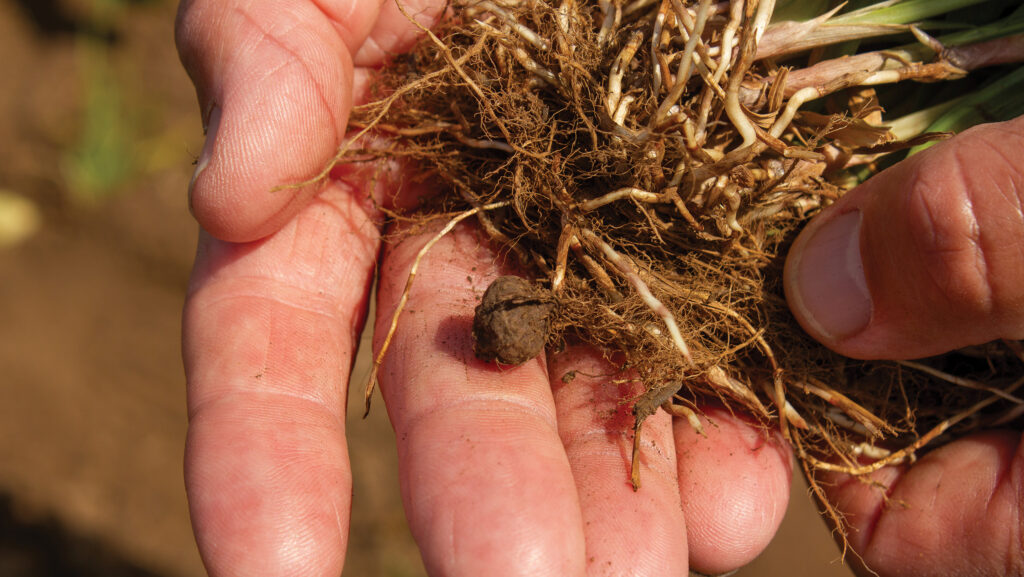
Nutlet © MAG/Richard Allison
Key points – Nutsedge in the UK
- UK distribution is poorly understood, making awareness and reporting immediate priorities
- One tuber can produce hundreds more, and tubers may remain viable for more than 10 years
- Root crops and soil-carrying machinery present the greatest risks of spreading
- Very small outbreaks can be carefully excavated, but all tubers and rhizomes must be removed
- Established infestations require repeated, integrated control
- Machinery should be cleaned before leaving affected land, with contaminated soil kept in the field
- Nutsedge could provide a model for wider UK surveillance of emerging agricultural weeds
- Severe infestations can cause major yield losses and make potato tubers unmarketable
Where is it a problem?
Yellow nutsedge is already a substantial agricultural weed in pockets of mainland Europe.
Belgian research estimates 35,000ha of agricultural land is infested in Belgium, while Sjef believes the figure for the Netherlands could be 40,000ha.
Only a fraction of the Dutch area is officially recorded, as growers face significant restrictions – as they do in other countries like Belgium and Germany – when land is formally listed as infested, which could discourage reporting.
In Flanders, for example, officially infested fields cannot be planted with root, tuber or bulb crops and must be worked last, with machinery cleaned, and contaminated soil retained in the field.
Sjef describes a Belgian example that shows how quickly progress in reducing an infestation can be reversed if this advice is ignored.
US research recorded maize yield losses of 17% under moderate and 41% under heavy uncontrolled infestations.
However, a well-established, vigorous crop can suppress nutsedge through shading, and maize offers more effective chemical and mechanical control opportunities than other crops.
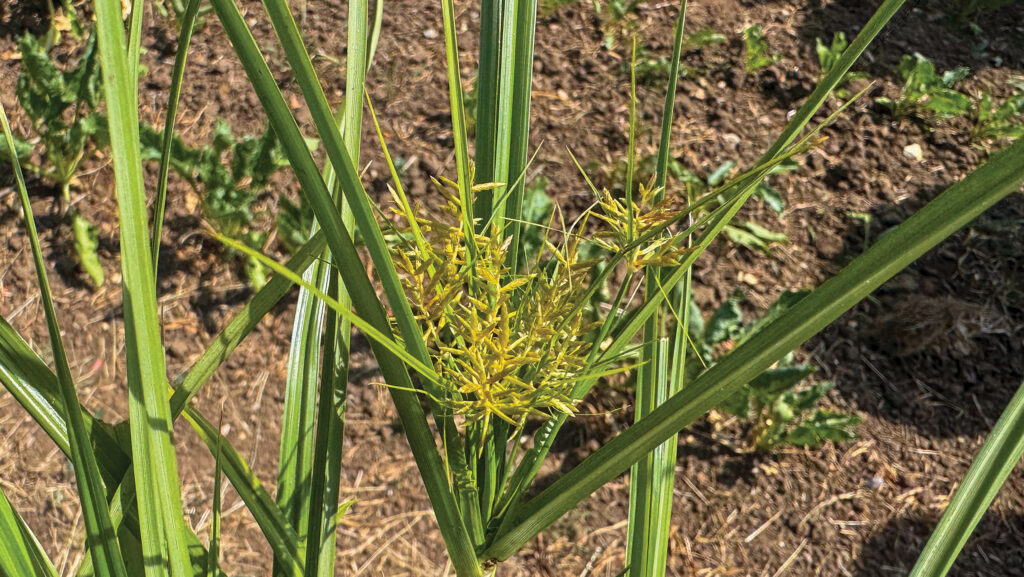
Nutsedge flower © MAG/Richard Allison
Herbicides dimethenamid-P, mesotrione and pyridate are all said to have activity against nutsedge, although variability is said to exist between populations.
On one farm, after several years of well-managed maize, a grower substantially reduced the tuber population, but after just one subsequent potato crop the nutsedge tuber stock had jumped by 800%.
“This shows how difficult it is for farmers, especially when you talk about ‘cash cow’ crops like potatoes, onions, bulbs or carrots. It’s really difficult to get rid of it and you can easily get a lot of extra tubers,” he explains.
Belgian work using field bean seed as a proxy for nutsedge tubers found some cultivators could spread tubers and rhizomes by tens of metres, while a two-row potato harvester retaining 30kg of soil could take about 60 tubers from a field (two tubers/kg soil).
Researchers also measured soil left on cultivation equipment: about 36kg on a rotary harrow, 17.2kg on a plough, 12.7kg on a cultivator and just over 8kg on both a disc harrow and subsoiler.
This shows how moving between infested fields is a substantial transfer risk.
“Machinery cleaning is often difficult in practice because people are in a hurry and don’t want to wait.
“But if you take five minutes, you can normally get about 95% of the soil off. It is worth spending some time on it,” says Sjef.
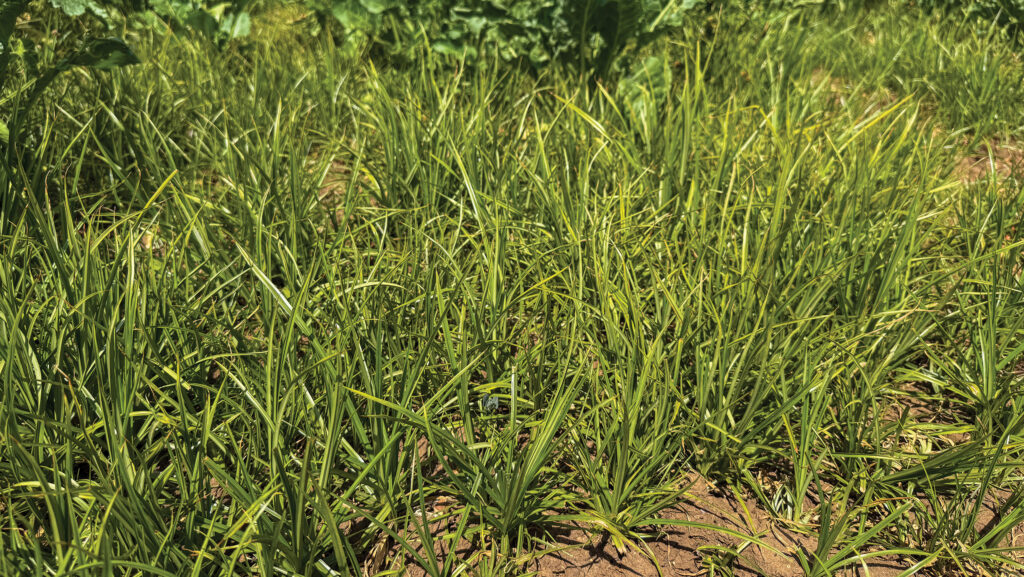
Nutsedge patch in sugar beet © MAG/Richard Allison
Norfolk experience
The challenge posed to UK growers is already evident on a farm in Norfolk, where independent agronomist Tim Martin, of AICC and Apex Agronomy, identified yellow nutsedge for the first time this year.
He has been aware of an isolated nutsedge population in Suffolk for some time, but finding it on a client’s land has come as a shock.
Tim believes its capacity to spread through both long-lived tubers and seed makes it an extremely serious threat and the farming industry needs to heed the warning.
“It’s much, much worse than blackgrass and far worse than Italian ryegrass for farms growing spring-planted crops such as sugar beet, potatoes and field veg,” he says.
Tim has carefully checked the farm’s other fields, found a few plants in a second field and quickly excavated and removed them, taking care not to leave rhizomes or tubers behind.
“Prevention is a lot easier than sorting it out once it’s established. Practice good hygiene around soil and machinery movement and you can go and hand rogue the first one or two plants.
“However, you won’t make much progress with that once you’ve got established clumps,” warns Tim.
The main infestation is in sugar beet this year and the field will be harvested last, after the farm’s other beet has been lifted. The harvester will then be thoroughly cleaned down in the affected field.
The farm has also sprayed off the worst-affected area with glyphosate and, at the time of writing, Tim did not yet know how effective that would be.
However, by removing the beet, the harvester has no reason to enter the most contaminated area, which will reduce the risk of weed material spreading.
“Any soil from a cleaner loader gets returned to that field and doesn’t get put anywhere else. The land will be treated like a quarantine field.”
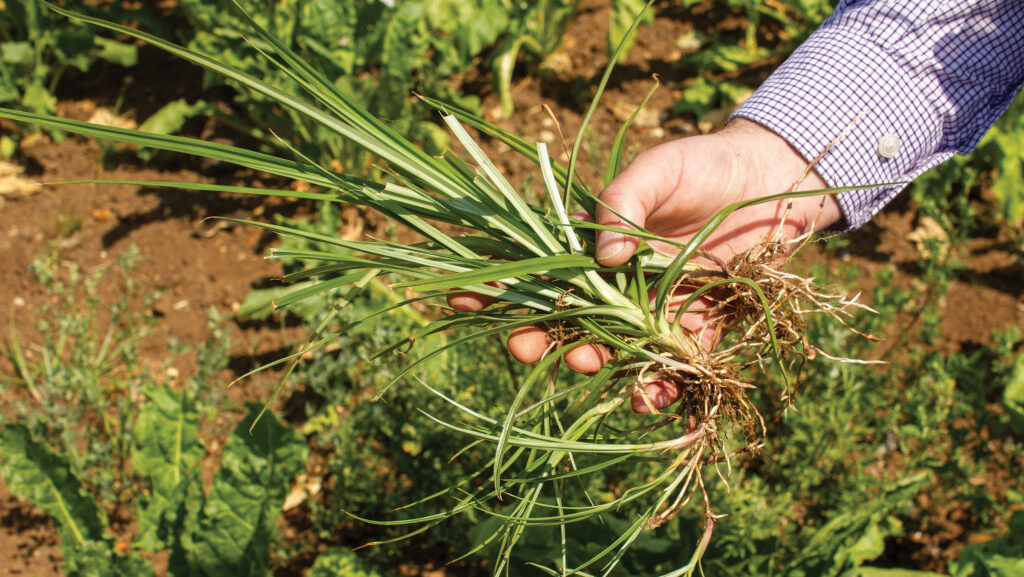
Nutsedge plant © MAG/Richard Allison
Rotational change
Another key measure for the affected fields is a change of rotation. No sugar beet or potatoes will be grown for the foreseeable future; the initial plan is two winter cereals, then possibly maize, before returning to winter cereals. Competitive crops should deny nutsedge light and space.
Tim says awareness of the problem must extend to everyone working on a farm, so any evidence of the weed’s presence is picked up early.
“It’s the spray operators; it’s all the other farm staff. They’re far more likely to see an odd plant or patch and raise the alarm.”
Seeing the European evidence reinforced Tim’s concern about the potential for nutsedge to become a major weed challenge in the UK.
“We should take note and realise the implications for us, particularly as the climate changes and we want to maximise our alternative cropping opportunities,” Tim warns.
Integrated approach
Sjef adds that there is no single answer, with many years of intensive chemical control failing to prevent yellow nutsedge spreading, and strategies now centred on prevention, monitoring and intervention.
Finding outbreaks early remains crucial and European guidance recommends inspections from spring to September, particularly around gateways, machinery entry points, watercourses and near known infestations.
Comparisons of different control strategies suggest that once established, control demands a multi-year strategy.
Three years of Belgian black-fallow work – leaving soil completely devoid of vegetation for a period – reduced tuber numbers by a median 70% and by up to 98%, but required four to seven chemical or mechanical interventions each year.
This intensive approach is likely to be unpalatable in the UK.
Short grazing achieved a 67% reduction, while winter cereals followed by intensive post-harvest control achieved 59%. Maize programmes combining pre- and post-emergence herbicides also performed strongly.
However, different genetic populations responded differently to control measures, suggesting UK populations may need to be collected and screened before European recommendations are assumed to transfer directly.
For example, some Belgian populations were less sensitive to programmes containing mesotrione and pyridate, and differences were also seen with glyphosate efficacy.
Nutsedge with larger tubers also tended to be harder to kill using heat and anaerobic soil disinfestation than smaller-tubered populations.
Long-term issue
John highlights a much broader long-term issue around ‘new’ weeds getting established in the UK, with C4 plant nutsedge sitting within a group of plants adapted to warmer conditions (alongside weeds like setaria (“foxtail”) species and barnyard grass).
These could become increasingly important as the UK adapts its cropping to warmer and drier conditions with species like chickpeas, lupins, grain maize and sunflowers, among others.
Establishing these crops could be challenging if “summer weeds” weeds like nutsedge are present with no adequate means of control.
Other weed species that are making themselves at home in the UK, like barnyard grass and thorn apple, along with evolving problems in established species like herbicide resistance, will add to the problem.
There is also a biosecurity concern, with seeds and machinery now moving internationally, creating opportunities for weed seeds, tubers or other plant material to reach UK farms.
That leaves a blind spot for an agronomically important introduction, like a herbicide-resistant population of a weed already present in Britain.
That could allow resistance genes in to create a substantially different control problem, without being treated as a new exotic species or automatically triggering a formal plant-health response.
“We need some data on where these problems are occuring and which species are spreading fastest. At present, the industry has anecdotal reports of certain species, but no actual baseline of what is where and what the problem is,” John says.
He favours anonymous survey work to record suspected or confirmed weeds, affected crops and broad locations, backed by routes for identification and ongoing monitoring.
Confidentiality is critical because growers will fear the effect on land value or rental opportunities.
Any framework would ideally involve stakeholders from all crop sectors to coordinate the identification, recording, advice and escalation to government, where necessary.
This leads John to highlight the initial error made in Europe with nutsedge.
“The weed was associated with a crop and treated as a crop problem, and that was a mistake. It’s a symptom of a much wider problem in agriculture.
“We need an industry-wide approach across crops and across systems for these weed threats, and awareness and publicising the identification is the first step.
“Growers and agronomists cannot report or contain a weed they do not recognise,” he concludes.