Wheat project examines effect of variety on weed suppression
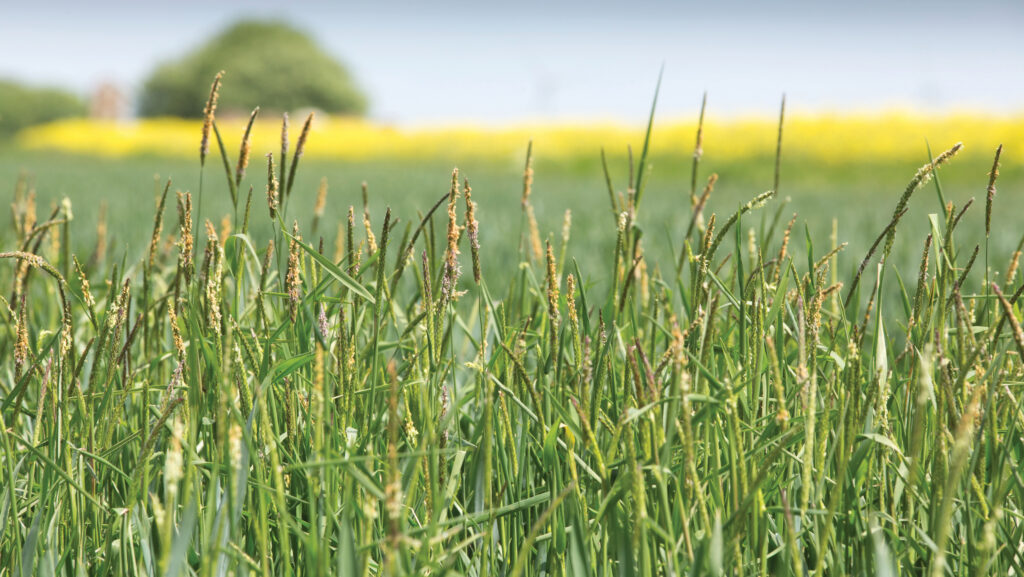 © Tim Scrivener
 An AHDB project has set out to investigate if different winter wheat varieties can affect levels of weed suppression.
Effective weed control remains a significant challenge in wheat production, particularly as herbicide options narrow and resistance pressures increase.
Dominic Amos, a research agronomist at project partner Cope Seeds, explains: “The aim is to explore how different varieties compete with weeds, focusing on traits that could be exploited as part of integrated weed management strategies.”
See also: Yellow rust resistance blamed on dominant wheat varieties
Three main mechanisms
The work hopes to identify three main mechanisms by which wheat varieties can suppress weeds:
- Early groundcover Rapid canopy closure shades and smothers weeds early in the season
- Early vigour/growth rate Fast early development allows the crop to get ahead of weeds
- Late-season height Taller canopies suppress weeds later in the season through shading.
Existing research on organic farms over the years has shown varietal differences to be quite large, although they are less pronounced under low weed pressure, for instance in 2025.
In some organic trials, yields differed by up to 1.8t/ha between “good” and “bad” varieties, showing variety choice can have a meaningful impact.
“Choosing a better adapted variety can give you a 50% yield increase, compared with choosing an unsuitable variety,” says Dominic. “The more inputs used, the smaller that difference becomes.
“Our results for 2025 showed that the best variety [Redwald] had a 50% higher yield than the worst performing [Champion] in a stressful season.
“Over three years the better suited varieties have been worth an extra 25% compared with the least suited.
“The RL [Recommended List] team are collecting data on the weed competitive traits.
“This information is being used to select varieties to test on farm, using organic and regen/low-input farms with weed communities so we can see the effects of weed levels on the different varieties.”
Small differences from the RL plot trials – carried out with no weeds – could lead to big differences when the varieties are tested on farm.
Early ground cover
Early ground cover was assessed across three RL trial sites. This was carried out last season at late tillering (mid- to late February) and at stem extension (late March/early April).
Overall, the spread was relatively narrow, with relatively little difference between varieties. Shergar came out on top with 59% ground cover.
Even these small advantages can still be meaningful under higher weed pressure.
Variety performance for early ground cover |
|
|
Variety |
Ground cover (%) |
|
Shergar |
59 |
|
Arnie |
58 |
|
Heartwood |
55.3 |
|
Diamond |
54.3 |
|
Redwald |
54.3 |
|
Extase |
54.2 |
|
Beowulf |
52.6 |
|
Flute |
52.6 |
|
Sparkler |
52.4 |
|
Defiance |
52.3 |
|
Cheer |
51.5 |
|
Imrie |
51.5 |
|
Newbie |
51.3 |
|
Bamford |
50.5 |
|
Arlington |
50.5 |
|
Mayflower (control) |
50.3 |
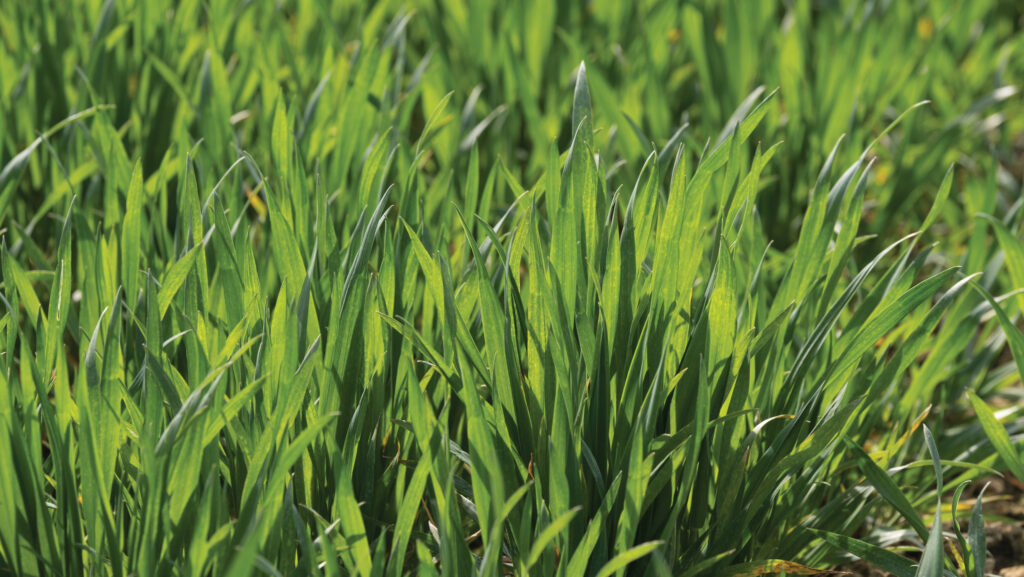
© Tim Scrivener
Early biomass and vigour
Early biomass production was used as a proxy for early vigour and competitive ability. Extase was used as the benchmark control for fast early growth.
“Early biomass can be a feature of phenology, which is the speed of development, but this is not always the case,” says Dominic.
“Goldfinch and Typhoon are late developers, while Extase is early.”
Biomass was measured on a visual scale of 1-9, with the highest biomass receiving a score of 9 and the lowest a 1.
Distribution of early biomass |
|
|
Variety |
Biomass |
|
Arnie |
5.3 |
|
Extase (Control) |
5 |
|
Heartwood |
4.9 |
|
Newbie |
4.9 |
|
Equipe |
4.9 |
|
Goldfinch |
3.3 |
|
Typhoon |
2.8 |
The role of variety blends in weed suppression
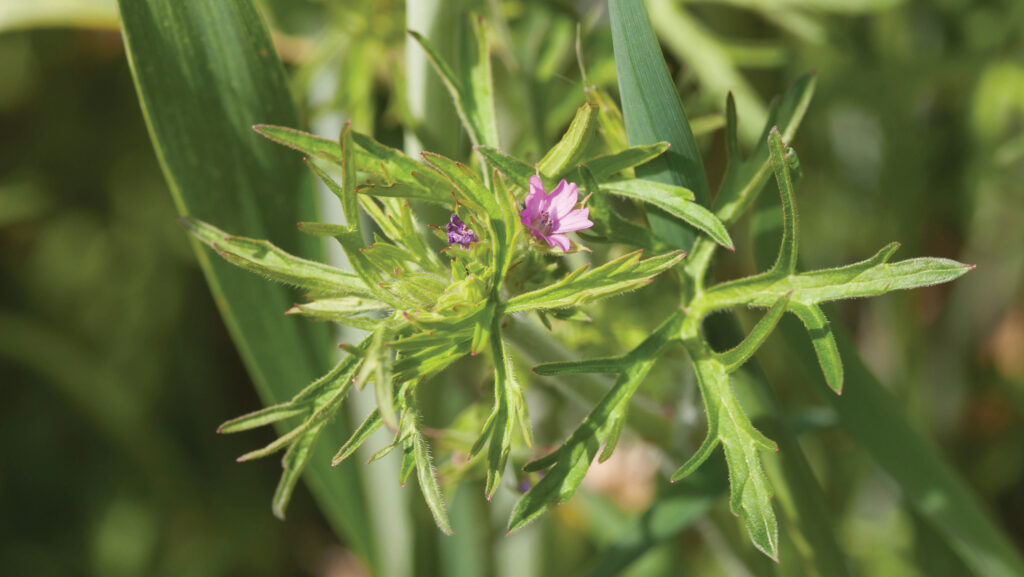
Cranesbill in winter wheat © Tim Scrivener
A key finding from the AHDB work is the potential value of wheat variety blends as a tool for weed suppression.
However, there is an assumption that all diversity is good and this may not be the case, warns Cope Seeds researcher Dominic Amos.
“You can see the negative impacts of selecting the wrong variety blends. Growers and agronomists have got to work out the ones which complement each other,” he says.
A blend of Extase and Mayflower improved weed suppression and in yield terms outperformed either variety grown alone, indicating that combining contrasting growth traits can enhance overall crop competitiveness.
Siskin/Mayflower and Siskin/Extase were other blends that showed particularly strong performance and consistently outyielded their individual variety plots.
1. Trait complementarity
Different varieties express competitive traits at different times:
- Varieties such as Mayflower contribute strong early groundcover, rapidly shading weeds soon after emergence
- Varieties such as Extase provide strong early biomass and vigour, maintaining competitive pressure as the season progresses.
2. Improved canopy architecture
Blends often create a more heterogeneous canopy structure, with variation in leaf angle, height and tillering. This can:
- Increase light interception by the crop
- Limit late-emerging weed growth.
3. Reduced risk from seasonal variability
Blends act as a risk management tool, ensuring at least some component of the crop is suited to its environments.
“Early varieties tend to be more resistant to drought and dominate in drier springs, whereas later varieties tend to be more susceptible to drought and may benefit from late rainfall,” says Dominic.
Varietal commentary from AHDB UK farm trials
- Extase Early biomass control (early-developing and vigorous)
- Mayflower Early groundcover control
- Arnie High biomass, high groundcover
- Defiance High groundcover
- Equipe High biomass
- Goldfinch Low biomass, slow development, late-developing
- Heartwood High biomass
- Nelson High spring vigour and rapid development
- Redwald High groundcover, strong historical performance
- Shergar High groundcover
- Typhoon Slow development, late developing
Dominic Amos was presenting his findings at the AHDB agronomy conference in Solihull at the end of 2025.