

Gene-edited soya shows promise in UK field trials
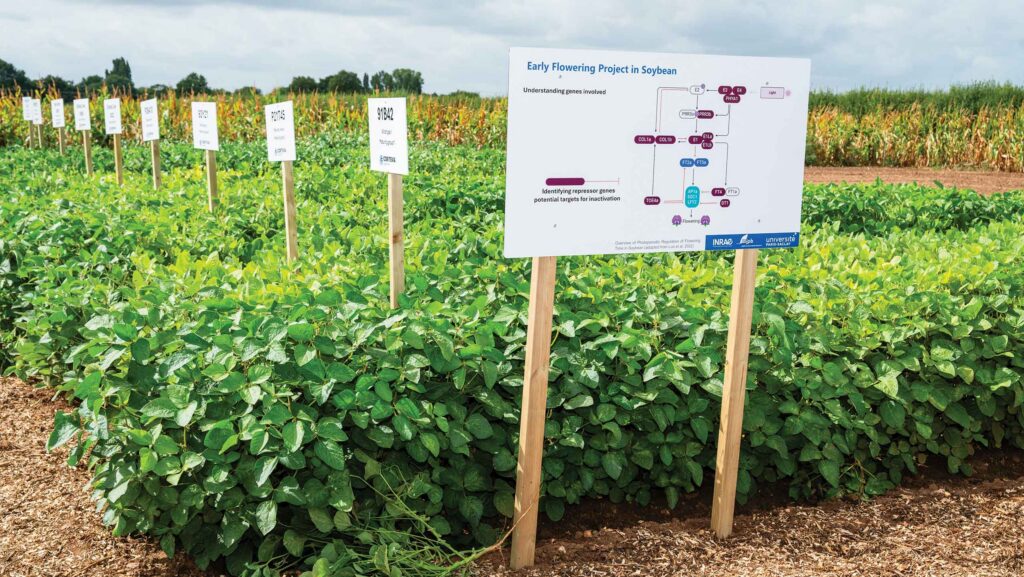 The Corteva soya trial at Wellesbourne © Dare and Hier Media
 Gene editing could help overcome one of the biggest barriers to growing soya commercially in Britain – getting the crop to mature before autumn weather arrives. Corteva Agriscience is trialling gene-edited soya at its Wellesbourne Research Station in Warwickshire, with early results showing a striking shift towards earlier maturity.
The work is part of a five-year collaboration with French research institute INRAE, with much of the initial work being carried out by PhD student Manon Monfort.
See also: Grower trial aims to unlock food-grade millet production
‘Beyond expectations’
For Dr Frank Röber, Corteva’s Europe Breeding Alliance lead, early results in the field are very promising. “It’s beyond expectations,” he says. “I have also seen them for the first time this year [in the field] and it really looks great.”
In early September, the Maturity Group 3 varieties – late-maturing types more suited to warmer US growing areas – were still flowering and had only small pods, while the gene-edited plants created from those maturity Group 3 germplasm had stopped flowering, were further advanced in pod development and had begun to turn yellow, a clear indication that senescence had begun. “That’s really proof of concept,” says Frank.
The challenge is that soya is a short-day plant, meaning its flowering is strongly influenced by day length. Long summer days at northern latitudes can delay flowering and push maturity into the autumn.
Britain therefore needs very early maturing varieties – typically 00 (double zero) or 000 (triple zero) – although later maturity groups generally offer greater yield potential.
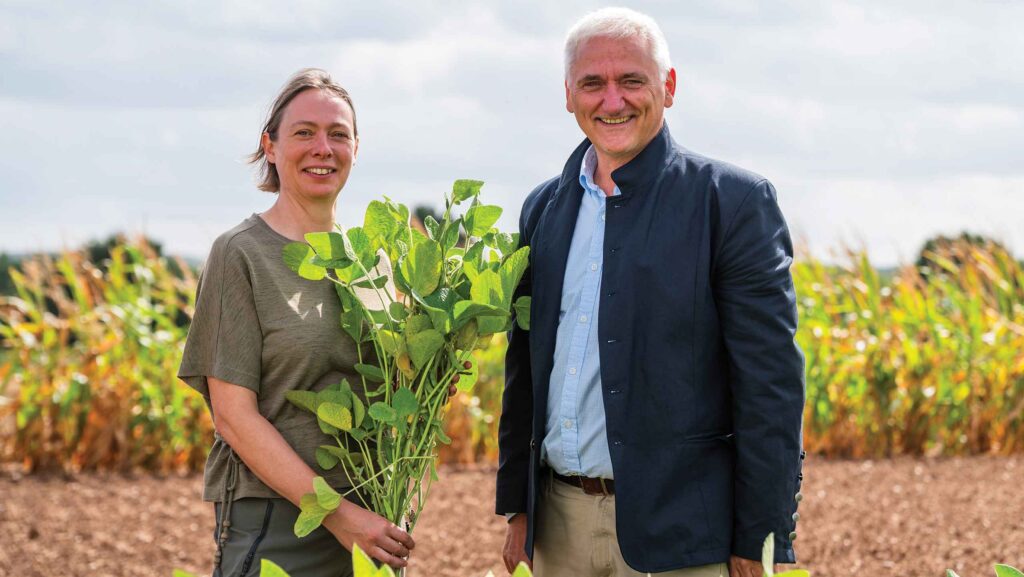
Dr Nancy Podevin and Dr Frank Röber from Corteva Agriscience © Dare and Hier Media
Frank’s aim is to combine the two – the yield potential of later genetics with the earliness required in Britain. “If we can move the late yields into earlier varieties, this is my job,” he says.
Corteva used Crispr-Cas gene editing to target genes involved in controlling flowering.
The work focuses on genes that suppress flowering, with the edited material at Wellesbourne showing a substantial advance in earliness.
Dr Nancy Podevin, the company’s genome-editing policy lead, says field testing is crucial.
“You always need to go to the field,” she says. “That’s why this precision-bred organism legislation in England is so important. Everybody across Europe is doing this research in the lab, but if you’re not able to go into the field, it is quite useless.”
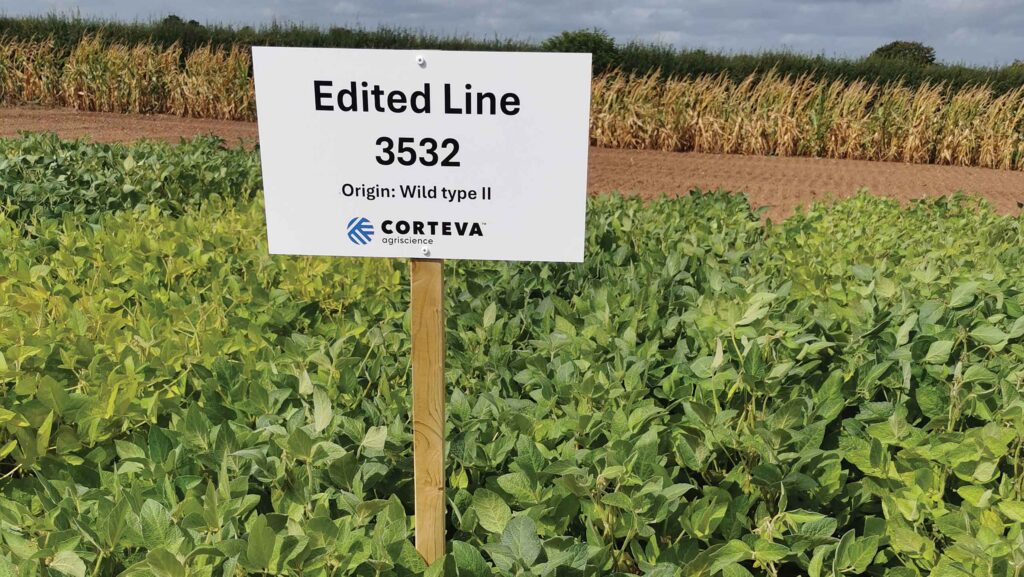
Corteva gene-edited crop in the field trial at Wellesbourne © MAG/Philip Case
Yield question remains
The next test is whether the early maturity can be combined with yield. Existing early varieties can suffer a yield penalty, and the researchers are trying to avoid that. “We’re trying to have a plant that produces as much as these late varieties, but flowers early,” Nancy says.
But even if the technology delivers on its promise, bringing a commercial UK soya crop to market will depend on overcoming agronomic and legislative challenges.
Why is growing soya so difficult in the UK?
Soya has potential as a UK break crop and a source of home-grown protein, but Britain sits at the northern edge of reliable soya bean production.
The crop is highly sensitive to day length. In northern Europe, long summer days can delay flowering and push maturity into the wet autumn, making harvest difficult. That creates a breeding dilemma. Later maturity groups generally have higher yield potential, but Britain needs very early varieties to finish in time.
Dr Frank Röber, Corteva’s Europe Breeding Alliance lead, says the breeder’s task is to maximise genetic diversity before selecting the best plants. “The breeder is widening the funnel,” he says. “If I don’t have choice, I cannot select something better.”
Gene editing provides a way to create useful variation. Researchers are targeting genes that suppress flowering, aiming to bring the yield potential of later-maturing soya into earlier maturity groups. The target is earlier maturity with competitive yield, disease performance and reliable harvestability.
Frank sees soya becoming an important UK break crop, fixing atmospheric nitrogen through with rhizobia and offering wider rotation and soil-health benefits.
England has a different route for precision-bred crops
England The Genetic Technology (Precision Breeding) Act 2023 and 2025 regulations created an operating framework for precision-bred organisms, requiring a Defra release notice for research and development field trials, with separate routes towards confirmation and marketing of precision-bred products.
EU The bloc has adopted a new framework for plants produced using certain new genomic techniques (NGTs), distinguishing NGT-1 and NGT-2. The regulation entered into force in July 2026, but its main provisions generally apply from 17 July 2028. Corteva says England currently offers a more proportionate route for field research.

Staying sharp shouldn't be a chore
Explore more / Transition
During the series we follow our group of 16 Transition Farmers through the challenges and opportunities as they seek to improve their farm businesses.
Transition is an independent editorial initiative supported by our UK-wide network of partners, who have made it possible to bring you this series.
Visit the Transition content hub to find out more.
