Project investigates feasibility of combinable hemp
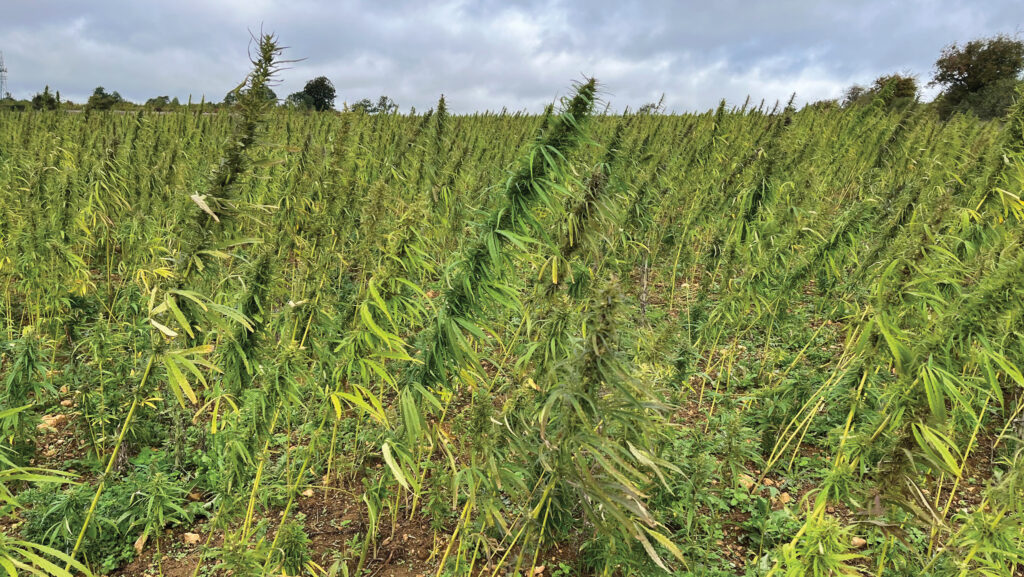 Hemp for seed © Lydia Smith
 For a crop that is relatively cheap to grow, with plenty of end market uses, hemp hasn’t exactly hit major highs in the UK.
Hemp has an array of potential uses, ranging from health creams to textiles and construction materials.
Part of the challenge has been a licensing process under the Misuse of Drugs Act (1971) which is required to grow a species that is mostly the same biologically as varieties grown for marijuana.
See also: How 6 farmers are managing fertiliser use in tight season
Hemp varieties contain 0.3% or lower tetrahydrocannabinol content, compared with 5-35% in marijuana.
Until last year that licensing was too restrictive to be practical on farms, especially the restriction to grow on fields that were not easily seen by the public.
But that’s been relaxed to allow a licensee to grow the crop anywhere on the farm for six years, rather than the previous three, opening new opportunities.
On-farm project
For the past four years, Staffordshire farmer Rob Atkin has been investigating the potential role of hemp on his farm as part of the Centre for High Carbon Capture Cropping (CHCx3) project led by Niab.
However, a key barrier has been harvesting the crop for fibre use. “You need a special cutter, and where I am in the West it hasn’t been logistically easy to get one of only three in the country here at the right time,” he says.
Buying the cutter is a major investment – about £40,000, plus the nearest processors are based in Yorkshire, meaning transport costs for a bulky product will eat into profits.
This has become the starting point for his Adopt project investigating growing varieties that can be combined and then used to produce hemp oil.
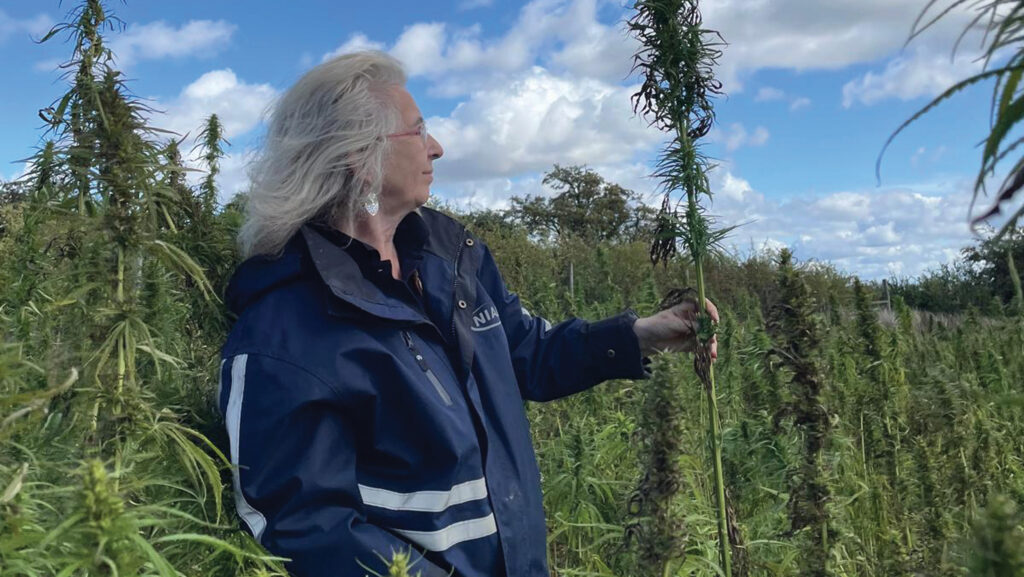
Lydia Smith in seed hemp © Lydia Smith
The idea was conceived by Rob alongside facilitator Dr Lydia Smith of Niab, and two other growers, Martin Cessford in Angus and Luke Palmer in Cambridgeshire.
Product markets are being considered by Hemp It Up’s Alison Easson, who has been producing cold-pressed hemp seed oil and protein powder products.
Harvested seeds will be sent for analysis to ensure they pass the relevant tests for human consumption.
They will then be cold pressed and used in end products such as cakes and hot cross buns at Ian Wilkinson’s FarmED education centre café and restaurant in Oxfordshire.
“Being able to harvest the crop more easily would tick more boxes as I can see the advantage of growing hemp in the rotation,” highlights Rob. “It’s a good break crop, and once it is growing, it looks after itself relatively well,” he says.
The main challenge he’s found during the trials is establishment. Hemp needs soil temperatures above 10C, but in dry springs the lack of moisture has been an issue.
Seed rates
One key difference between growing for seed rather than fibre is seed rate. Crops for fibre are typically grown at a higher seed rate of 50kg/ha because competition will push them to grow taller, Rob says.
“For seed yield, we’ve dropped the seed rate to 30kg/ha in the hope that they will bush out and produce more seeds, a bit like you see with an oilseed rape crop. In year two, I’d like to test some different seed rates, if possible.”
He will also slightly increase nitrogen. “For a fibre crop we use around 70kg/ha of N, but for seed we’re going to apply 100kg/ha.”
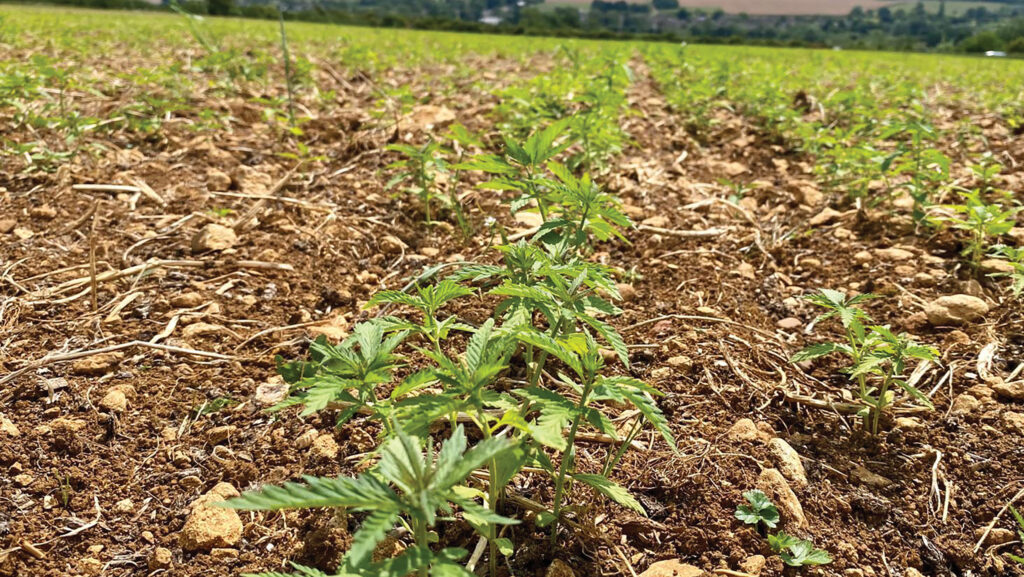
Emerging hemp for fibre © Lydia Smith
Usually that would be in one split, but with the dry weather at planting, he decided to split into two equal doses, with the second split applied once the crop has established.
No other herbicide or insecticide inputs are likely to be required or even available with crop competition helping to shade out weeds.
Rob is hopeful harvest should commence around the end of August or early September, with the aim of a moisture content of about 9% – similar to oilseed rape crops.
Combine setup will likely need to be fine-tuned, he predicts.
“We have a MacDon header, which I’m confident will cope with hemp. I doubt there is a hemp setting on our New Holland combine though, so I’ll likely set it on oilseed rape to begin with and fine tune from there,” he says.
A key requirement is that the hemp can be followed by a first wheat crop drilled by early October, he adds. “The whole point of the project is to look at whether these varieties will fit into the system, as well as perform.”
Putting varieties to the test
Trials will test the success of three varieties – one sourced from France and two imported from the US. The project will investigate how each performs in UK conditions.
The French variety, USO 31 is an earlier maturing variety taking about 100-125 days to mature. Seed yields of about 0.8-1t/ha and 30.9% oil content are possible, according to the EU Registered Variety Catalogue.
The downside is that, as a dual variety, it puts more resources into stem and leaf, points out Lydia. “That’s not necessarily ideal if seed is your primary aim,” she says.
Other French and European varieties were aimed at either the fibre market, or in the case of Finnish variety Finola, not competitive enough against weeds, which led to Lydia widening the search to North America.
“The Canadians are supportive of hemp as an industrial or seed crop, and also legalised cannabis for, let’s say, pharmaceutical use. While I don’t think pharmaceutical hemp is that exciting for our farmers, the two factors together have helped put more effort into hemp breeding in North America,” she explains.
That led her to US-based breeder New West Genetics (NWG), which has started commercialising both open pollinated and a hybrid variety. Amplify, the hybrid variety, is particularly exciting, Lydia says.
“Usually in hemp you have both male and female plants, which if you’re harvesting for fibre doesn’t matter. But if you’re harvesting for seed, the male ones are no good because they don’t produce seed.”
In some cannabinoid markets, chemicals are used to induce a greater female percentage in hemp crops, but the scientists at New West Genetics have identified a genetic trait that creates almost fully female crops. The trait is non-GMO and in trials in the US has led to up to a doubling of yields.
“I doubt we will get that as it hasn’t been bred for UK conditions,” Lydia says. “But I’ve had long conversations about where we are geographically in comparison, and whether our UK conditions would work, and we’re reasonably confident.”
However, to maximise the chance of finding successful varieties for all environments, an open-pollinated variety, Elite, from New West Genetics is also being trialled. “This will have both male and female plants, but it is an improved yielding variety,” explains Lydia.
Genetic switch could improve hemp oil marketability
Using a standard mutation breeding approach, Prof Ian Graham’s team at the University of York has altered the fatty acid composition within the seed oil of a fourth variety.
This new line is being tested in Niab plots.
“Hemp seed is extremely attractive as a food because it contains omega-3, -6 and -9 fatty acids, which are associated with maintaining a healthy body. But it has a poor shelf life, and if you buy a bottle it needs to be kept cool and in the dark to prevent it turning,” Lydia explains.
As part of the CHCx3 project, Ian and his colleagues have been using a non-GM approach to produce genetic lines that produce oil containing more oleic acid, the major fatty acid in olive oil, and less linoleic and linolenic acids, which have a short shelf life. If successful, this could create new markets for UK growers.