

Relay cropping: What it is and how it might work in the UK
 © Mike Abram
 Relay cropping, where a grower plants a second crop into a field before the first crop is harvested, has gained niche popularity in the US as an alternative to double-cropping soya beans.
In the US version, promoted on social media by Indiana grower Jason Mauck, soya beans are planted in the spring between strips of winter wheat sown in the autumn, giving the beans a head start.
Once the wheat is harvested in early July, the extra sunlight available to the beans encourages growth, which rapidly fills the gap left by the harvested wheat crop. In Jason’s system, the combined approach lowers inputs costs while aggregately improving returns.
See also: How US farmer increases profitability through relay cropping
It’s a system that Oxfordshire grower Ben Adams is seeking to replicate in a Defra-funded Accelerating Development of Practices and Technologies (Adopt) project over the next two seasons.
Having experimented successfully with another version of intercropping, where two or more crops are grown and harvested together, he sees relay cropping as the next step.
“I know how intercropping works and I’ve seen the benefits from it, so I wanted to push the boundaries further,” he explains.
Ben Adams © Mike Abram
UK challenge
The challenge is that it is very difficult in UK conditions to ripen a second crop after wheat, which itself is typically harvested about a month or more later in the UK than where the system is used in the US.
Part of the reason is that Indiana, for example, lies nearly on the same latitude as central Spain and southern Italy, some 10deg further south than the UK, giving more heat units to ripen crops later in summer.
To counter this, Ben has switched the autumn-drilled crop to Craft winter malting barley, which at least should be harvested around the same time as wheat in the US. “The earlier I can harvest, the better chance I can give the relay crop to grow,” he explains.
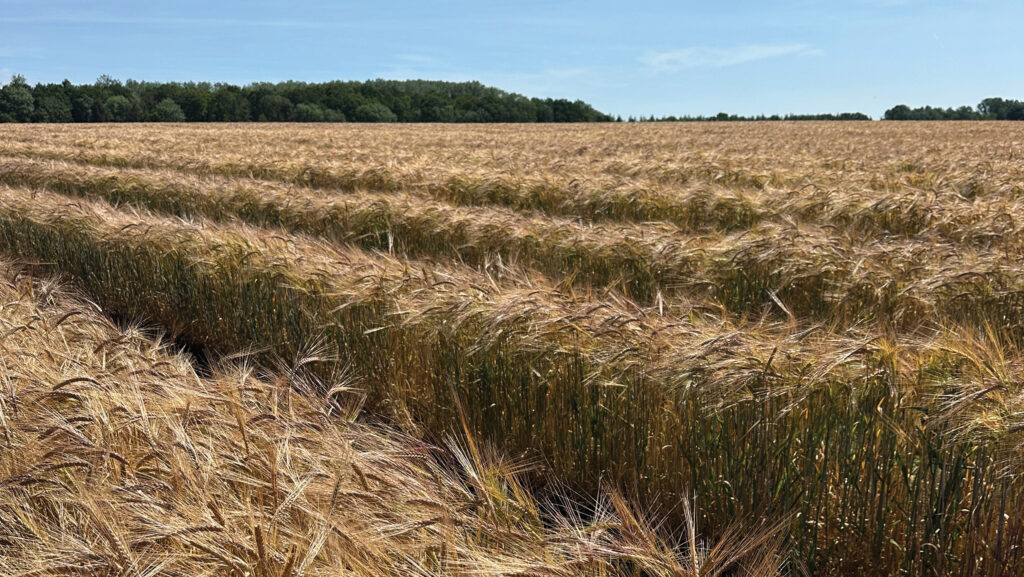
In the trial, a 10ha field has been split into five different areas. The control area is a traditional block of the Craft winter barley, drilled on 27 September.
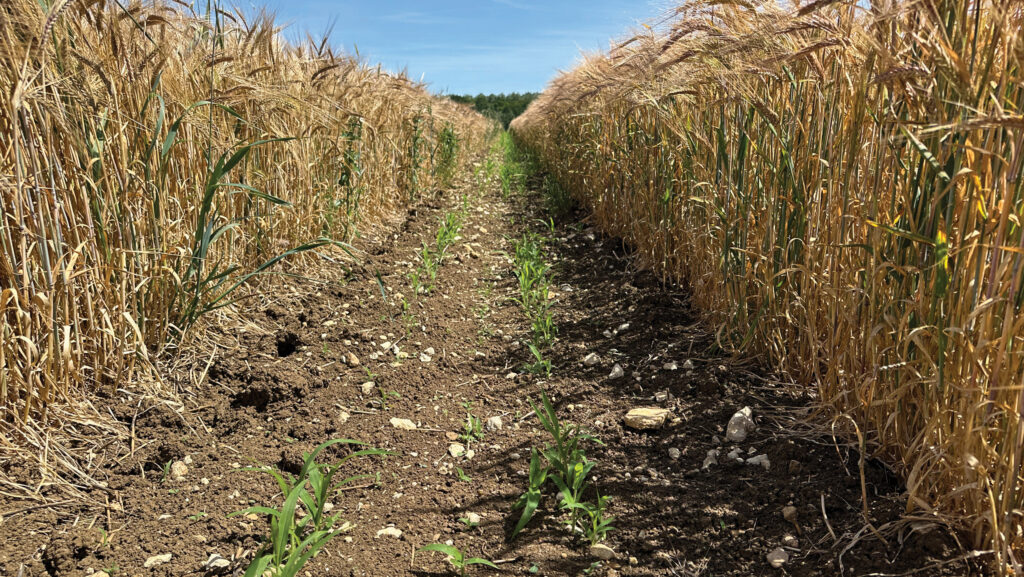
The rest of the field is drilled with 1m strips of the barley with a 1m gap in which four relay crops are being tested – sorghum, linseed, white millet and soya beans.
“These are the four I think will work best in the system.”
Ben is using existing machinery for the trial as much as possible, so six rows of barley were drilled in each strip with a Horsch Avatar on 16.6cm row spacing. “We plugged up the pipes with some blue pipe and duct tape; six rows on, six rows off.
“That fits with other machinery, including the Kuhn Megant drill used for the spring relay crops, tramlines and existing wheel spacings. The only thing that doesn’t quite fit is the combine, which stretches out to 3.2m, meaning the outside wheel won’t run fully in the winter barley row,” he says.
“Hopefully, I can borrow a tracked machine that has slightly narrower wheel spacings.”
The barley was direct-drilled into a catch crop following last season’s wheat crop, which Ben was hoping to keep as an overwintered cover crop in the 1m gaps ahead of the spring relay crops.
“The idea is to spray just the barley or just the relay.” That helps cut input costs, although pro-rata rates will remain, as for overall spraying.
© Mike Abram
This season
This season, it hasn’t gone quite to plan. First, he hasn’t had the opportunity to adapt the sprayer to use hoods, instead switching 110deg nozzles for 80deg ones to reduce overlap.
But more importantly, he found the Trimble GPS on the sprayer didn’t quite match the GPS on the John Deere tractor used for drilling. “Effectively it shifted over about one foot [30cm], which means one to two rows of barley haven’t received any herbicide, while some of the cover crop did,” he explains.
Hand-roguing has helped improve the weed control in the barley, while he decided to use an adapted 3m Shakerator with wide points on the legs running through the relay crop area before drilling to remove the remaining cover crop and weeds.
“It means our weed control on the outside edges isn’t as good as it could be, as we didn’t dare go too near the barley.”
That should be improved in year two of the trial, he says. “Once we have the hoods in place for the sprayer, we should be able to spray glyphosate down the rows and then drill straight into it, not disturbing anywhere near as much soil.”
Three of the four spring relay crops were drilled on 9 May, with the soya beans at the end of the month, following seed procurement delays with the variety imported from Canada.
“It is a non-GMO variety that came with an inoculant, and was quite expensive to import, but it should mature earlier than what is sold in the UK,” he says.
All four spring relay crops have emerged and established reasonably well given the dry weather. Ben is hoping to harvest by the end of September.
“Hopefully, we can get the relay off by then so we can drill the next crop of winter barley straight behind.”
Second year
The trial is designed to be a two-year switching system where the crops effectively swap positions on the metre-wide spacings. After the barley harvest in July, Ben plans to plant a cover crop in the rows where the barley was growing.
“This will be mostly clover based, so it is not too competitive, with some oats in for nutrient scavenging,” he explains.
Winter barley will then follow in the same position as the current relay crops. “Technically, the field will be in a third cereal next year, but I don’t think there will be any take-all issues because the barley won’t be on the same strip.”
Over winter both cover crop and winter barley will be grazed by sheep, with next year’s relay crops drilled into the cover crop.
“It will be interesting to see if it can almost be a continual system,” he says.
That depends on finding relay crop options that mature in time for the system to operate efficiently. Linseed is the most likely option to fit, he suggests. It’s also the option that has the most straightforward commercial prospect, with Ben planning to sell it on the open market.
He uses both millet and sorghum as part of his on-farm winter bird food mixes within environmental schemes, or as supplementary bird food.
Growing these effectively for that use will save money on buying them in, he says, although if successful as a relay crop, he would likely need to look for contracts with specialist producers to scale up.
The same would apply for soya, perhaps the least likely to be successful, with this year’s harvest being home-saved for seed for next year’s trial.
While investigating the practicality of relay cropping is the primary goal of the Adopt trial, profitability is obviously a crucial factor in whether it is worthwhile pursuing.
“Basically, the barley needs to yield more than 50% of the control barley, with the relay cropping making up any of the slack, including covering the cost of the extra passes,” he says.
Adas and Ceres Rural, alongside facilitator the British On-Farm Innovation Network, are providing scientific and economic analysis as part of the project, while Yorkshire grower Simon Smith will also be growing relay crops next season.
What is Adopt?
The Accelerating Development of Practices and Technologies (Adopt) funding is part of Defra’s £5m Farming Innovation Programme. The grants support farmer-led on-farm trials developing and testing new solutions to farming challenges, with the results shared to help other farmers.
Projects must have the potential to improve productivity, resilience or sustainability, and progression towards net-zero farming, and have total costs of £50,000-£200,000. They last from six months to two years and are led by a farmer.
For more information, visit the ADOPT Support Hub.
Catch up on our coverage of some of the key Adopt projects:
