How no-till, rotation and resilience are driving Kenya’s farming shift
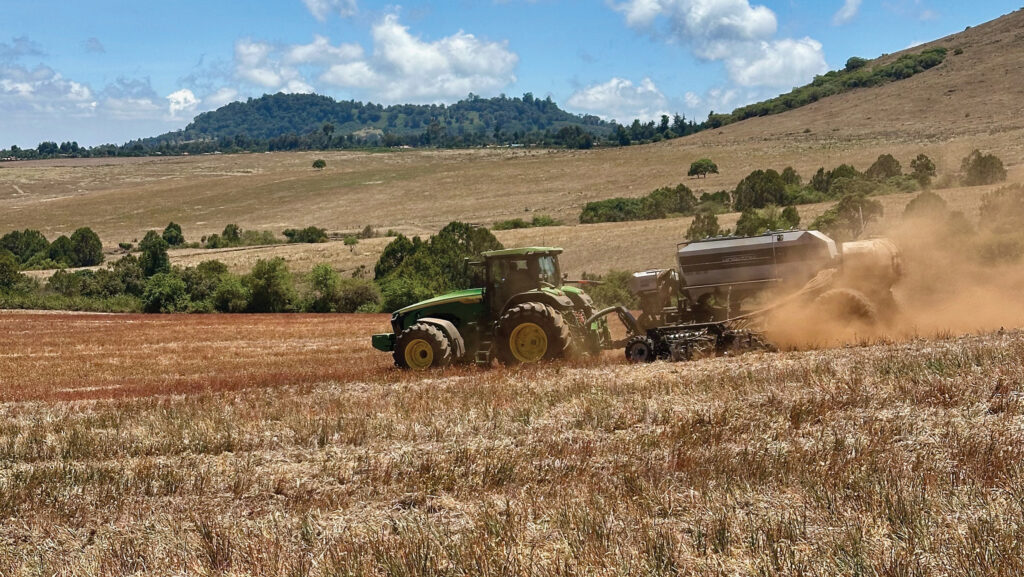 Peas being drilled with
a UK Horizon direct drill © Mike Abram
Peas being drilled with
a UK Horizon direct drill © Mike Abram Think of Kenyan agriculture and it’s likely tea, coffee and cut flowers spring to mind, perhaps with various vegetable crops, such as green beans, which are imported into UK supermarkets.
But up in the foothills of Mount Kenya, sitting alongside rose producers and bordering on game reserves, is a significant area of very familiar combinable crops.
See also: Young farmer completes marathon 2,000-mile US harvest
More than 2,000m above sea level, the climate is relatively cool, with daytime temperatures typically in the 20s all year round and 600-1000mm of rain.
With a constant 12 hours of daylight, and no winter to speak of, all the cropping on farms is of what we would term spring varieties, says British-born agronomist David Jones.
He’s just coming to the end of an eight-year spell in the country, advising 10 large-scale Kenyan farmers, who in 2009 formed a co-operative called Agventure. They farm about 12,000ha in total.
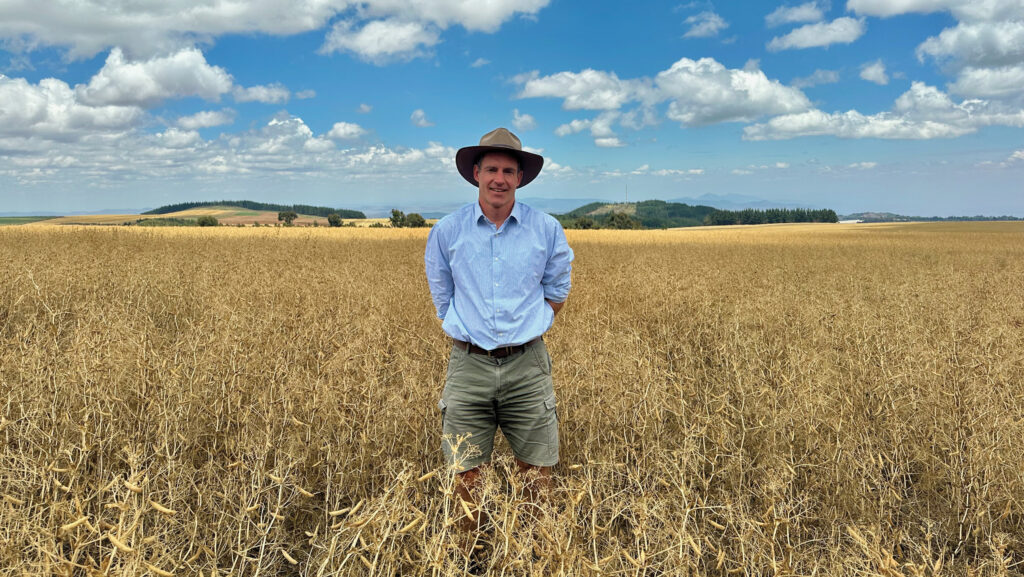
David Jones in a crop of peas before harvest © Mike Abram
Four of the farms are located near Nanyuki, about four hours north of Nairobi. Another three farms are five hours south-west of Nanyuki, close to Nakuru, and a three farms are in Rumuruti, three and a half hours to the north-west.
The farms grow a range of combinable crops, including wheat, barley and break crops such as oilseed rape, peas and, increasingly, niche crops, such as chickpeas, lupins and seed potatoes.
Unsustainable system
This cropping diversity wasn’t always the case, with a monoculture of cereals typical, until the formation of Agventure.
The increasing realisation the system wasn’t sustainable was prompted by visits from advisers, including Australian no-till expert Wayne Smith and agronomist Greg Giblett.
A trip to New South Wales helped firm up ideas to transition to a three-pronged approach of no-till, controlled traffic farming and a more diverse rotation – initially with peas and oilseed rape added to barley and wheat crops.
With no established seed supply or local agronomic knowledge for growing these break crops, one of the key pillars in the newly formed Agventure co-operative was setting up its own research and development arm, which David has played an integral part in establishing.
There are now four 1.5ha trials sites, consisting of a couple of thousand small plots each season. Variety development is a key focus, alongside answering immediate agronomic challenges and trialling new approaches.
Typically, each farm is split in half for cropping purposes, David explains. “We plant or harvest half in March and the other half in September or October.”
In between there is a five- to six-month period of fallow, storing the seasonal rainfall just after harvest.
“The idea is to plant into stored moisture around a month before the seasonal rain, encouraging rooting at depth,” David says.
“You then get rain until flowering and early grain fill, with hopefully lots of sunshine for the final two months before harvesting in either February/March or September/October.”
Sourcing varieties challenges
While some of the malting barley and oilseed rape varieties grown on the Agventure farms will be familiar to UK growers, that’s not true for wheat.
Barley and peas “travel” well, agronomist David Jones says, with malting barley variety Planet, in particular, recognised as being a “game changer” for yields in the country.
Crop performance
Success has also been found with both European and Australian spring oilseed rape varieties, although for slightly different reasons, with European varieties tending to be slightly higher yielding, but weaker against diseases, such as phoma stem canker.
“Australian varieties are short, have good disease resistance, and are very hardy.
“They’re like a pickup truck – reliable and don’t let you down – but seem to hit a yield ceiling of 3t/ha. Whereas varieties like Jazz will push to 3.5-4t/ha.”
In contrast, wheat bred elsewhere struggles to adapt to the local environment in Kenya. “It’s day length dependence,” David says.
“You need broadening day length in the spring to initiate flowering. We have a consistent 12 hours of sunlight all year round.”
With the economics of growing the crop struggling – especially compared with the malting barley, a key requirement for Agventure is finding better wheat varieties, so it has invested into a variety selection trials programme.
“We work with CIMMYT (the International Center of Wheat and Maize Improvement) – if it wasn’t for them, it would be impossible to grow wheat in Kenya,” David says.
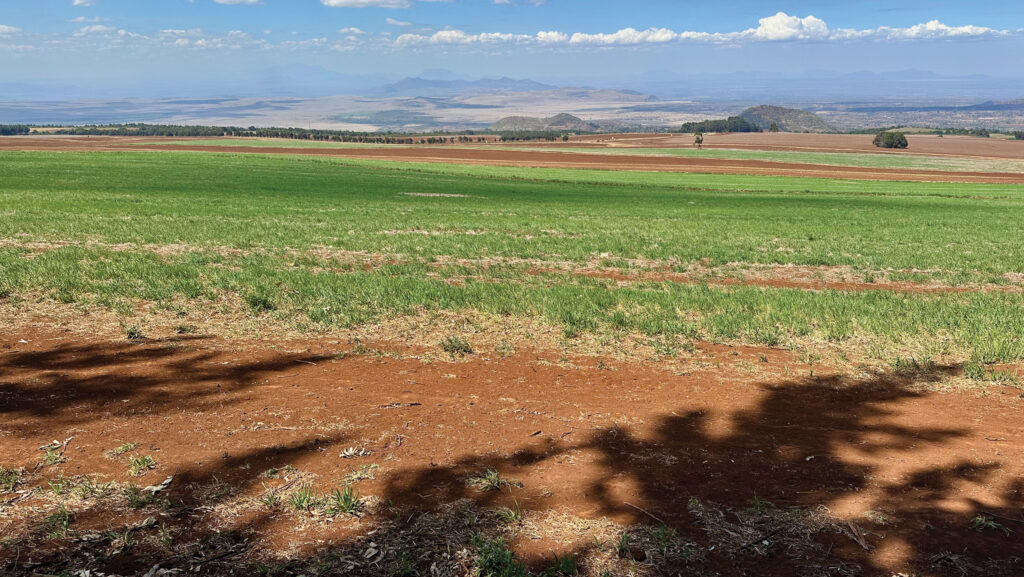
Kenyan arable farmland in the foothills of Mount Kenya © Mike Abram
No-fallow trial
On some of the farms – with zero-tillage and controlled traffic farming helping to improve soil water holding capacity – both double cropping and growing cover crops, rather than leaving land fallow, are being tried.
The 1,000ha Ol Donyo farm, near Mount Kenya, has the lowest elevation at 2,300m and is the driest, with an average rainfall of 635mm.
Here, Bryn Llewelyn used double cropping as a tool to improve soil health when he first started using no-till establishment and a more diverse rotation.
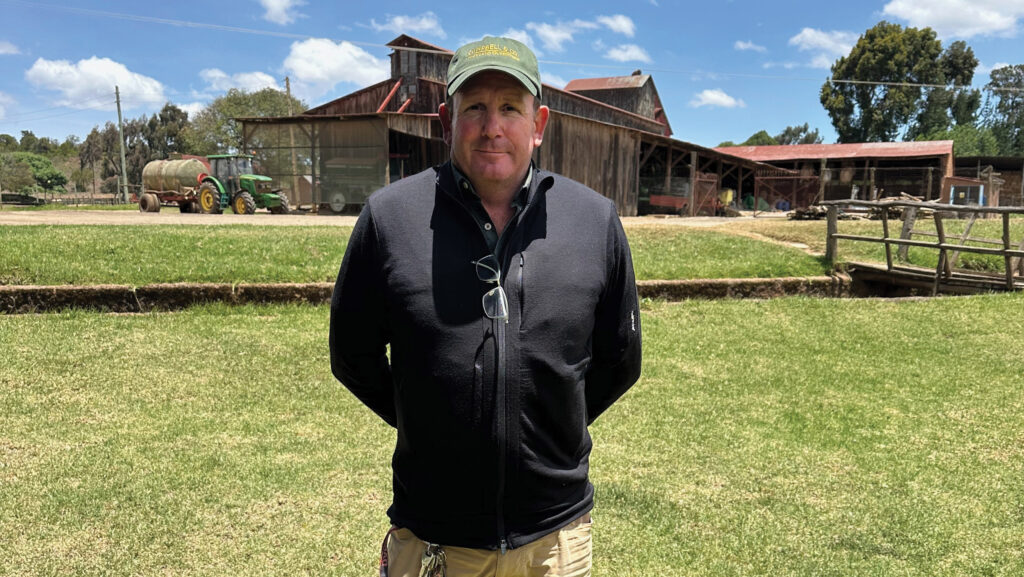
Bryn Llewelyn © Mike Abram
“We needed the soil biology to change quickly, and we knew the quickest way was to keep soil biology going all year round, rather than growing something for four to six months and then letting it go to sleep,” he explains.
The plan worked in terms of soil biology improving, with earthworms reappearing.
“Our soils have developed hugely. We used to root only 20-30cm deep; now it’s into the second metre. It increased our resilience to dry spells, and we don’t get waterlogged in heavy rain.”
But there were some practical limitations to double cropping. Any delays in planting could have a knock-on effect of harvesting in the rain and then missing the next drilling window.
“We worked out sometimes you were doing double the work for the same overall yield, and that yield would be of lower quality,” Bryn says.
Logistically, it requires more combine and drilling capacity, and significantly more storage, increasing fixed costs, while double cropping also increases the frequency of break crops, adding to disease risks.
Timings of double cropping are now more targeted, with rainfall one factor to consider.
Located on the equator, the climate is dictated by El Nino and La Nina weather patterns, with the former bringing heavier rainfall and the latter drier periods, Bryn says.
“If you’re going into La Niña, it’s a single crop; if it’s El Nino, then we look at double cropping. It has a place, but you’ve got to do it at the right time.”
Glyphosate use
Over the past couple of years, several of the Agventure farms have trialled growing cover crops in between cash crops.
Historically, the fallow period between cash crops has seen up to five sprays of glyphosate to control weeds and to conserve moisture for the next crop.
The concern is growing a cover crop will use some of the moisture and affect the following cash crop. “We’re still learning,” Bryn says.
“To make sure you have enough moisture, you’re growing the cover crop immediately after harvest and then trying to get it dealt with before the fallow rain finishes, so there is enough moisture for the next crop.”
Last year, the farm sprayed grasses early to help weed pressure, leaving broad-leaved species until later.
The challenge is not delaying too much to create a broad-leaved weed problem and whether to use glyphosate.
“We’re trying to get away from glyphosate, so we’re going to try crimp-rolling this season.”
Cover crop grazing
On Jamie Murray’s 1,200ha Marania Farm, cover crops are being grazed with a herd of 1,250 Aberdeen Angus cattle, which are crossed with the local Boran breed for extra resilience.
The farm has cut glyphosate use in half, David says, and there have been benefits for the beef enterprise.
The Aberdeen Angus were struggling to maintain body condition without getting fed extra hay when it gets dry, explains farm manager Damian Fison.
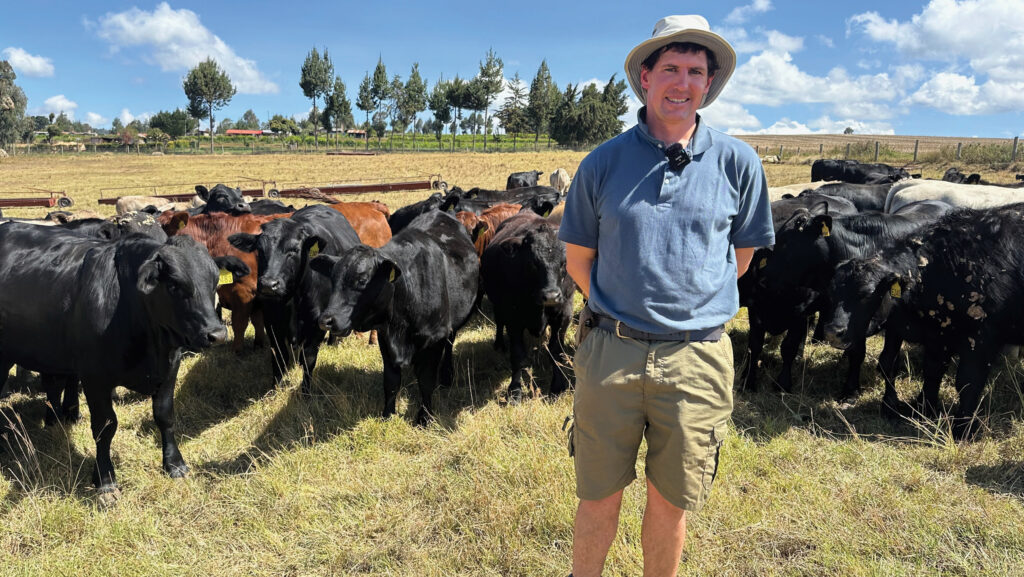
Damian Fison with the herd © Mike Abram
Crossing the breed with the Boran, which has a shoulder hump that stores extra fat, has helped convert poorer forage into meat and fat more effectively, while improving calving rates.
“They’re also a lot more resistant to tick-borne diseases.”
Grazing cover crops with up to 300 head of cattle a block is still in the experimentation phase.
A mob- grazing approach is taken with animals moved up to seven times a day, after seeing yield hits on following crops, especially oilseed rape, where the covers have been grazed too heavily. “Compaction is a concern,” Damian says.
Initial measurements are finding liveweight gains of about 1kg/day compared with about half that for animals grazing the rough pasture on the hills.
Forage cover crops grown at the next-door Kisima Farm – also a member of the Agventure group – were grazed by the Marania cattle for the first time, David says.
Pea alternatives
The aim was to try alternatives to peas to reduce risk, so the area is split between the forage cover crop, peas, chickpeas and beans.
The cover crop could be in for 18 months potentially, David says. “It does a lot of good, bringing in diversity, pollinators and nutrient cycling.”
From the eight species sown, arrowleaf clover has stood out, with an area being harvested for seed to multiply up for future years. Ryegrass and other clovers, such as crimson, and lucerne, haven’t been as successful on the higher altitude at Kisima.
“Whether this is a long-term option, I’m not sure. It’s not going to make as much money as a good pea crop,” David admits.
Where cover crops definitely have a place is before peas.
Yields were better from later plantings of green peas, and the use of bentazone herbicide reduced yields at higher altitudes.
“We’re looking to use cover crops to provide more surface mulch to reduce weed emergence after planting, so we don’t need to use bentazone,” David says.
Later pea planting also coincides with peak fallow rainfall, reducing the risk of planting into ground where the moisture has been used by the cover crop pre-fallow rain.
“Where we’ve trialled this, we built up aphid numbers in the cereal rye cover crop and noticed a huge influx of beneficial insects.
“We planted the peas straight into the cover, and it’s the first pea crop in years where we’ve not had to spray an insecticide for aphids.”
Sourcing seed, whether for cover crops or new varieties of cash crops, is a challenge in Kenya.
For cover crops, there are no seed merchants, so seed is either found in local markets or brought in from abroad – where allowed – and multiplied up on various member farms.

Staying sharp shouldn't be a chore