Poor grain outlook sees farms rethink rotations and machinery
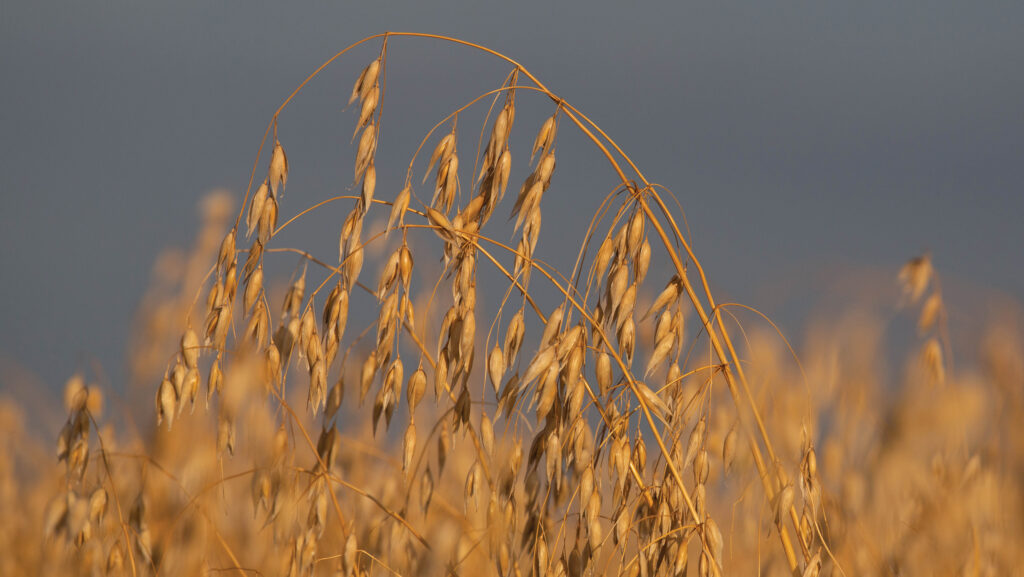 Oats ready for harvest © Tim Scrivener
 For many arable farmers, the reality of low grain prices and minimal government support has triggered some of the toughest decisions of their careers.
As margins tighten and markets fail to recover, growers are turning to rotation rethinks, machinery changes and alternative market ventures as some of the remaining tools left to stabilise cashflow.
Farmers Weekly catches up with two farmers, who share how they are switching up their business to stay afloat.
See also: Farmer Focus: More land needed to maximise machinery use
Robert and Will Pugh: Smaller machines and milled grains
For father-and-son team Robert and Will Pugh, the key to surviving in a time of poor grain prices has meant a hard look at machinery costs and rotation planning.
“To make a margin, we must trim our costs. We can’t increase output as we’re limited by markets and by the genetic potential of crops.
“Cutting fuel, crop inputs, labour and tractor hours is how we can get a handle of our costs,” explains Will.
That mindset has guided almost every decision on the farm over the past 12 months.
Oats have been scrapped from the rotation, as margins simply did not stack up.
All winter wheat and barley are milled on farm and delivered to local beef farmers, to add value to grain and secure a better price on farm.
Machinery costs
“There’s no point in chasing horsepower when it doesn’t pay,” says Robert.
“We’ve realised smaller, strategic kit suits our system better.”
Instead of upgrading to a 300hp tractor, when it came to changing in their most recent machine, the Pughs deliberately downgraded to a smaller 200hp tractor.
This meant reduced depreciation, fuel consumption and repair costs.
The change in machinery power fitted well with their cultivation rethink.
Previously, establishment was based on a Simba Solo disc cultivator and, if required, a pass with the subsoiler, followed by a Vaderstad Rapid drill.
Now, Robert and Will have moved to a Claydon drill, purchased this year through the Farming Equipment and Technology Fund grant.
All winter cereals have been drilled using the Claydon system this season.
“We’ve still got our combi-drill and plough if we need them, but the Claydon has become the mainstay of the system,” says Will.
Rotation rethink
Oats have been dropped from the rotation, as margins simply did not stack up.
In their place, the pair introduced a two-year legume fallow, supported through the Sustainable Farming Incentive (SFI).
The original idea was to rotate the two-year legume fallow around the farm, but that’s now unfeasible, given the uncertainty over the future of SFI.
“One field of winter wheat failed last year, so we put the area into a legume fallow instead of oats,” says Will.
“It gave us a guaranteed payment, and once it was established, we had no further expenditure.
“It was then cut, baled, sprayed off and went straight back into a crop of winter wheat.”
The results have been encouraging.
The legume mix, which included a host of vetches and clovers, improved soil structure and fed the soil biology, hopefully setting the land up for a high-yielding wheat crop.
“This spring, we’ll be monitoring it closely and adjusting the fertiliser programme accordingly,” Will adds.
The pair are hoping to make a real saving on fertiliser use.
With the uncertain future, Robert and Will are looking at other break crop options, potentially whole crop spring cereals, such as peas and barley grown for livestock feed.
However, Will stresses: “The numbers have to stack up.”
Adding value with on-farm mill
While cost-cutting and rotation changes have been key, the Pughs’ on-farm milling operation has provided another vital buffer against poor grain prices.
All home-grown wheat and winter barley is milled on-site and sold as beef finishing rations to local farmers.
What started nearly 20 years ago as a favour delivering grain to a few neighbours has evolved into a fully registered feed mill.
Today, the Pughs mill about 2,000t of wheat and barley each year.
Demand has grown so much that they now buy additional grain from nearby farms to keep up.
“This has been a great way to add value to what we’re already doing,” says Will.
“It helps secure income and supports other local farmers, too.”
The farm’s 60-head suckler herd provides another strand of diversification and rotational benefit.
Straw from the cereal crops goes back into the livestock system, and manure returns nutrients to the arable ground.
Andy Barr: Shift away from spring crops
Andy Barr © MAG/Colin Miller
Kent arable farmer Andy Barr is shifting away from spring cropping this season as dry springs and unpredictable weather patterns have resulted in poor yields and returns.
Andy farms just over 300ha of arable land across varying soil types near Ashford.
He says the rotation shift is necessary to maintain profitability and resilience. “It was a tough year for spring cropping.
“The crops established well, but with such dry weather, they were dying off early due to the complete lack of moisture especially on lighter land,” explains Andy.
Regen approach
For the past 25 years, Andy has adopted a “regenerative” approach, focusing on low-till and direct drilling, along with a diverse rotation of spring crops and overwinter cover crops to improve soil health.
Typically, 35% of his rotation would be dedicated to spring crops, but changing weather patterns have forced him to reduce spring cropping to just 10% of his farmed area.
“Dry springs are clearly becoming the norm for us. Harvest 2024 was a wet year, and I produced my highest ever spring bean yield.
“This year was another dry year, and I had my lowest, which was roughly half of 2024’s yield. Clearly, a big impact on profitability,” recalls Andy.
Spring peas and beans are no longer being grown as Andy deems the crops too risky.
Spring barley and OSR
He is considerably reducing his spring barley area, which is making up the remainder of his spring cropped land.
“Spring barley yields weren’t disastrous this year, but still about 2t/ha down on my best,” he notes.
Instead, he is edging up his area of oilseed rape, after its improved performance over the past few seasons.
“I’ve been companion cropping my OSR to help improve soil structure and reduce pest and disease pressure.
Legumes and N-fixing
“Beans have proven to be the best companion crop so far as they help to reduce flea beetle larvae,” says Andy.
He has long heard the accepted wisdom that legumes boost residual nitrogen for following crops, but soil testing has shown a more complex picture.
“When we’ve done N soil tests in the spring after beans or peas, results have often related more to how wet the winter was.
“We’ve had wetter winters and drier springs, and even when the tests are higher, Niab advice is not to reduce wheat N unless readings are above 100kg/ha – which is rare,” he explains.