Pros and cons of wider row spacing for cropping resilience
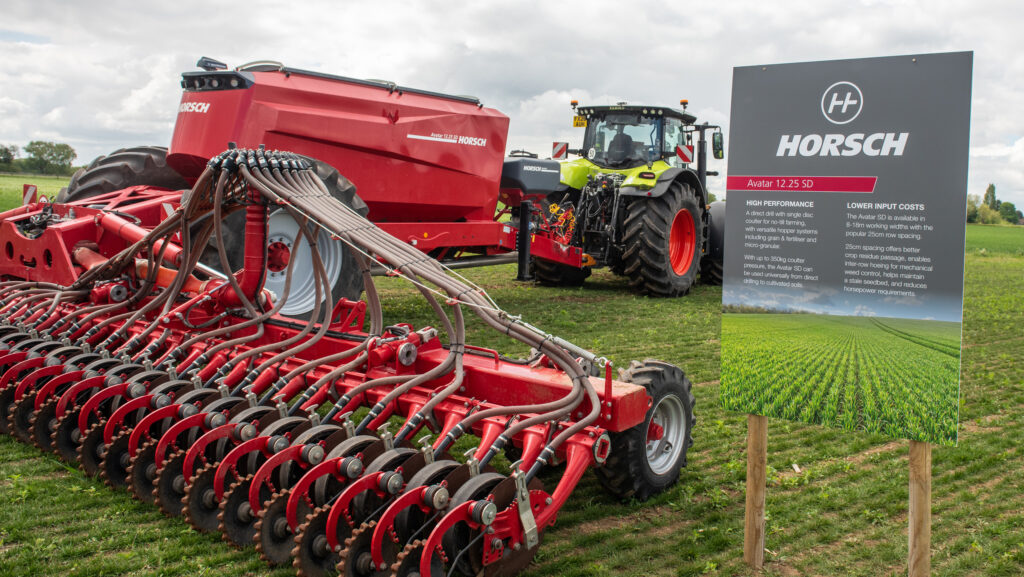 Horsch drill at Arable Insights Live event at Dyson Farming © Phil Weedon
 Wider-row spacing could offer arable farmers the opportunity to establish a more resilient cropping system.
Farmers Weekly hears the latest advice from machinery specialist Horsch and rounds-up the pros and cons of 25cm row spacing.
See also: Guidance on the right conditions for drilling for successful crop establishment
The pros
One of the biggest benefits of 25cm row spacing is reduced plant competition and the development of stronger root systems, explains Gareth Burgess, regional sales manager at Horsch.
“Individual crops can tiller more, creating an opportunity for growers to reduce seed rates, while still achieving target ear counts,” says Gareth.
Wider rows can improve airflow through the crop canopy, reducing humidity and creating less favourable conditions for diseases such as septoria.
Better light penetration lower into the canopy can also help maintain green leaf area and support crop health.
The system also lends itself well to reduced-disturbance and direct-drilling systems.
Drills such as the Horsch Avatar create minimal soil movement, helping preserve soil structure, retain moisture and reduce establishment costs.
For growers looking to reduce herbicide reliance, 25cm row spacing allows for the possibility of inter-row hoeing.
The wider spacing provides enough room for mechanical weeding equipment to operate between rows, reducing reliance on chemistry.
Breeders are increasingly taking an interest in wider-row systems.
Several varieties in the pipeline are expected to be well suited to 25cm systems, with traits such as strong early vigour.
Operationally, wider rows can provide greater flexibility.
The reduced crop competition can allow later-drilled wheats to establish strongly, while the system often works well in high-residue situations following cover crops or previous cereal crops.
The cons
The most raised concern is weed pressure.
Wider rows inevitably leave more exposed soil between plants during the early stages of growth, creating opportunity for weeds to emerge and compete with the crop.
Slower canopy closure can allow more light to reach the soil surface, potentially encouraging weed germination.
However, the issue is not entirely clear-cut, says Gareth, because many growers using 25cm systems are also adopting low-disturbance drilling so fewer weed seeds are brought to the surface.
Crop appearance can also be challenging. Wider-row crops can look thin during the autumn, until tillering increases in the spring.
Variety choice becomes more important. Not every wheat is suited to wider-row systems – for example, those with poor tillering or weak early vigour.
Spring barley presents a particular challenge.
Gareth advises against 25cm row spacing in this crop as it relies more heavily on plant numbers to build canopy structure.
“In wider-row systems there can be insufficient plant-to-plant support, increasing the risk of brackling as crops approach harvest,” he explains.
There is the question of yield consistency, but this is heavily dependent on wider farming practices and soil type.
Horsch was discussing the benefits of 25cm row spacing at Farmers Weekly’s recent Arable Insights Live event hosted at Dyson Farming, providing industry stakeholders with the latest agronomy advice and technology updates.