Welsh grower changes drill for better seed placement
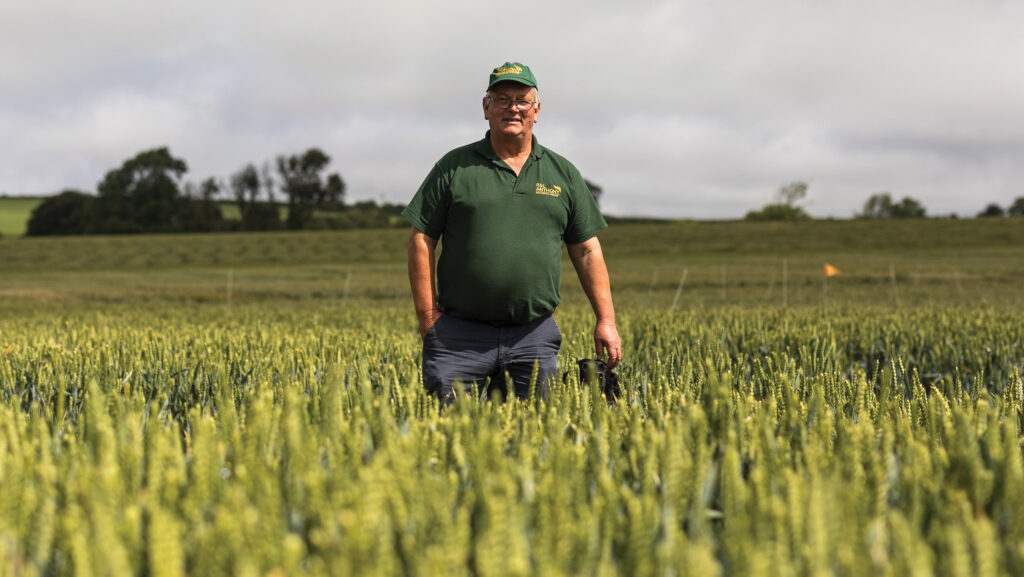 Richard Anthony © John Wellings
 A change in drill and the launch of a new “mixed ration in a bale” service to local dairy, beef and sheep farmers are among the changes being implemented this season by the Farmers Weekly 2025 Arable Farmer of the Year.
Getting crops off to a good even start is vital for Richard Anthony, when growing high-yielding cereals in a high rainfall area.
See also: Farmers Weekly Awards 2025: Arable Farmer of the Year
Farm facts
- Area 1,370ha of arable cropping
- Cropping Winter wheat, oilseed rape, maize, forage rye/westerwolds, Italian ryegrass and cover crops
- Soils Shallow soils, ranging from sands to heavy clay
However, this can be a challenge on the variable, shallow soils that he crops in the western end of the Vale of Glamorgan.
So, last autumn, he replaced the 6m Vaderstad Rapid with a 9m Horsch Pronto fitted with the Autoforce Coulter system for better seed placement.
He explains that the system automatically adjusts coulter pressure while on the move to suit varying soil conditions, thereby planting seed at a more consistent depth.
For example, when in a softer patch in a field, the coulters will go too deep, while on the rocky slopes, they can go too shallow.
The result is uneven timing of emergence, and he hopes to eliminate this with the change.
The drill has three hoppers enabling different seeds to be drilled in a single pass, like the Westerwolds, forage rye and vetch.
In addition, the drill tractor has been fitted with larger VF900/60/42 tyres, allowing tyre pressures to be reduced to 0.6 bar.
Last September, this forage mix was the first crop to be planted with the new drill.
The same fields will be drilled this spring with maize again as part of the double-cropping approach before going into wheat next autumn.
“We were really pleased how it performed and the Westerwold rye and vetch mix has emerged evenly.”
The plan is to use the new drill on wheat and forage crops, although he will continue to use the Mzuri Protil 4m strip-till drill for oilseed rape and companion crops.
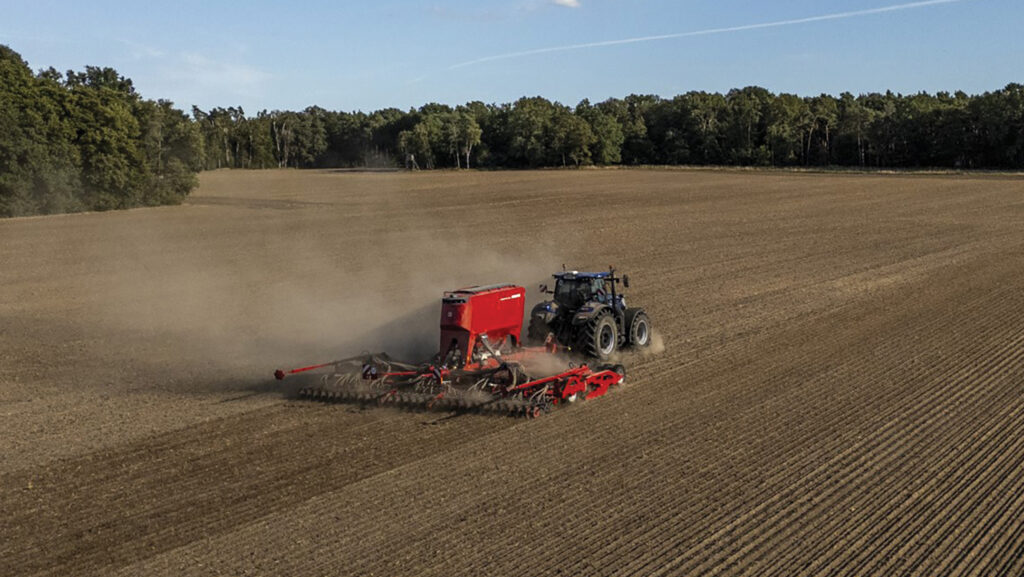
Horsch Pronto © Horsch
New forage service
In another change, Richard and his son, David, have created a new local market for the grass and maize silage produced on the farm by offering a total ration.
The forage crops are a key part of the cropping system with their rotational benefits.
Last year, the family invested in an Orkel stationary baler, which can bale and wrap various materials such as forage.
It offers a practical way to preserve and transport clamp silage in 1t bales.
David started out selling their clamp silage (wrapped) to local farmers who don’t have the facilities to clamp their own.
Grazing crops to manage septoria disease risk
About 90% of Richard Anthony’s winter wheat is being grazed by sheep this winter, as he looks to manage disease and encourage tillering.
Winter cereal crops have established well, although some septoria has already been spotted in some of the forward crops.
Richard normally grazes some of the cereals, but being an exceptionally early drilling season, most is being grazed.
He hopes it will help reduce the need for a T0 fungicide, providing there are no yellow rust problems.
“We try to focus most of the spend on the key T1 and T2 fungicides, and last year we even had to go with a T3 and a T4 to keep crops clean.”
He says that after ear emergence, the sea mist last summer meant there was a higher disease risk despite no measurable rainfall.
“You have to use your windscreen wipers as there is so much moisture even though it’s not raining.”
However, this winter they have expanded the service to include fully mixed rations that include maize silage, grass silage and will include concentrate such as rolled wheat in the future.
The range will include a dry cow mix, a heifer mix and one for ewes carrying twins.
Richard explains that farmers like the wrapped bales, as it keeps the feed fresh until they are opened.
He said they are seeing a lot of local interest from dairy, beef and sheep farmers.