

Farmer Focus: Do you re-test soil after lime application?
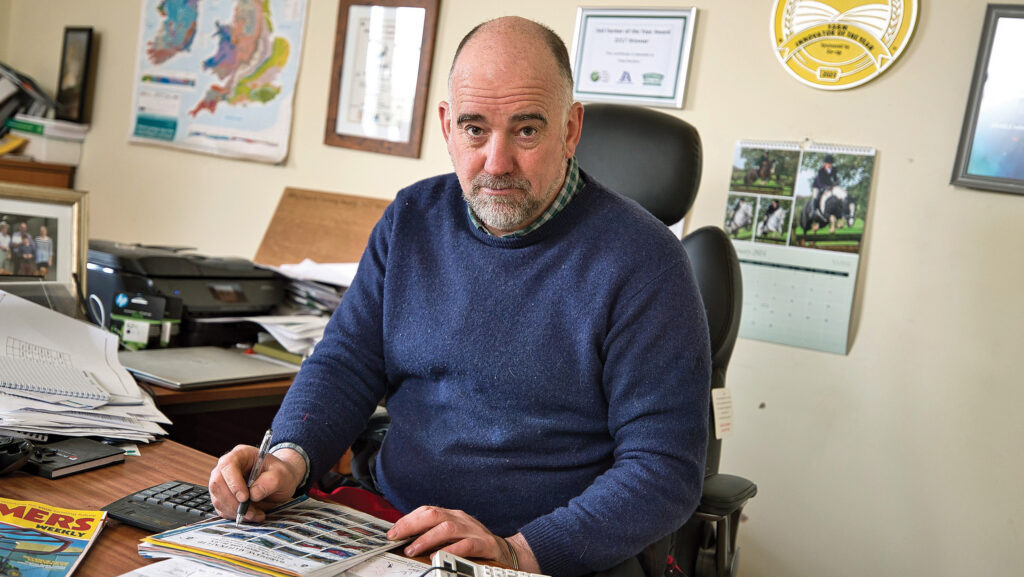 Tim Parton © Richard Stanton
 My run of luck continues…. I have broken my leg since my last article, yet life goes on. I have a full leg cast, with a bend so I can sit in my wheelchair and still get around (thank you to NHS staff for engineering this living “art form”) – simply another challenge.
It is the time of year when you see piles of lime in fields around the country, waiting to be spread.
Ask yourself if you ever consider the particle size of lime about to be spread on your land? Do you re-test your soil after application to see if “the problem” has been rectified?
See also: Why one farmer believes calcium is king of soil nutrients
About the author

In my experience the answer to both questions is no, but why not? If you have invested in a product, do you not want to prove that it has been worthwhile?
Most people seem to test their soil, apply lime, then don’t re-test until four-five years’ time and the process continues, as people just take it for granted that the job is done and the investment worthwhile.
Consider this: Any Lime particle larger than 0.6 mm will not break down quickly, so the neutralising value will be very poor and may not change pH for up to two years or longer depending on particle size, maybe even decades.
Calcium is the king of nutrients in my opinion. FW’s deputy Arable editor Emma Gillbard did a fantastic article on my thoughts last year if you would like to read it (see the link above).
I have found prilled lime to be more cost effective, with a more reliable neutralising value, plus guaranteeing me the calcium I want available to my growing plant. Calcium is far more than just pH.
It is nice to see wheat prices improve slightly, but they are still nowhere near where they need to be, given the environmental factors and cost production.
As with everything I am sure things will eventually turn around, yet I hope it’s not to the detriment of the consumer – note the lack of food security from our government/great leaders!
I’m hoping my luck takes a change of direction before my next article. I wish you all a safe and easy drilling season.