Fierce competition for barley fungicides
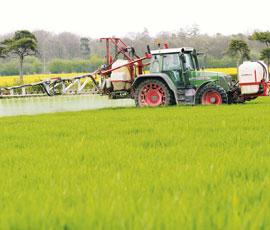
Competition for a place in barley fungicide programmes will be fierce this season, predicts Andrew Gilchrist of Scottish Agronomy.
“The existing chemistry that we have at our disposal is very good,” he says. “Now the SDHIs have come along too. Although they’re very welcome, they represent a smaller step in barley than they do in wheat.”
He reports encouraging results from Scottish Agronomy trials, despite low disease pressure last year. “The SDHIs bring extra greening, more clout on both rhynchosporium and ramularia and they last a bit longer,” he summarises.
He believes that one application at T2 will be the main use in barley. “It’s going to be hard to justify two applications unless we get very high disease pressure.”
Mr Gilchrist is not concerned about the differences between the three SDHIs highlighted by HGCA-funded work on their effectiveness on rhynchosporium.
“In an eradicant situation, there were two better performers in Adexar and Siltra Xpro,” he says. “But that’s a false picture. It’s very rare to deploy fungicides in an eradicant situation in the field.”
So while he believes that the HGCA data can be useful, he points out that it’s a snapshot. “It doesn’t mirror what happens in the field and how the products perform in fungicide programmes.”
More useful for growers, he reckons, is the information that all the SDHIs – Siltra Xpro, Adexar and Bontima – do a good job against rhynchosporium in a protectant situation.
“Siltra Xpro offers a bit more as an eradicant due to its prothioconazole content.”
Ramularia is a well-established disease in Scotland which can be very damaging, he notes. “But it is very straightforward to protect crops against and can still be done with very old chemistry, which is also very cost-effective.”
Including chlorothalonil (as in Bravo) at T2 will do an excellent job on ramularia, he advises. “Anything that a triazole or SDHI brings is additive. So having chlorothalonil in the mix is important and it is right up there with the new chemistry in the HGCA data.
“Of course, triazole and SDHI chemistry will be in there as well at that timing. So the cover is in place, regardless.”
The new SDHI chemistry is also strong on net blotch and reasonable on mildew, continues Mr Gilchrist. “It usually offers enough on mildew for Scotland as most spring barley varieties have good resistance ratings.”
Brown rust only strikes occasionally on barley in the north, he adds.
Covering the extra cost of SDHIs isn’t going to be difficult in a normal year, he calculates. “Getting an extra 0.1-0.2t/ha of yield and a reasonable malting premium is going to meet that additional expense.”
However, last year there was no yield response in Scottish Agronomy trials, he acknowledges. “But disease levels were particularly low. If you look back over the previous three years, there was a 0.2-0.25t/ha response.”
While there’s no way of growers knowing what the disease pressure is likely to be, it would be wrong to dismiss the use of SDHIs on the basis of one year, he comments.
“However, there’s no doubt that their use is more price sensitive than it is in wheat and that there’s plenty of competition from existing chemistry,” summarises Mr Gilchrist.
His final point is that Seguris is also registered for barley, as well as wheat. “We’ve done some work with it in barley and it looks very promising at the T2 slot.”
Actives
Adexar – epoxiconazole and fluxapyroxad
Bontima – cyprodinil and isopyrazam
Seguris – isopyrazam + epoxiconazole
Siltra Xpro – bixafen and prothioconazole
See our dedicated fungicides page for more on whether you should use an SDHI on wheat this spring and which one.