Harvest 2026: A spring crop disaster and poor straw yields
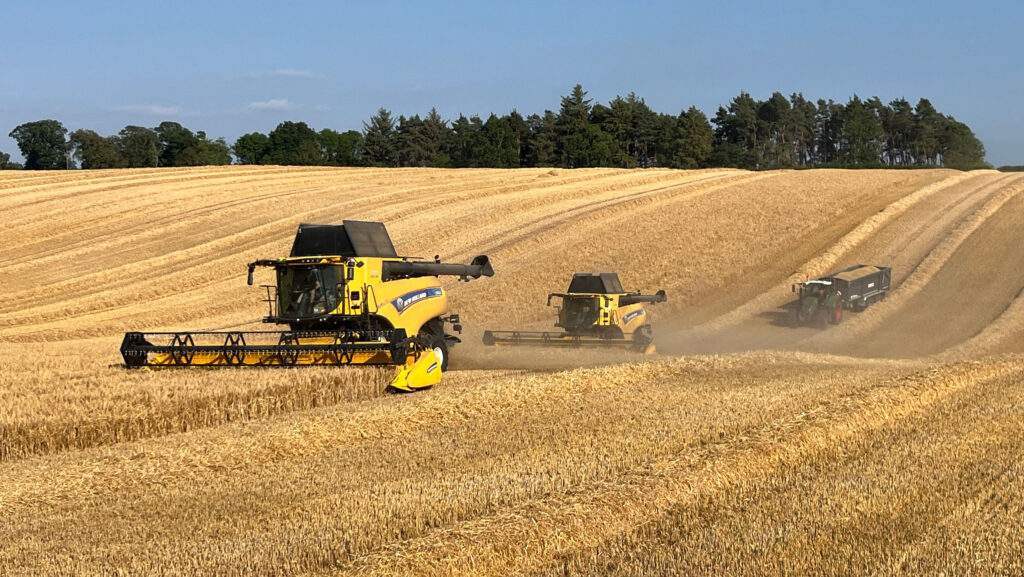 © Dexter Parsons
 Straw is a valuable commodity in some parts of the UK, but for one Welsh grower, winter barley straw yields have been poor. In Northants, spring crops have been a disaster.
Northamptonshire
David Reynolds, who farms near Kettering, finished harvest unprecedentedly early on 23 July.
“I don’t ever remember finishing this early; we usually start at or around the Peterborough Show, and that was last week,” he says.
“Winter wheat, winter oilseed rape and winter barley have been pretty good, but the spring crops have been a disaster.”
See also: A day in the life: Managing 100,000t of grain at PX Farms
Notably, the spring barley averaged just 2-3t/ha. “We haven’t had rain for 39 days and there’s nothing we can do.”
Milling wheats were down to 8t/ha where David would expect to see over 9t/ha, but quality is good with the Hagberg at 280-290 seconds and 13% protein.
Mascani oats have done OK at about 6t/ha, with winter barley yielding 7.5t/ha.
“The oilseed rape was fairly good, yielding just over 3.5t/ha. Though to get 6-6.5% moisture we were starting at 4am and stopping when it got too dry.”
Pembrokeshire
Further west, at Pantycoch Farm, Letterston, Geoff Thomas began harvest 10-14 days earlier than normal.
The Caravelle winter barley was variable, with yields between 6-8t/ha. While the Palladium winter wheat has yielded better at 8.5t/ha.
He runs a bale contracting business, too. “The barley straw yield, which is important here, was very disappointing,” explains Geoff.
They averaged about 7-9 round bales/ha, in contrast to 20 to 25 bales/ha from the wheat.
The spring barley – of which they have 80ha, remains 10 days off harvest at present.
For Geoff, though, the most notable thing this harvest is how dry it has been.
“This year we had two fields come off at 12%, which is absolutely unheard of. So, at the moment drying costs will be nil.”
Londonderry
Across the Irish Sea, Richard Kane, who farms more than 300ha at Broglasco Farm, Myroe, has harvested 60ha so far.
“We had a tough winter, with wet weather from October to March and a cold spring,” says Richard.
“We have finished cutting our barley crop and are currently into the oilseed rape.”
The Tardis barley yielded 7t/ha. “Yields were not so good on earlier cuts, usually we’d see 8-9t/ha.”
The Cognac oilseed rape, which they grow, crush and bottle on farm for their award-winning rapeseed oil business, Broighter Gold, yielded 4t/ha, having swathed the crop for the first time. He is pleased with the results.
The remaining crops – Dawsum and Graham winter wheat, and Quintus spring wheat are looking well.
“Eighty percent of the winter wheat crops are looking good, with the spring wheat looking excellent, but I think we have another two to two-and-a-half weeks to go before we have any results there.”
Roxburghshire
On the Scottish borders near St Boswells, Kelso, Jack Parsons, farm manager at Mertoun Estate Farm, commenced his 1,700ha to harvest on 15 July – 10 days earlier than usual.
The Penrose oats, grown on contract for Quaker, have yielded 9t/ha so far. While the Caravelle and Kingsbarn winter barley averaged 8.2t/ha, though results varied across the farm.
“We had a bit of yellow dwarf this year, so those fields affected were obviously a bit worse,” explains Jack.
“But we haven’t had to dry anything – which is very unusual for us.
“We started cutting the Tom, Aurelia and Crusoe oilseed rapes on Wednesday (28 July) and they are doing really well, over 5t/ha.”
He remains cautiously optimistic about his winter wheat.
“Our main crop is the winter wheat, but we’re not expecting to finish that until the end of August or early September.”