

Harvest 2026: Harvest nears completion for some
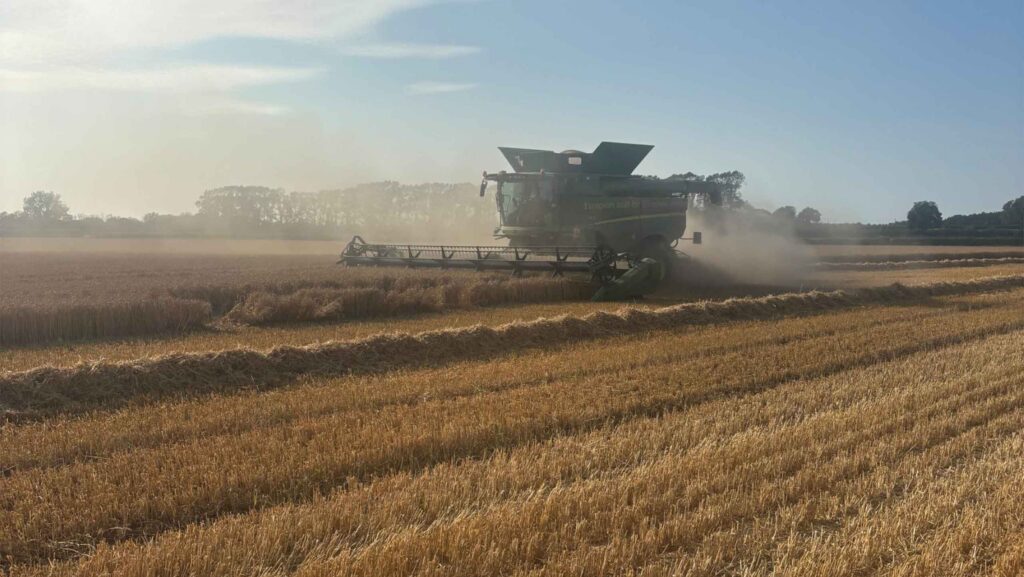 Combining at Fransham Farms in Norfolk © Will Mallon
 The end of harvest is in sight for some farmers, especially in the South and East, thanks to the early start. Despite lower-than-average yields, quality has been a pleasant surprise for many.
See also: Could highest yielding soft wheat be the next market leader?
Devon
Harvest in the South West is nearing completion for father-and-son team Jim and Joe Mawle, at Willey Farm near Okehampton.
“We’ve finished the winter barley, winter oats and oilseed rape and are a couple of days into the winter wheat now,” said Joe. “Then it’s just the beans to go.
“The oats have suffered with the dry conditions, averaging 5-5.5t/ha, where normally we’d see 7t/ha. However, we have had nice bright samples with a good specific weight [52-55kg] and lovely straw.”
Barley yields (Kingsbarn, Inys and Kestrel) have ranged from 6t/ha to 8.5t/ha, but specific weights have been at the low end at 63-65kg/hl.
“With it being so dry, it has been difficult to separate the awns this year, which has had an effect on specific weight,” Joe explains.
“The straw has been good, though, and of the three varieties, Kestrel has proven its worth in a very high-pressured year for barley yellow dwarf virus.”
Of the oilseed rape, Maverick has been the standout performer (the other being Anika). Yields have ranged from 2.3t/ha to 5.2t/ha and it came off at 6-7% moisture. “We’ve been combining very early and very late into the evening to try to get the optimum moisture.”
Graham, Insitor, Champion and Typhoon wheat has done OK depending on the soil type. Yields have ranged from 6t/ha and 9t/ha, with a specific weight of 77-79kg/hl. “Unfortunately, the heat wave has frazzled some crops and compromised the finish,” he said.
“We’re very thankful for an early harvest with limited drying expense and great ground conditions. Cooling and conditioning grain are the main priorities for us at present – and planning for next year’s cropping.”
Berkshire
Further north, dry conditions are top of George Brown’s mind at Priors Farm, near Newbury. While farming 214ha of organic Laureate and Westminster spring barley at home, he also manages 400ha of wheat and oilseed rape under contract and runs a WhatsApp group to alert farmers in the area to field fires.
The group has over 400 farmers signed up, ready to spring into action to support fellow farmers and the local fire services where needed. “We have the kit and the resources; it makes sense if we can co-ordinate it to help with the problem.”
See also: 400-strong WhatsApp group helps tackle harvest fires
Of this year’s harvest, George is underwhelmed. Yields are 60% of usual normal levels, at 4.5-7.8t/ha – down by about 3t/ha.
Laureate malting barley had a specific weight of 65kg/hl, while Westminster (grown for seed) did 69kg/hl. “Overall moisture levels are incredibly low, as we’ve had only 30mm of rain since March.”
Shropshire
Further north, harvest is 10-14 days ahead of normal for Paul Bird at Flashbrook Grange, Newport, Shropshire.
“Yields have been a little down; the winter barley [Caravelle] did well, yielding about 8t/ha, which is not too bad, though we have had better in previous years”. The winter oats crop of Mascani, which they finished this week, averaged about 7.2t/ha.
“We are now on the Graham winter wheat and I’m hopeful that might fare better, as it’s on slightly heavier land. Currently, we are averaging 7.8t/ha, where usually we would expect to get about 9t/ha.”
Norfolk
Meanwhile, in the East, Will Mallon at Fransham Farms, near Dereham, has also made quick progress. “Harvest is now all done and dusted – we’ve never finished this early before,” he says.
Lotus milling wheat, grown as a trial to replace Bamford, yielded 9.2t/ha, which he was very pleased with – and is keeping 14t of seed to dress and sow for next year.
“Bamford yielded 9t/ha with a specific weight of 80kg/hl. We have had 10t/ha in the past, but we are happy with the result for our land,” notes Will “We’re hopeful the protein will meet millers’ specifications; it just needs to be a good price.”
Tardis feed barley yielded 8.3t/ha, while Mascani oats produced 7.5-8t/ha. “I was very concerned going into harvest, so considering the horrendous growing season, I’m pleased with the overall results.”
