Harvest 2026: Promising yields in Yorks and on Lincs coast
As farms as far as Yorkshire enter the final stages of harvest, the North East remains positive, with earlier summer moisture helping deliver satisfactory yields despite a challenging season.
See also: How new grain store secured farm’s future after storm
North Yorkshire
Starting in the North near Stokesley, Andrew Gloag at Busby House Farm is yet to finish harvest across his 1,416ha of combinable crops, but remains well ahead of previous years.
“Last year we were about three weeks ahead and this year is the same,” he says. “But I’ve never cut wheat in July before – until this year.”
Andrew is around halfway through 682ha of winter feed wheat, comprising 581ha of Scope, Graham and Beowulf as first wheats and 101ha of Beowulf as a second wheat.
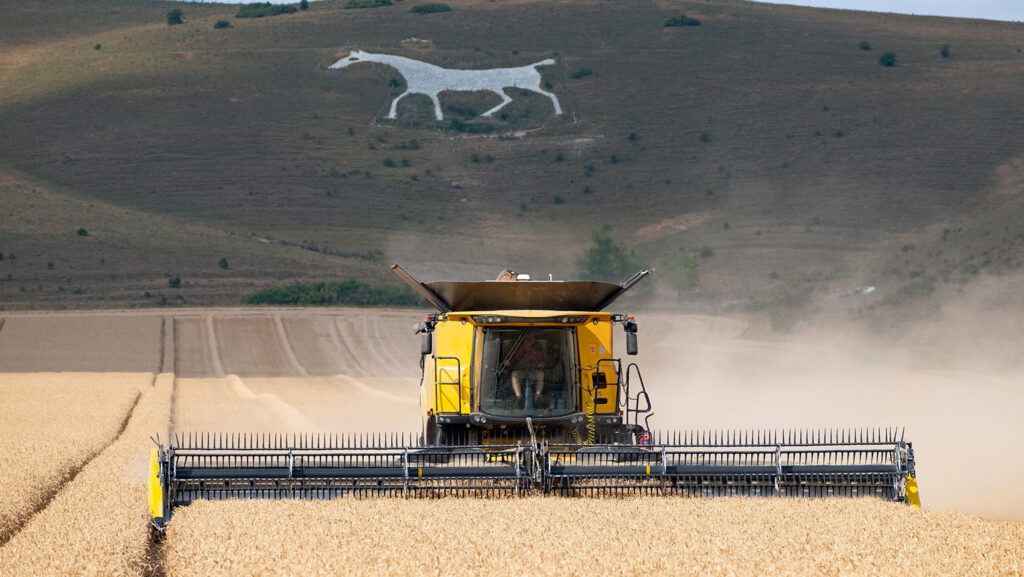
Palladium wheat being combined at Manor Farm, Alton, Barnes, in the Vale of Pewsey. Image submitted by Tim Carson
“So far yields have been promising and with good quality at 78-81kg/hl.”
Some 222ha of oilseed rape has reprieved the previous year’s performance, averaging 4.7t/ha. “Last year cabbage stem flea beetle decimated the crop; we averaged about 1.97t/ha,” he adds.
His 344ha of six-row hybrid Kingsbarn winter barley has produced excellent quality, with the best fields yielding 10.8t/ha at 70.9kg/hl specific weight and 13% moisture.
The rest has averaged 7.9t/ha at 67-68kg/hl.
His 50ha of peas have been desiccated and are fit to combine, but the 73ha of Lynx spring beans are disappointing.
Rather than the expected 12-15 pods from base to top, plants are carrying just six to eight pods through the middle.
Andrew expects to finish by early September, with 29ha of rye scheduled for combining at the end of August.
East Yorkshire
Heading east to Frodingham, one arable farmer and contractor – who requested not to be named – says it has not been a record-breaking harvest, but nor has it been a disaster.
Harvest began early with 20ha of Caravelle winter feed barley, yielding 7.2t/ha at 13.5% moisture. Quality was slightly light at 65kg/hl specific weight.
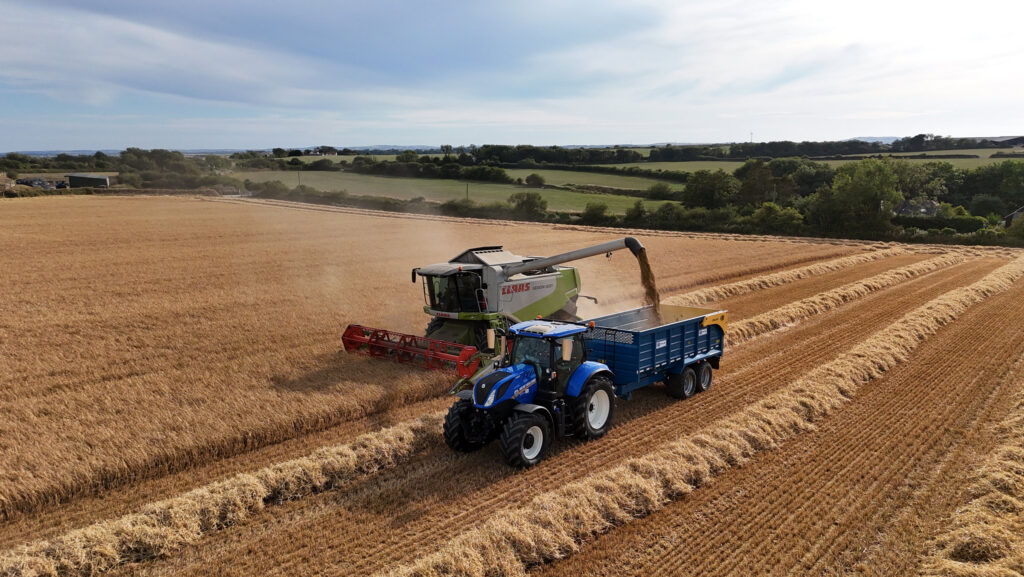
Spring barley being cut by J&J Kerkin contractors, Cornwall. Image submitted by Noah Kerkin
This was followed by 20ha of oilseed rape, drilled with a companion crop in mid-August, which returned 4t/ha.
The farm’s 120ha of winter wheat has also performed well, helped by heavier clay loams retaining sufficient moisture from early summer rainfall.
Seed crops of Lotus and Vibe averaged 9.5t/ha at 76-81kg/hl with 9-10.5% protein.
Hard and soft wheat blends have been introduced to diversify cropping and improve disease resilience, with most destined for the feed market.
Spring oats yielded 7t/ha across 18ha, while seed beans achieved 4.2t/ha at 13% moisture.
Left to harvest is 27ha of flax. Previously grown for seed, hopes are for 1-1.2t/ha while developing additional markets.
Lincolnshire
Across near Skegness, David Pridgeon at Willow Farm says the coast benefited during the drought from pockets of moisture retained from earlier summer rainfall.
“We’ve had a relatively easy harvest,” he says. “Yields have been good, compared with other parts of the country; we’ve held onto the moisture a bit more here.”
Harvest started three weeks earlier than usual, with 120ha of Craft winter malting barley combined from 4 July.
The crop averaged 10t/ha at 13.5% moisture, producing good malting quality at 71kg/hl specific weight and 1.55-1.7% nitrogen.
Oilseed rape escaped cabbage stem flea beetle pressure, yielding 5t/ha after looking strong throughout the season.
Across 350ha of winter wheat, about three-quarters was down to milling varieties Palladium, Skyfall and Vibe, with the remainder put to feed wheats.
Entering wheat on 1 August marks the earliest David has ever harvested the crop.
Palladium has been the standout performer at 12t/ha, with the remaining varieties achieving 10-11t/ha.
Specific weights have exceeded 80kg/hl, which David believes has driven yields. Yellow rust appeared but remained below levels of concern.
Gloucestershire
Heading to the South West, Chris Padfield at The Hawthorns, near Staunton, is particularly happy with his barley harvest.
“I think we’ve grown the best barley we’ve ever had,” says Chris, who combined 35ha of six-row hybrid Kingsbarn at the beginning of July at 10% moisture.
“It went into some of our heaviest land, old marshland, and it’s done very well at 8.9t/ha – quality has been excellent at 67kg/hl specific weight.”
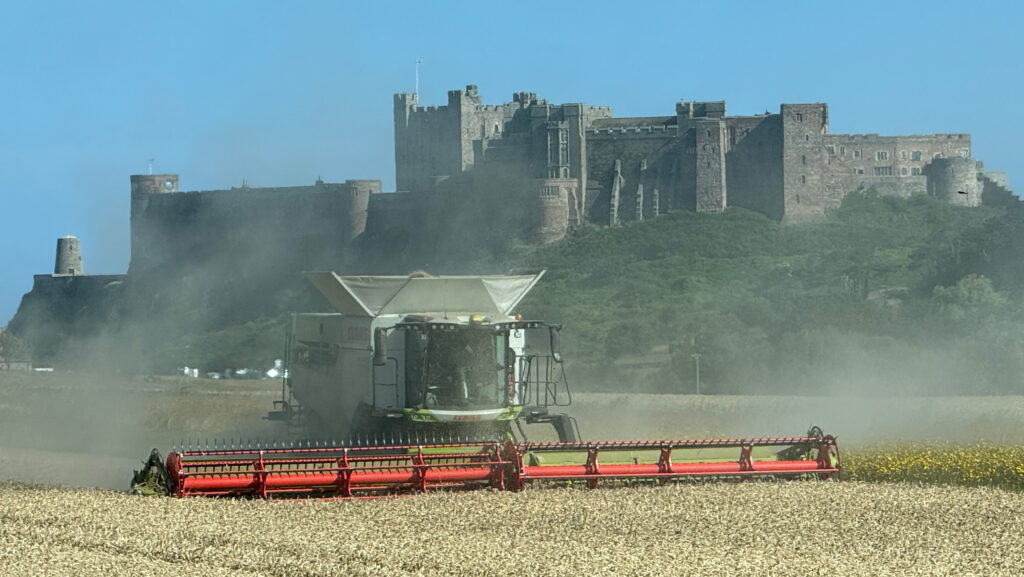
Bamford wheat being cut at Greenhill Farm, Bamburgh, Northumberland. Image submitted by Frankie Armstrong
However, his 35ha of Graham winter wheat yielded just 4.8t/ha. Chris attributes this to a wet winter causing compaction, delayed fertiliser applications and drought impacting an already poorly established crop.
Harvest was complete by the end of July, with oilseed rape arriving in store much earlier than usual.
“Usually by late July we’d have 1,000t of oilseed rape in store, with the rest yet to come in. This year by late July, we had 4,000t in store with very little left to come.”