Harvest Highlights: Crops suffer in East and 2am wheat harvest
Harvest is proving a very mixed affair. Some farmers are reasonably happy with both yields and quality, and others think it will be a year to forget.
See also: 5 top tips on getting the most from slurry on stubble
Crops suffer in Essex
In Essex, James Wombwell is very much in the latter camp. “Everything in this area is suffering,” he says. “We can’t do this job without water.”
Two years ago, he hadn’t even started his oilseed rape at Rectory Farm, Ickleton – now he’s got just 222ha of wheat left to cut.
“Anything after root crops has struggled – the worst wheat I’ve heard is 4t/ha.”
His own SY Cheer has ranged from 5.5t/ha after sugar beet up to a highlight of 10.2t/ha – but the average will be around 7t/ha.
Beowulf, drilled in December, is currently running at 6.1t/ha.
“My father said 1976 was the worst year ever – this is going to be a close second,” he adds. “But in 1976 prices doubled – and we’re not seeing that.”
Oilseed rape ranged from 2.8t/ha to 4.4/ha and will have averaged 4t/ha. “There will be a lot of farms going bankrupt this year.”
2am wheat harvest in Warwickshire
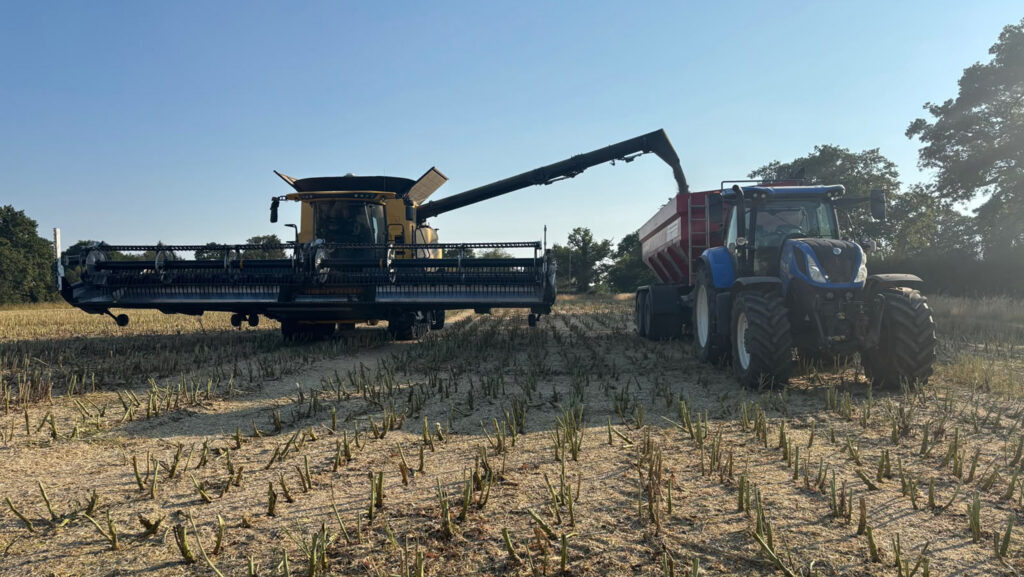
It’s a different picture for Frans Hamman in Warwickshire, where harvest is going well, but with some unusual combining hours.
© Frans Hamman
Skyfall wheat has been coming off at 11-12% moisture, regardless of the time of cutting.
Frans started cutting crops late at night and into the early hours to get more moisture into the crop and reduce fire risk, only to find the wheat was actually drier at 2am than earlier that day.
Yields are slightly below average at 8t/ha, but quality is excellent at 83.5kg/hl, 14% protein and 380 Hagberg.
Crusoe and Pinnacle oilseed rape came off at 6% moisture and averaged 3.8t/ha with an oil content of 41.5%, while Caravalle winter barley did 7.8t/ha at 10-11% moisture.
This year, Frans is trialling a new service with R Adams & Sons haulage – it’s delivering trailers to the farm, which Frans is moving around with a dolly and loading directly in the field.
“It’s been working really well and there’s a huge time saving,” he says. Out of 440t, just 40t had to be tipped at the farm – the rest has been moved straight to the grain store.
“We’ve been loading 50-60t/hour – and if I had more combines it would all be the in shed already. Even the beans will be in by the weekend.”
Starting on the Wildfarmed wheat in Wiltshire
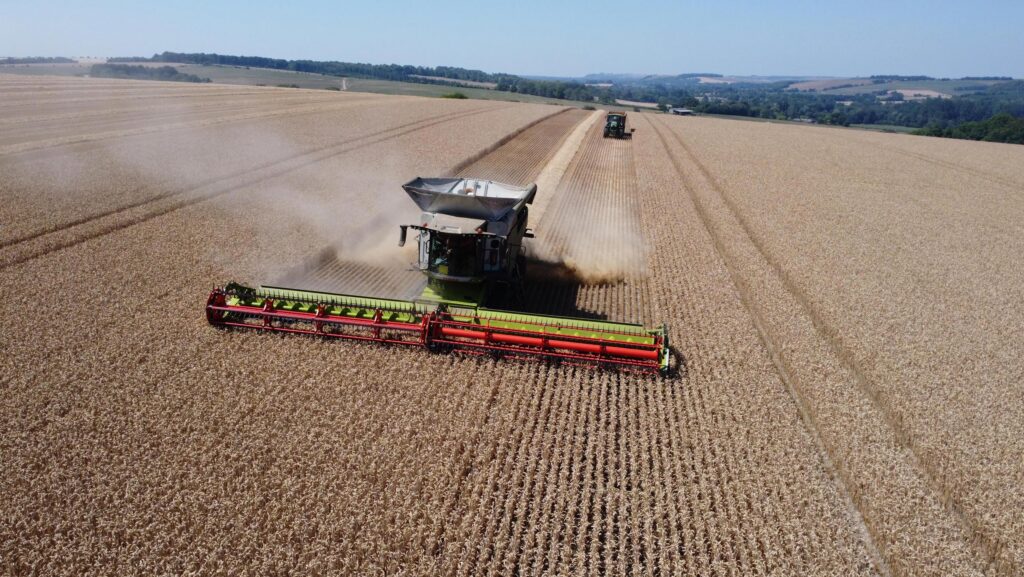
In Wiltshire, Josh Stratton’s harvest near Codford St Mary is progressing. He has finished winter barley, most of the oilseed rape and made a start on wheat.
© Josh Stratton
The 65ha of milling wheat has been grown for Wildfarmed without fungicide or insecticide.
“It has done a very respectable 7t/ha, and is really good milling quality, so I’m very happy about that,” says Josh.
It has achieved 13.5% protein and 77kg/hl specific weight. “It’s our first year growing for Wildfarmed and it’s been very successful.”
His remaining 400ha of feed wheat is a blend of Beowulf, Scope and Dawsum.
However, the 150ha of Armada oilseed rape was variable, says Josh. “Where it was good, it was doing 4.5-5t/ha, and where it wasn’t, it was 3-3.25t/ha.
“It was 46% oil, so overall we’re happy with that.”
The 280ha of Craft winter barley for Molson Coors averaged 9t/ha. “We’re very pleased with it, and it was very dry at 10-11% moisture,” he says.
The quality was also good, with nitrogen at 1.5-1.7%, 68-70kg/hl specific weight and screenings at 4%.
Next will be 5ha of peas to finish off the 45ha of Marfona, which has achieved 3.7-4t/ha so far.
Then it’ll be 200ha of Laureate spring barley, and 200ha of Mascani oats to come.
Nearly halfway in Nottinghamshire
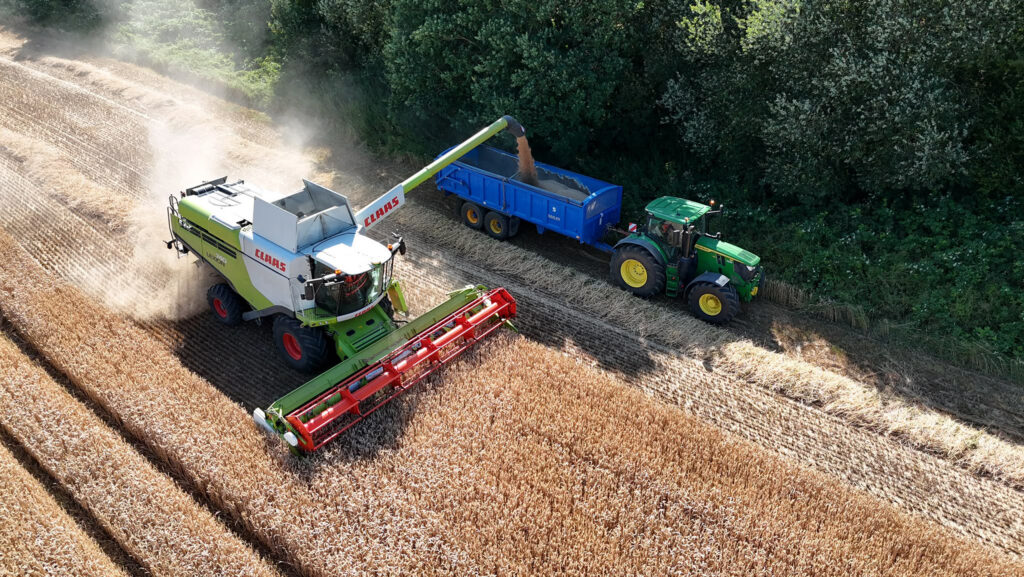
Further north, Michael Hardstaff has cut nearly 200ha of Arnie, Beowulf and Champion wheat on his sandy land at Hall Farm, near Linby, Nottinghamshire, out of a total of 485ha. Averaging 6.8-7.9t/ha, it came off at below 14.5% moisture.
© Michael Hardstaff
“The sandy land comes early, and I am slightly disappointed with the yields because it looked really good six weeks ago,” says Michael.
“That said, it is going well because it’s dry; it’s easy and it’s threshing well, it’s just a disappointing yield.”
The 60ha of Planet spring barley is nearly ready to go on the sandy soil, and wheat on the heavy soil is imminent.
“The spring barley is not looking hugely exciting, but it’s not too bad, as long as we catch it at the right time.”