Winter barley below par in Northern Ireland and Scotland
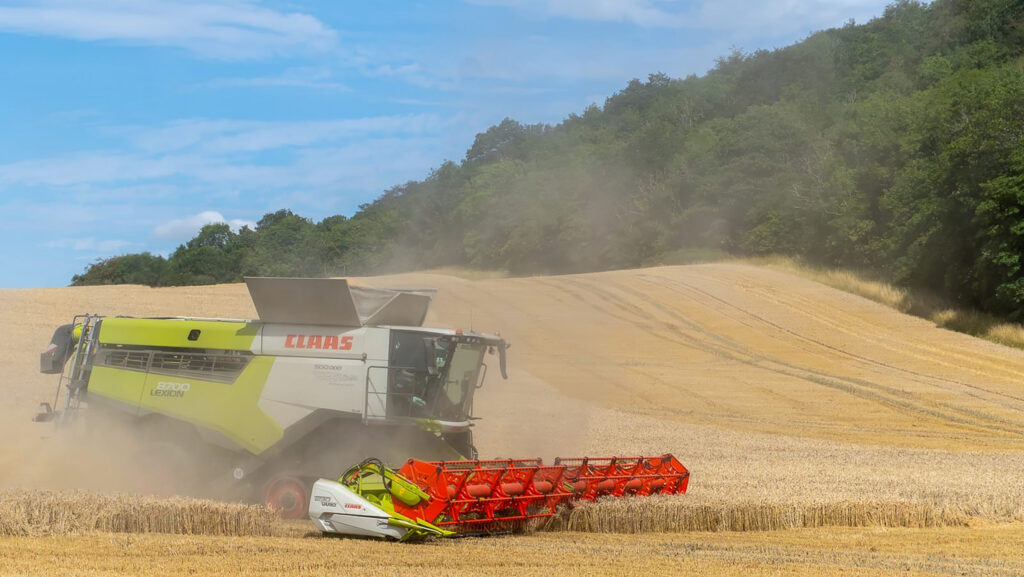 Harvest at Leckerstone Farm, Dumferline © John Hutcheson
 Winter barley yields have continued to disappoint as harvest moves further north into Northern Ireland and Scotland.
However, there is hope that wheat will deliver better results.
See also: Did drought or heat have greater effect on crop yields this harvest?
Herefordshire
“It’s been the joint worst harvest in 45 years,” says Jamie Rogers at White Hall Farm, Hampton Bishop, with all yields down.
“Everything was looking great until the end of May, but unfortunately the weather just cooked it.”
The 150ha of winter wheat (including Graham) averaged 7.2t/ha at 11% moisture, while 4ha of Laureate spring barley (planted to replace wheat lost to flooding) did 4.7t/ha.
“Harvest was finished within three days in mid-July, when normally it wouldn’t have started until the end of July.”
Straw yields were better than last year, but still 20% below normal, says Jamie.
“We’ve yet to turn a wheel planting anything, as the ground is too dry and hard. We’re not planning to change much in terms of our cropping, but we are building in resilience with specialist break crops.”
East Yorkshire
Across in the North East, Guy Shelby has had a good – if relentless – harvest at Benningholme Grange near Beverley, Yorkshire.
“It’s been so dry, many of us around here have been on edge because of fires. Everyone just wants to get done now and put the kit in the shed,” he says.
“Our vining peas, which were cut quite early in July, yielded 6.5t/ha.”
The 100ha of oilseed rape crop (a conventional/hybrid mix) averaged around 5t/ha, with 7-7.5% moisture content and 44-46% oil content.
The 260ha of Vibe, Cheer, Graham, Bamford and Hexton winter wheat (mostly grown as a second wheat) averaged 10t/ha.
“Results were not as good as we would have liked; we have patches of light land which has bought the yield down a bit,” he says.
“Specific weights were 76-82kg/hl, with Cheer standing out at 12.5% protein.”
The 52ha of spring barley averaged 7.5t/ha. Guy grew Hurler for feed alongside Skyway and Ptarmigan malting barleys, both meeting spec, with Ptarmigan yielding 9.6t/ha.
With just his Daytona seed pea crop to finish and potatoes to come in September, this is an early finish for Guy, who would ordinarily only be starting harvest now.
“I think we’ve fared better up here than a lot of the country, and we haven’t had to dry anything which is making a big difference.”
Scotland
Further north in Fife, John Hutcheson is just over half way through his 930ha harvest at Leckerstone farm, Dunfermline.
“We are a week ahead of 2025, and we were a week ahead of 2024 then, so harvest is definitely earlier than usual,” he says.
Winter barley, oilseed rape and approximately half of the winter wheat is in the barn, and with heavy to medium soils, and rain at the right times, John feels fortunate.
“Winter wheat has performed well, averaging 9.5-10t/ha and coming in dry.
“Cutting below 16% moisture used to be abnormal for us, but this year we’ve been cutting at around 14-15%,” he says.
“Our Crome oilseed rape has been the star this year. Moisture levels were around 11% so it needed some drying.”
And with yields of 4.3-4.4t/ha, John is happy.
But the Caravelle, Tardis and Funky winter barley was below par at around 7.9t/ha.
Looking ahead, John expects to complete harvest this month.
“The wet spring helped to get spring crops going and I think we’re on track for average yields for our spring oats and barley.
“But the thing that’s stood out to me is the commitment of my team and other farmers around the country.
The sheer hard work takes a special kind of person, and credit is due to all involved.”
Londonderry
Across the Irish Sea, harvest is just getting started for Robert Moore at Molenan Estate, Londonderry.
“We’ve had a reasonably dry year here and so far yields have been a little disappointing,” he says.
“However, the straw is baling well and the market is good, which helps.”
Having cut 30ha of Caravelle, Belfry and Tardis winter barley, he has been disappointed with yields, at around 6t/ha – normally he would expect 7.4t/ha.
Still to meet the combine are 35ha of winter wheat, 24ha of spring barley, 12ha of oilseed rape and nearly 10ha of beans.
“The winter wheat is looking well; it has decent heads on it and grains are filling. We won’t be harvesting that for another 10 days,” he says.
But the oilseed rape is imminent. “It doesn’t tend to do brilliantly here, usually around 3.7t/ha, but as we had a wet winter and the field is quite low-lying I’d expect we will only get around 2.5t/ha.”
The spring barley has suffered from the dry season, he adds.
“The crop is looking quite short and the heads are small, so it’s not anything special.”
However, the beans are looking promising. “This year’s crop is looking fabulous.
“They won’t be harvested until early October though, so there’s a little time to go on them.”