Inputs Price Monitor reveals how much farmers pay
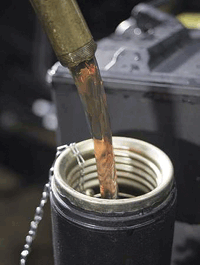
Over 200 farmers from around the country have so far taken part in the Farmers Weekly/NFU Inputs Price Monitor, giving an accurate picture of how much they are paying for a wide range of farm inputs.
| The Inputs Price Monitor is live at all times and open to all farmers. The more who take part each month, the better the data we can generate. So please log on now and play your part. |
Results so far show that, despite the steady rise in oil prices since the start of the year, with the market now topping $70/barrel for Brent crude, this has not yet been passed on to farmers at the pump.
“National average prices for red diesel have been sitting between 39p/litre and 42p/litre for most of the year and this month’s average of 40.81p/litre is very much in keeping with that,” said NFU farm inputs adviser Hannah Moule.
There was only limited regional variation, with the highest red diesel prices – about 42p/litre – being found in Scotland, Northern Ireland and Wales and the lowest prices – about 39p/litre – recorded in the East and West Midlands.
“With the way crude oil prices are going, and the way petrol and diesel have gone up on garage forecourts, we may well see some upturn in red diesel prices as the summer progresses, though farmers would do well to negotiate with their suppliers,” said Miss Moule.
Similar advice is also given in the fertiliser business, with the IPM results revealing a wider range of prices.
GrowHow and Yara opened the season at the start of last month with a recommended retail price for ammonium nitrate of £175/tonne. The actual price paid by farmers has come out at £177/tonne, suggesting merchants have been taking some extra margin.
But while there is little regional variation in the results, the range of price quotes nationally was wide at £170 to £180/tonne, suggesting there may still be room to negotiate.
There was also a significant price gap between those buying less than 20t of fertiliser and those buying larger volumes.
“There was a very good entry for UK AN, suggesting that GrowHow’s lower starting price has stimulated buying,” said Miss Moule.
The IPM results also give a good idea of how much farmers are paying for electricity – one of the hardest things to monitor due to lack of transparency.
The overall average price for peak usage was 10.82p/kWh. But the ranges were huge. For example, in East Anglia the lowest peak price reported was 7.32p/kWh and the highest was 21.13, averaging 13.03p/kWh. The averages regionally varied between 9.2p/kWh in the South East and 13.32p/kWh in the North West.
The Inputs Price Monitor is live at all times and open to all farmers. The more who take part each month, the better the data we can generate. So please log on now and play your part.

For a comment on this story, see Phil Clarke’s Business Blog