Trials reveal best ways to maximise cover crop benefits
 © GNP
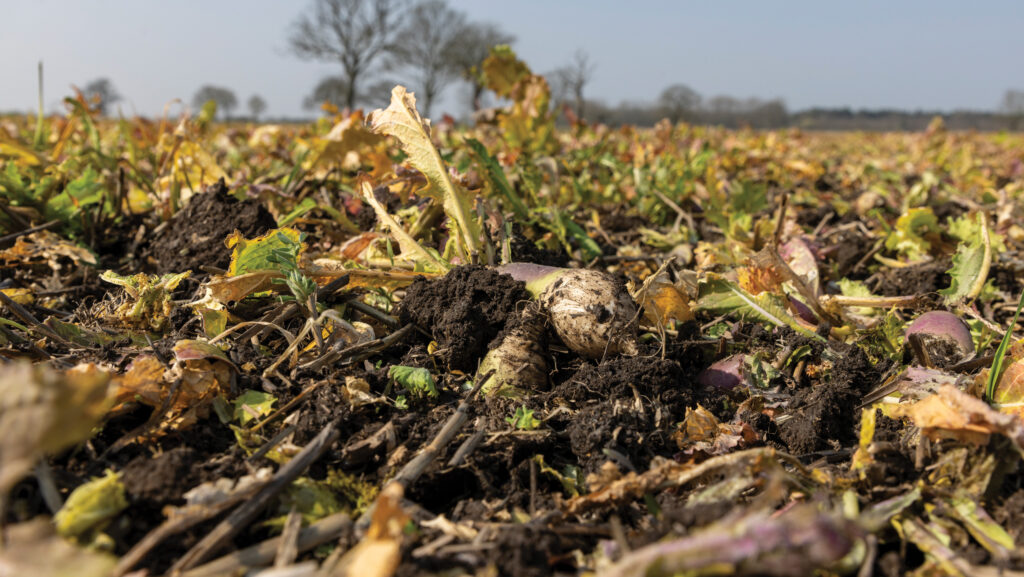
© GNP Opting for a chemical method cover crop destruction and at a later timing are key to getting the most out of cover crops, according to a series of three trials.
Data also show that reductions in N fertiliser inputs are possible in the following crop, as it utilises nitrogen that would otherwise have been leached from soils.
Cover crops offer several well proven benefits such as erosion control and reduced nitrate leaching losses.
See also: Why N cut could be bad for cover crop growth and soil health
However, much less is known about how they affect N supply to the following crop. For example, how much N is available and can this N be lost before its available for the following crop?
To find out, Adas principal soil scientist Ann Boghal carried out a series of on-farm trials.
Destruction technique
The first trial looked at destruction technique, comparing a mechanical approach (roll on frost, chop and incorporate) with a chemical (glyphosate) approach.
It found that mechanical destruction led to an increased weed burden. In conclusion, growing a cover crop led to a yield increase in the following spring oats, but only when destroyed chemically.
The second trial focused on one farmer in Hertfordshire and his cover crop mix ahead of spring oats being drilled in spring 2024.
This time, Ann looked at the timing of the two destruction methods (18 January versus 28 February), along with two different nitrogen fertiliser rates – standard farm practice (145kg/ha) and a reduced rate (30kg/ha less) – to see if there was any scope to cut back rates without adversely affecting yields.
Early destruction increased the risk of nitrate leaching before the spring oat crops established.
Sampling showed that by mid-March, nitrate levels in drainage from the early destruction cover crop was higher than in the untreated stubble.
The highest soil mineral nitrogen was seen with the cover crop destroyed chemically which resulted in the highest yields, suggesting more nitrogen was available to the following crop.
In conclusion, she says reductions (at least 30kg/ha) in N fertiliser are possible following cover crops, without impacting yields.
Cost analysis
A cost analysis benefit showed the increase in crop yield and the reduction in fertiliser use completely covered the extra cost of growing a cover crop when destroyed chemically at the later timing (£573/ha net margin versus £584/ha).
Claiming the Sustainable Farming Incentive option for cover crops led to a greater increase in net margin, taking it to £713/ha.
In the third trial, Ann dropped mechanical destruction as it did not stack up and added legumes to the cover crop mix to see if this would allow greater reductions in fertiliser inputs.
The cover crop recovered 45-50kg/ha of additional N compared to the overwintered stubble. Inclusion of legumes increased N in the biomass by up to 35kg/ha.
This suggests significant legume growth and nitrogen fixation occurred between January and
February 2025. “We got a stonking amount of nitrogen [140kg/ha] of soil mineral nitrogen plus above ground biomass.”
Ann had high hopes of seeing yield benefits, but unlike trials one and two, there were no differences in yield.
She puts it down to the season with such a dry spring and summer where the cover crop sucked up any soil moisture.
The current thinking is that the oats did not get hold of it, she says.
Work is ongoing this season, with the fourth trial looking at soil health and structure, as well as nitrogen.
All these trials were funded by Affinity Water. Trial one also had additional funding from Portsmouth Water.
Trial key findings
- Cover crops reduce nitrogen losses over winter
- Mechanical destruction can lead to yield penalties
- Early termination increases leaching risk
- Cover crops can increase yields in following crops, but not always
- Reductions in N fertiliser are possible following cover crops
- Cost of cover crops are compensated for, by increase in yield and lower fertiliser costs
Companion crops following vining peas
Companion crops are more effective at reducing nitrate leaching losses than catch crops after a crop of vining peas, according to new research.
In certain seasons, this extra retained nitrogen increases yields in a following crop of winter wheat.
Vining peas leave behind high amounts of residual soil mineral nitrogen after harvest, equating to about 100kg of N/ha.
Adas senior soil scientist Dr Kate Smith points out, on light free draining land, this nitrogen is at risk of being leached from soils.
Anglian Water has been concerned for some time about high leaching losses in North Lincolnshire, where there are light soils over chalk flints and vining peas tend to be grown.
Previous work from Adas and Birds Eye showed that a catch crop established after peas, and destroyed ahead of winter wheat drilling, can reduce nitrate leaching losses by 45-65%.
However, could retaining a catch crop for longer – so it effectively becomes a companion crop to the following winter wheat crop – deliver greater benefits?
First demonstration
To compare the two approaches, a tramline demonstration was carried out on sandy loam soils in North Lincolnshire over the 2020-21 season, with funding from Anglian Water.
The vining peas were harvested on 1 July, and a ground cover drilled on 7 August.
Kate says the only difference between treatments was the destruction date for the cover crop of buckwheat, linseed, phacelia, sunflower, crimson clover and red clover.
The catch crop was destroyed on 1 October, and wheat drilled on 8 October.
For the companion, wheat was drilled into the cover. The companion was sprayed off with a post-emergence herbicide the following March/April.
Results showed that the companion crop held onto nitrogen better than the catch crop, resulting in lower leaching losses than both the untreated stubble and the catch crop.
“About 120kg/ha of nitrogen was lost with the stubble and catch crop, while the companion crop lost half that,” says Kate, who believes the catch crop was decaying over winter with the captured nitrogen subsequently leached.
So what would be the impact on winter wheat yields in the following year and can farmers reduce N fertiliser inputs where the N has been retained?
To test this, two rates of nitrogen were applied the following spring – the farm standard (280kg/ha) and a reduced rate (85kg/ha less).
Kate says there was no effect of catch crop versus companion crop on yields. However, reducing the N fertiliser rate resulted in lower yields (10t/ha versus 11.2t/ha).
Second demonstration
In the second demonstration, over 2023-24, a simplified mix was used – as some species such as sunflowers had failed to establish.
For the control, soil analysis showed there was a large amount of residual nitrogen (180kg/ha) sitting in the soil over chalk.
Kate says it was a high leaching risk year, with record levels of rainfall in the autumn and the following spring.
Leaching losses were highest on the stubble (over 50kg/ha). The lowest was for the companion crop (25kg/ha), and the catch crop was in between (30kg/ha).
Again, Kate looked at two different fertiliser rates (200kg/ha versus 115kg/ha) and this time saw differences in yield. Reducing N fertiliser led to a 0.7t/ha reduction in yield.
Across both nitrogen rates, the companion crop increased yields by 0.64t/ha over stubbles and 0.52t/ha more than the catch crop.
In conclusion, looking at both seasons, the companion crop was more effective at reducing nitrate leaching losses. However, the impact on yields differed between the seasons.
Kate points out that after the wet autumn of 2023, crops were generally hungry for nitrogen in spring 2024.
She believes that the companion crop held onto the nitrogen for longer than the catch crop and, therefore, helped to make N available to the growing winter wheat crop later in the growing season.
However, she stresses that further work is needed before any recommendations can be made.
Research is needed to identify the optimum companion crop mix and determine the amount of nitrogen that is available to the following crop.
In summary
- Companion crops are more effective at reducing nitrate losses than catch crops
- The impact on following wheat yields differed
- The results are based on work carried out at a demonstration site
- Adas principal soil scientist Ann Boghal and Adas senior soil scientist Dr Kate Smith were speaking at the Roots to Regenerative Agriculture conference organised by the Association of Applied Biologists and held in York