New direct drill opener gently cracks calcite layer
 © MAG/Richard Allison
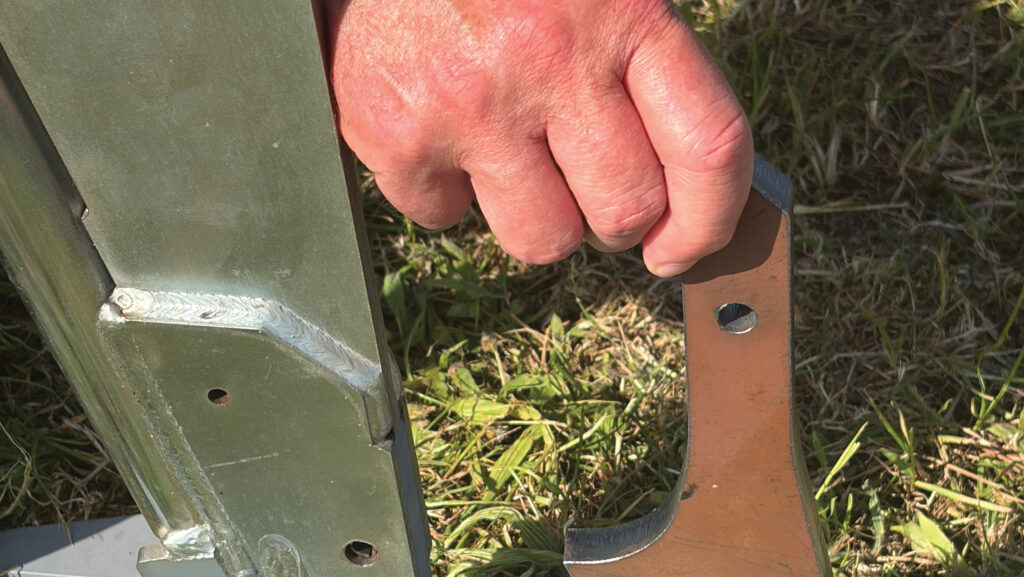
 A cultivations expert has designed a new low-disturbance direct drill opener that gently cracks the calcite layer, found in some high-calcium soils, that can hinder rooting.
At last year’s open day, independent soil consultant David Purdy highlighted a problem that is increasingly being seen in certain high-calcium soils.
The heavy, silty clay soils at the Lamport site are high in calcium which, when the soil is dry, forms very tight bonds between the clay platelets.
In dry seasons, a hard calcite plate forms at a depth down to 8-10cm. These layers can create physical barriers to establishment, root penetration, air passage and infiltration, limiting the depth and extent of root growth.
See also: How trial is cracking calcite problem in high-calcium soils
Over the past year, independent cultivations expert Philip Wright has been refining the approach to tackle this layer when drilling cover crops.
He explains that tackling it at this stage means that any blackgrass emerging as a result of moving soil can be taken out before drilling the commercial crop the following spring with as little soil disturbance as possible.
Last season, Philip had seen some success cracking the calcite layer with low-disturbance legs, alongside managing slightly deeper trafficking compaction (Meir Soil Conditioner).
However, where the surface compaction was 8cm or less in depth, he found that he was not able to control the depth precisely enough – it was too deep on the ridges and not deep enough in the hollows.
Tom Land © MAG/Richard Allison
This is where Tom Land at Landwrx comes in. Tom, who founded the agricultural engineering business near Herefordshire, has developed a parallelogram linkage system on his custom-built direct drills and inter-row seeders, which are specifically designed to cultivate to a consistent depth.
Philip designed the opener, which was fitted to a Landwrx drill. It is designed to place the seed and gently cultivate below this, with a wing lifting and cracking the calcite plate to help rooting. The cracking is gentle enough to affect the seeding zone only.
This allows beneficial soil biota, including fungi, to be unaffected in the soil structure between the rows, enabling this to recolonise across as the cover establishes. “All we are trying to achieve is vertically cracked zones and not over cultivate.”
Last summer, the Landwrx drill with the prototype openers was used to establish cover crops (black oat, phacelia, linseed, buckwheat, vetch, berseem clover) on 18 August 2025 in System 4 (spring-sown wheat after an autumn cover crop) in the main systems work at Lamport.
Philip says initial observations show good establishment of the following commercial wheat crop with good rooting and effective blackgrass control. In addition, the beneficial effects of many years of direct drilling crops are maintained.