

When should regenerative growers cultivate?
 © Tim Scrivener
 Minimal, or in many cases zero tillage, is a core, often non-negotiable tenet of regenerative farming practices. But growers shouldn’t be overly concerned about using occasional strategic cultivation, according to soils and cultivation consultant Philip Wright.
A meta-analysis by Dr Yash Dang, principal research fellow at the University of Queensland, of research papers investigating the impact of occasional strategic tillage from across the world found that negative effects on parameters such as plant available water, nutrient availability, soil-borne diseases and carbon, were short-lived, Philip says.
See also: New direct drill opener gently cracks calcite layer
“Recovery from any negative effects was generally six months or less, with recovery times depending on how long the soil had been in a regenerative system.
“The longer it had been, the quicker the recovery,” he says.
Occasional strategic tillage in the UK can effectively resolve virtually all common issues encountered in no-till systems, Philip says, including many weed and pest control challenges, compaction and poor water infiltration.
To cultivate or not
Use indicators to help determine whether cultivation is required, he advises.
“For example, the roots of the crop that you just harvested or are about to harvest are an indicator. If they are struggling to get through a zone, it’s probably telling you something is needed.”
Cover crop growth is another potential indicator, Niab’s Dr Elizabeth Stockdale says. “We often think about making the soil fit before we establish cover crops, but that’s the wrong way round. It can be too late to put in a cover crop if you spend time cultivating before drilling.
“So drill the cover crop as timely as possible and use it as your sensing crop. If there are areas that don’t establish, you can investigate and still have time to act before the cash crop,” she says.
“And it’s good as you’re unlikely to ever need to take remedial action on the whole field.”
Growers could also use yield maps or visual evaluations of soil structure (VESS) to find areas that need further investigation, Philip adds, typically by taking a spade into the field.
“These simple indicators will give you a steer on whether you need to do anything.
“If the current roots are growing unrestricted and yields are not particularly affected, then leave it alone, particularly in a dry year when there can be some natural restructuring in your soils.”
Before digging a hole, walk the field, Elizabeth adds. “If you have ponding, try to understand where it is coming from. Is it moving from other parts of the field? That will help you decide where to dig.”
Effective drainage is fundamental, Philip notes. “Use all the indicators that you can to determine if there is a barrier [to water movement], and if there is, address that first to get effective drainage.”
What cultivations
Where tillage is deemed necessary, the goal is to use the least amount of disturbance. Aim to lift and stretch soil rather than turning it over, Philip says. He also advises adopting “functional zone management” by differentiating between areas that need soil movement to those that don’t.
“For example, where the legs of a cultivator go, you have what you might call an active turnover zone that facilitates drainage, root pathways and nutrient passage.”
But in between the legs, it’s equally important to have a zone where soil is not disturbed to any great degree, which supports both future machinery traffic, while also protecting soil biology, such as mycorrhizal fungi and earthworms, which are often compromised by intensive soil movement.
“Every time you put a leg through, you will compromise soil biology, so don’t be worried if you haven’t moved some soil zones to the same extent.
“It’s positive, if there is a zone in the middle that you can feel is firmer than where the legs have gone through. If you dig both where the legs have and haven’t gone, and don’t feel any difference, you’re probably wasting your time.”
Checking the effectiveness of a cultivation after the first run is a good, if relatively rare, practice, Elizabeth notes.
“That’s a great time to assess whether the cultivation is doing what you want it to do at the depth you want. It’s better to decide then that you’re making more of a mess than after you’ve finished,” she concludes.
Case Study: Simon Cowell, St Motts Farm, Essex
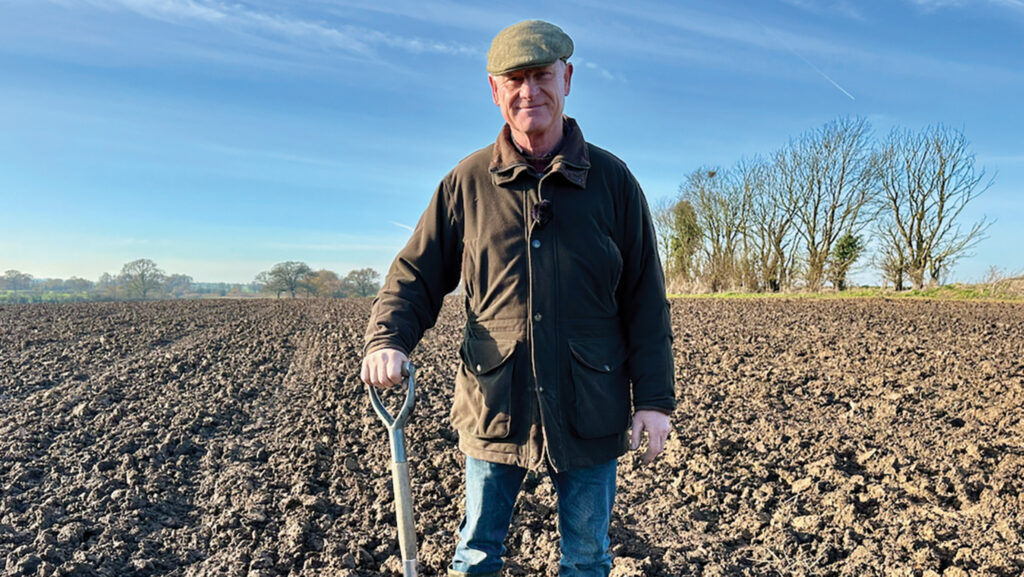
Simon Cowell in a ploughed field © Mike Abram
Two years of trials in which Essex farmer Simon Cowell has ploughed a section of a field that had been a direct drill system for more than 20 years have highlighted that an occasional tillage pass is beneficial.
Simon embarked on the trials after finding his wheat yields plateauing despite the many benefits from direct-drilling his heavy clay soils, which include lower costs from reduced labour requirements, a smaller tractor, fewer new tyres and lower fuel bills.
“But the best thing for me was consistent and even germination of crops, which I wasn’t achieving in trying to make seed-beds on heavy clay soil that was either too wet or too dry.”
He explains when he immediately started direct-drilling, he was investing far less money in growing the crops, had less capital tied up, which means when things do go wrong, there’s less risk.
Yield plateau
But over the years he had noticed a plateau in field yields, which he partially puts down to tying up nutrients.
“If you’re sequestering 1t/ha/yr of carbon, at a carbon: nitrogen ratio of 10:1, that’s 100 kg/ha of nitrogen, which otherwise would be available to the crop.
“While you might get a little more nitrogen fixation from increased soil biology, there’s almost a case for applying more nitrogen in this system as you’re growing two crops – the cash crop and your carbon crop.”
He also thinks not mixing soil leading to chemical residues, such as herbicides, and auto toxic compounds produced by plants accumulating in the topsoil, which potentially affect crop performance.
“I have an Adopt grant to investigate this further,” he says.
To test whether cultivation would alleviate these problems, he embarked on a trial where he ploughed one-third of a field going into wheat (see Farmers Weekly, 23 Jan 2025 and 17 Sep 2025), which showed a 1.7t/ha increase in yield for the ploughed section.
That trial has been continued this season, with another third of the field ploughed, leaving a three blocks: wheat drilled after ploughing, wheat direct-drilled in the section ploughed two seasons ago, and his continuous direct-drilled block.
Benefits in year 2
This harvest’s yields have shown a continued benefit from ploughing, with the second year after ploughing yielding 8.1t/ha, compared with 7.6t/ha from first year ploughing and 7.1t/ha from 22 years no-till.
“The first year ploughed seemed to be showing a bit more stress in April and May before a few light showers perked it up,” Simon comments.
Figures taken from Nix’s Farm Management Pocket Book, suggest his plough- and power harrow-based system costs about £275/ha, while a 2.7 t/ha total yield increase over two years at current wheat prices is worth £486/ha.
“I’m pleased there was an ongoing benefit from the ploughing in year two – that makes it more worthwhile.”
Even so, it’s not an easy decision to plough more area, he says. The benefit from first year ploughing was less this season, while a second trial last year where he ploughed before linseed yielded less than the direct-drilled comparison.
Increasing the area of ploughing would mean a higher labour requirement or using contractors, cutting into the potential profit margin, he says.
“If the Adopt project helps solve some of the challenges [with direct-drilling and plateauing yields] without too much extra work that would be great. On our soil type, direct-drilling is still the right system overall.”
Content for this article was taken from the Groundswell 2026 session “Cultivating a strategy – matching cultivations to soil needs for regenerative agriculture”
Staying sharp shouldn't be a chore
Explore more / Transition
During the series we follow our group of 16 Transition Farmers through the challenges and opportunities as they seek to improve their farm businesses.
Transition is an independent editorial initiative supported by our UK-wide network of partners, who have made it possible to bring you this series.
Visit the Transition content hub to find out more.
