Why mixed farming could help future-proof arable farms
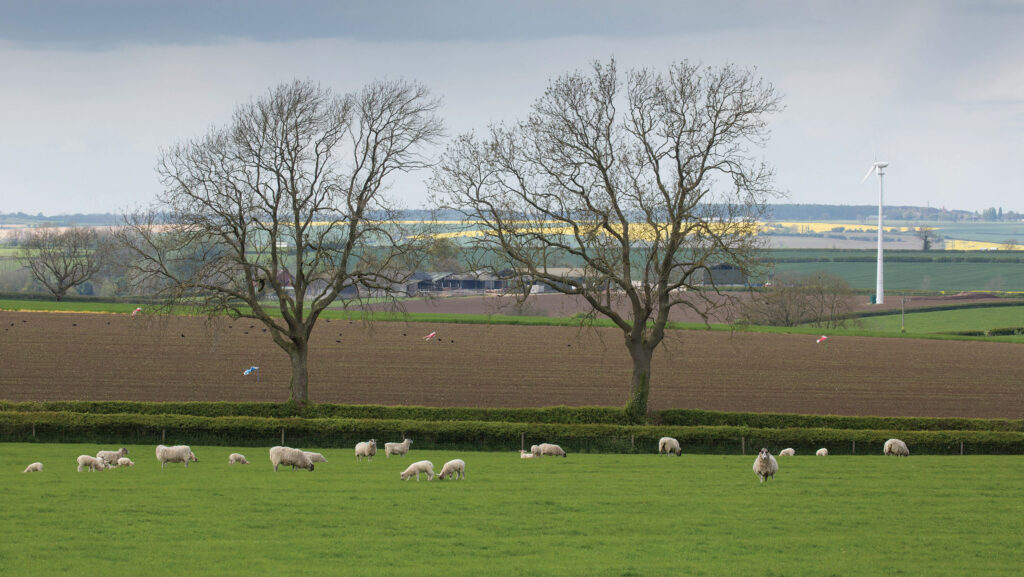 © Tim Scrivener
Sky-high input prices, combined with unpredictable weather and depressed markets make arable farming particularly precarious.
Yet the answers to sustainable cropping do not need to be overly complex.
Perhaps it is time growers got back to basics and implement traditional mixed farming methods, rather than relying on bigger machines and more land to make finances stack-up.
See also: Cambs grower quits sugar beet as no longer worth the gamble
Growers are constantly looking for lower-cost input systems to spread business risk, but resilience and robustness must be integrated on farm for businesses to thrive in the long term.
Many problems facing arable farmers can be remedied by integrating livestock and building diversity into the rotation – whether it’s herbal leys reducing weed burden or organic manures cutting fertiliser spend.
The building blocks of farming
“Over the past 70 years, half of all soil organic carbon has been lost from arable soils,” notes Ian Wilkinson, co-founder of the FarmED education centre and Cotswold Seeds managing director.
“We need more mixed farming systems to rebuild this structure.
“The answers are right under our noses; we just need to apply common sense to get our agricultural systems working again,” he says.
Ian notes that the basic building blocks of farming remain unchanged:
- Good-quality soil
- Sufficient soil carbon levels to grow healthy crops
- Diversity and resilience in the system
- Integration of livestock and/or organic manures
- Inclusion of legumes in the rotation
- Timeliness of operations
“After all, without diversity – both in terms of rotations and income streams – the system will likely fail,” he says.
Legumes v nitrogen fertiliser
Before the mass introduction of artificial fertilisers in the 1940s, legumes proved an effective and natural way to build soil fertility, whether grown as cash crops or as forage for animals.
Ian highlights that 100 years ago, one in every seven fields in the Cotswolds was sainfoin – a drought-tolerant legume that provided vital feed for livestock and excellent soil fertility.
A typical rotation in the Cotswolds at that time would have also included wheat, barley, beans and flax.
However, much of this traditional knowledge on legumes was lost with the arrival of artificial fertilisers.
“We must break our dependence on synthetic nitrogen fertiliser and focus on soil biology.
“The information is out there in old farming books, research papers and historic studies. We just need to look for it,” says Ian.
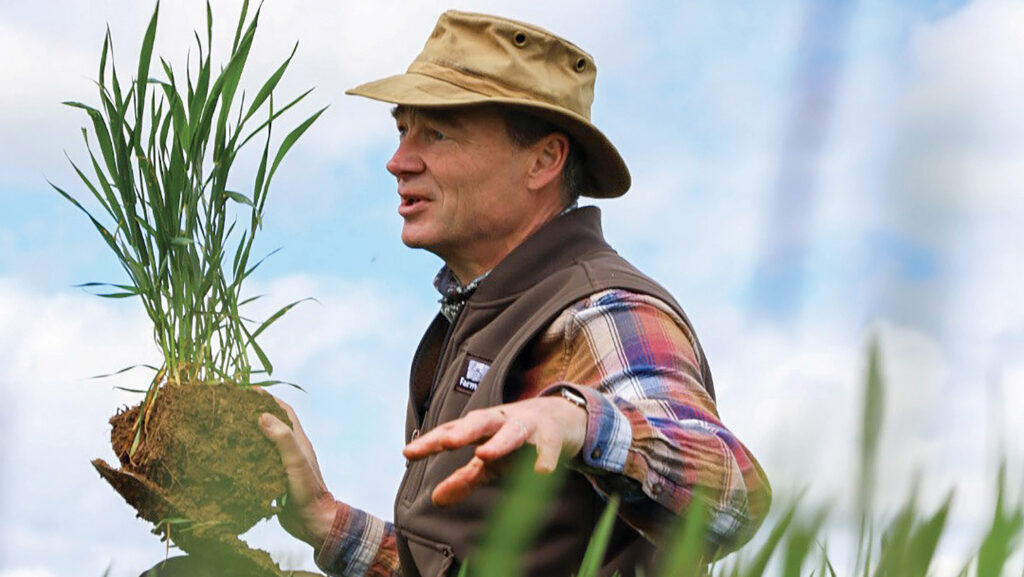
Ian Wilkinson © FarmED
Dry springs and cropping challenges
One of the major downsides to growing spring-sown legumes such as peas and beans is the recent lack of spring rainfall, which hampered establishment and made many crops unviable.
“This year, we counted rain in millimetres rather than inches. From April to September, we had virtually no rain at all. Crops planted in May simply did not survive,” says Ian.
Together this depressed legume markets, a shortfall in agronomy knowledge and climate predictions pointing towards drier springs and summers, the appetite for spring planted pulses is not the strongest.
“In the same way Canadian farmers avoid winter crops due to their climate, parts of the UK – particularly southern and eastern England – may no longer be suitable to grow traditional spring crops,” says Ian.
Instead, deep-rooting perennial crops, such as sainfoin and lucerne, which managed to endure this summer’s dry conditions while shallow-rooted crops perished, could be integrated into rotations.
This can build soil fertility and fix nitrogen, while keeping crops growing, water cycling and carbon being sequestered, even in times of heat and drought.
Another alternative to spring-sown legumes is winter beans. The FarmED education centre and demo farm is replacing spring peas with winter beans as part of its trial work.
“Winter beans survive the winter well, establish strongly, and benefit the rotation, particularly when it comes to the following winter wheat crop” says Ian.
The farm aims to sell the beans as a premium food product in the farm’s on-site café, alongside its own heritage flour.
“We are focused on keeping farm produce on site as much as possible and shortening the supply chain,” says Ian.
A bottom-up food system
The idea of simply growing commodities to sell at world prices to large corporate food manufacturers, which strip out the nutrition to create processed food, is an unsustainable and unsatisfactory way to farm.
“We need a new and improved food system that is fit for purpose for the next 20 years.
“Farmers need to be ready to produce what is required for the future, led by a bottom-up movement,” reports Ian.
There is huge scope to create a better food system in the UK.
“We cannot ignore the destruction occurring in the wider food supply chain.
“We need farmers, growers, millers, bakers, and brewers all working together to get food right for the consumer,” he says.
“We want a true, authentic, transparent supply chain that delivers nutritional produce.”
Improving soil health
Soil health goes hand in hand with sustainable farming and producing nutritional food, but it is a long-term investment.
“We have been farming here at FarmED for 13 years and are only just beginning to see measurable soil improvements now,” Ian says.
Soil infiltration tests carried out at the end of September this year across a diversified rotation containing sainfoin, hemp, and winter wheat versus a continuous cereal crop highlighted a stark contrast in soil health.
A total of 100ml water was poured into steel tubes half buried in the soil, taking one minute in the diverse rotation plot and eight minutes in the cereal plot.
A project taking in place at FarmED in collaboration with the Centre for High Carbon Capture Crops at Niab is investigating the effects of different plant species on carbon capture.
They discovered more carbon is stored for longer periods and at greater depths where there is higher plant diversity – for example, through the use of herbal leys.
Call to government to support farmers and reduce reliance on N fertiliser
Environmental organisations including the Soil Association are calling on the government to provide support to farmers to reduce reliance on synthetic nitrogen fertiliser and encourage farmers to grow legumes and pulses and adopt nature-friendly farming practices.
Gareth Morgan, head of farming policy at the Soil Association, says: “Nitrogen is what mainly grows the food on our plates, but there are ways to get it naturally.
“More mixed farming with livestock, and planting peas, beans, legumes and clover to fix nitrogen in the soil, can go hand-in-hand.
Research cited in the Sustainable Nitrogen Alliance report points to profit gains of up to 45% in livestock systems and around 10% in arable and mixed systems where nature-friendly practices are used.
Soil Association celebrates 80 years
The Soil Association is celebrating its 80th anniversary year, and to mark the occasion the charity is spotlighting 80 “voices” from across the food and farming system.
Ian Wilkinson, director of Cotswold Seeds and FarmED, forms part of the campaign, helping reshape how food is produced and consumed.
The Soil Association was co-founded by Lady Eve Balfour in 1946 and has championed organic and nature-friendly practices for eight decades.
For more information, visit Celebrating 80 years of Soil Association.