On-farm biochar production a step closer to commercialisation
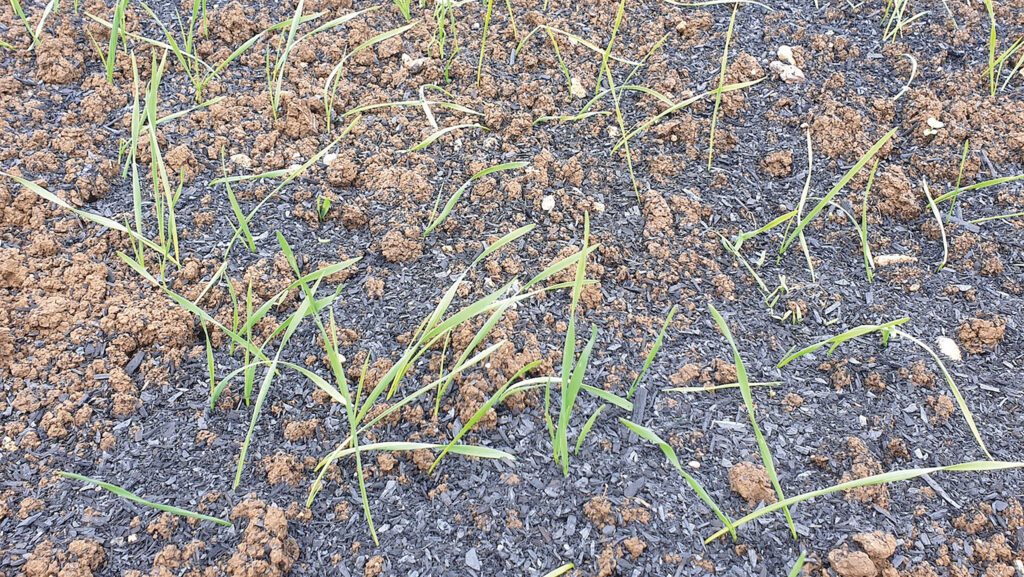 © CapChar
 On-farm biochar production is a step closer to commercialisation after a UK biochar specialist launched an integrated biochar and heat recovery system on a Hampshire farm.
Biochar is a charcoal-like residue containing 75-80% pure carbon. It is produced during a process known as pyrolysis where organic material is heated to temperatures of 300-700C in an oxygen-limited environment.
See also: 7 organically approved soil amendments to boost cropping systems
The carbon-rich product can be used as a beneficial soil amendment.
The new system brings together three elements that UK clean technology company CapChar has been developing: on-farm biochar production, thermal energy recovery and digital measurement of carbon removals.
The setup processes locally sourced woodchip into biochar while capturing the heat generated during pyrolysis for storage and later use, explains Adam Samuel, co-founder of CapChar.
About the Hampshire trial farm
The farm trialling the Biochar system is a livestock system located near Petersfield, Hampshire, which operates on 80ha in the South Downs National Park. The farm rears dairy replacements and has an 80 cow suckler herd.
The intention is for the biochar to be used as an under layer in cattle bedding to reduce ammonia emissions and improve cattle foot health.
The manure and biochar will then be spread on grassland to boost organic matter and improve water holding capacity.
The excess heat will be used to dry wood chip and logs for the solid fuel market. Other uses for the heat are being explored.
Pyrolysis produces substantial thermal energy, useful for a wider range of agricultural applications, including crop and biomass drying, space heating and other farm processes.
However, that energy is generated when the kiln is operating and for a farm the demand for heat may occur at a different time.
The new system is designed to address this mismatch with a patent-pending thermal battery.
Instead of requiring the heat to be used immediately, the system captures and stores the recovered energy so that it can be released when it is needed.
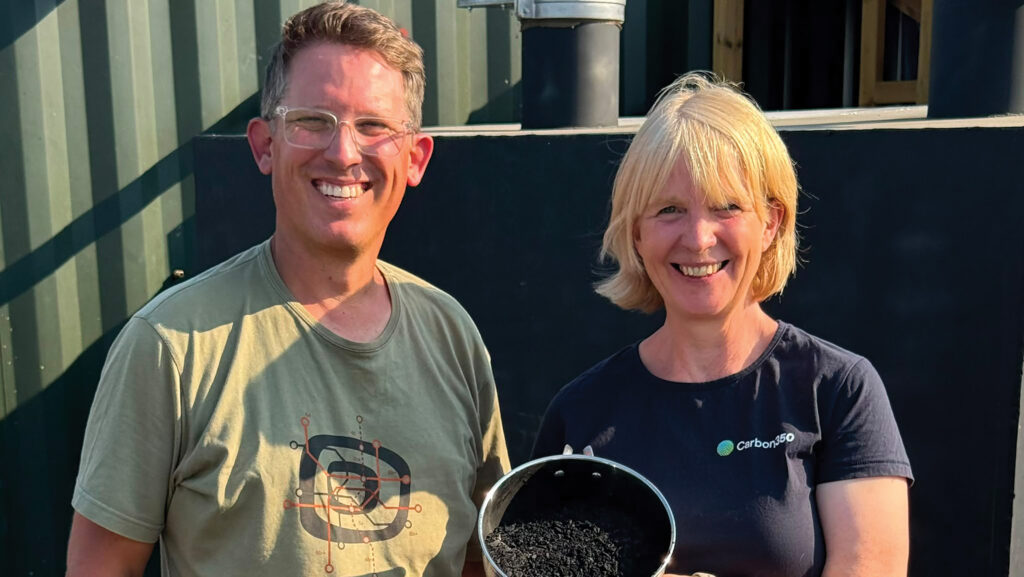
Adam Samuel and Catherine Daley © CapChar
The ability to decouple biochar production from heat demand could therefore be important to CapChar’s ambition to develop smaller, modular systems that can operate close to both biomass sources and potential users of the resulting heat.
“This opens opportunities for farms and rural businesses to use pyrolysis heat for applications on demand,” says Adam.
Digital measurement
CapChar is now incorporating digital measurement, reporting and verification (dMRV) into its systems.
The aim is to collect the information needed to quantify and verify the amount of durable carbon removal generated by each installation.
About 4t of woodchip produces 1t of biochar, representing roughly 2-2.5t of carbon dioxide equivalent.
The company also estimated that about 74% of the carbon could remain in the ground for more than 100 years once the biochar was applied to land.
This long-term stability is what gives biochar its potential role as a carbon-removal technology. Carbon absorbed by plants from the atmosphere can be converted into a more durable form and stored in soils.
The Hampshire project is expected to remove close to 250t of CO2e, subject to final production data and lifecycle assessment.
A distributed model
The firm’s ambition is to develop small-scale pyrolysis equipment available to farms, allowing landowners to turn locally available organic material into biochar, rather than relying on large, centralised pyrolysis plants.
Teaming up with carbon credit advisory and project development company Carbon350, the firm is developing a model for local biochar production using woody residues while creating durable carbon removal.
Catherine Daley, chief executive and founder of Carbon350, says: “This is about pioneering a distributed UK model for biochar carbon removal, local biomass, local heat, local soil health, and high-integrity carbon credits.”
By processing material locally, the company aims to reduce the need to transport bulky biomass over long distances while allowing farms, landowners, biochar project developers and rural businesses to capture more of the potential value from their local resources.
This matters because woody biomass is bulky and can be expensive and carbon-intensive to transport long distances. Processing it closer to where it is produced could reduce transport requirements while allowing more of the value of the material to remain within rural communities.
CapChar is now using the Hampshire installation to generate further operational data as it continues to develop the technology towards wider commercial deployment.
CapChar has also developed the Biochar Carbon Code, which it describes as a framework for measuring and verifying UK biochar carbon removals.
Lessons from pilot work Cornwall
The Hampshire installation builds on a previous project in Cornwall carried out with biochar project developer Restord and its founder Tom Previte.
Adam Samuel, co-founder of CapChar, says: “One of the biggest lessons was that making good use of the energy from pyrolysis is fundamental to creating a stronger commercial model.”
The result is intended to be a more complete proposition for farms, landowners and rural businesses, with locally sourced biomass going into the system and biochar, useful thermal energy and a measurable carbon-removal benefit coming out of the system.
Benefits of biochar
The porous structure of biochar means it can provide a habitat for soil microorganisms and help improve nutrient-use efficiency. It can also be incorporated into manure, compost or digestate, used as part of animal bedding and potentially added to slurry systems.
However, it’s worth noting the precise agronomic benefits depend on the feedstock, production process, soil and application rate.