

Why increasing soil microbes is key to regen cropping
 © GNP
Microbes are an integral part of soil life and they are essential to allow soil to perform all of its functions, including nutrient cycling, says an expert.
Healthy soils should have around 10bn microbes in one teaspoon, which is greater than the population of Earth, says large animal vet and public health nutritionist, Lucy Williamson.
See also: Regen premium helps West Midlands family battle blackgrass
Microbes enable plants to build up their own antioxidants, which act as a plant’s natural immune system.
“Whichever living system they are in, microbes do three important things: build resilience, impact metabolic processes – which drive health – and release nutrients,” says Lucy.
So how can farmers improve the microbial populations in their soil, and can it make a difference to soil health or crop yields?
Phil White, who farms 160ha in Oxfordshire, was hoping to understand just that when he began an arable trial in 2025.
He applied a Microbz product – which uses live, naturally derived microbes – to 16ha of spring oats as a foliar treatment six weeks after drilling.
It was a challenging growing season of weather extremes, with yields down across the board.
However, the treated plot achieved 2.6t/ha against 1.5t/ha on the untreated plot.
“There was a clear difference; it was more vigorous and established well,” he says.
Other positive indicators included a taller and denser crop, stronger stems and reduced weed pressure. In addition, soil nitrogen availability increased by 30% (from 0.247%N to 0.323%N).
Reduced inputs
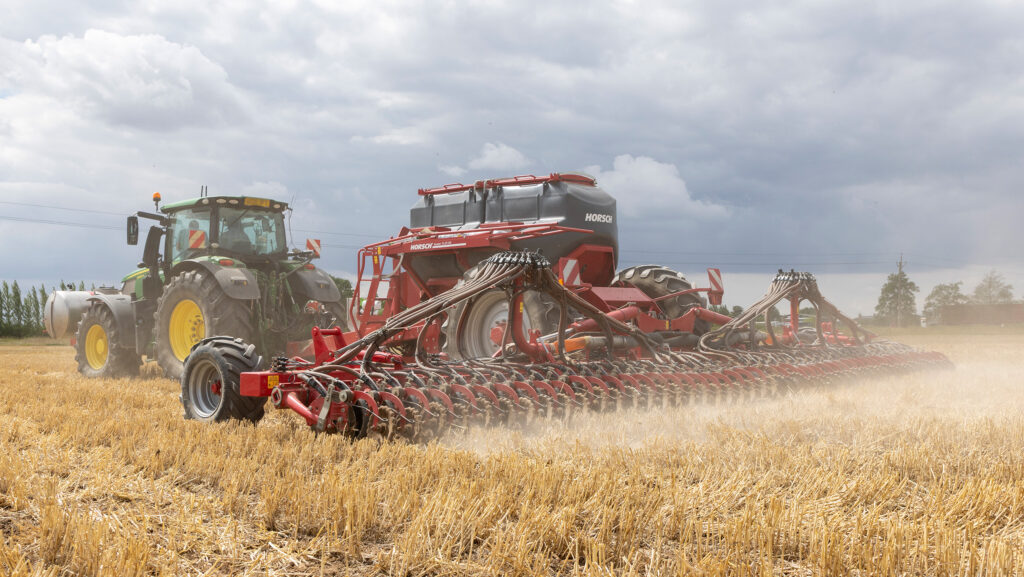
Another arable farmer who has had success with microbes is Tim Parton, a regenerative agronomist who until recently was farm manager at the 300ha Brewood Park Farm, Staffordshire.
“When I was managing the farm, we were getting good yields,” recalls Tim.
“But costs were increasing and we had reached a point where nitrogen was no longer having an impact on yields, so we decided to reduce our inputs and see what happened.”
Tim stopped applications of fungicides, and reduced tillage. “By reducing our input costs, we had more budget to play with.
“We bought in some products and even brewed our own microbes, which were applied using liquid applicators on the grain drill – making feed available to the seed straight away – or using a foliar spray, which helps to fix nitrogen and improve resistance to pathogens. We saw a difference within eight months.”
He says his best wheat yield was 12t/ha where he had averaged 8-9t/ha conventionally. His best oilseed rape yield was 7t/ha – a jump from averages of 4.5t/ha.
By farming for biology rather than chemistry, everything starts to change, explains Tim.
“You can see it with your own eyes. The wildlife improves, insect numbers increase – everything in the cycle starts to work again.
“Get a fork and a microscope, learn about your soil, measure infiltration rates and worm counts – look and observe,” he advises.
But success isn’t something that happens overnight, and costs will always vary depending on the year.
“Toxicity in soils has been growing for decades, and we need to start the healing process. It isn’t a quick fix,” says Tim.
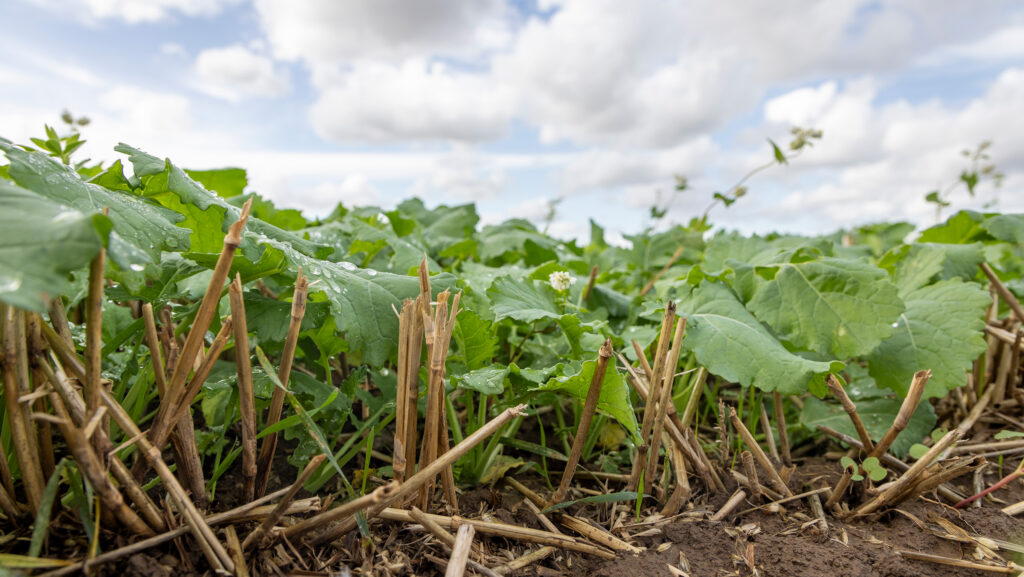
Reducing tillage, and thus compaction, improves soil porosity, creating good conditions for the microbe community.
“Once you get porosity right, the soil can soak up more water. I was able to get my soil to a point where we could infiltrate one inch of water every 30 seconds – the soil was like a big carbon sponge.”
© GNP
The microbe-plant relationship
Farmers do need to address the limiting factors in their soil, explains Dan Kittredge, US organic farmer and executive director at the Bionutrient Food Association (BFA) and the Bionutrient Institute (BI).
Because microbes evolved alongside plants and share a symbiotic relationship with them, it’s essential to understand the environmental conditions needed for that relationship to function well.
“Microbes need five things – air, water, food, minerals and to be present in the first place. But once you get that right, the transformation can be quick – I saw visible changes in my land in just two months.”
Dan’s quest for improvement didn’t stop at the farm gate. As founder of the BFA, he provides training for farmers across the world on how to achieve good soil health, with resulting economic and physical benefits.
“Increasing soil health correlated with a decreasing cost of production, better pest and disease resistance, better shelf life, flavour, farm viability, carbon sequestration and ecological system function.”
Farmers across the US supplied 10,000 crop samples from 25 different crops for research carried out by the BI.
The results demonstrated that the only factor which correlated with the nutritional value of food was the level of life in the soil – and what connected the nutrient levels with food were the microbes.
However, for Dan and the BFA, it is about more than just improving soils.
The institute has also developed a hand-held spectrometer, based on the same technology used in the Hubble Space Telescope, which enables people to scan food to ascertain its nutritional value.
While the prototype has been a success, the ultimate test will be when it reaches the consumer.
“It’s three to five years before we have these sensors in phones to do this. If we can help people choose the better tomatoes – or beef, wheat, milk etc – off the shelf and leave the worst, there will be a direct economic incentive to the supply chain to focus on nutrition as opposed to volume,” says Dan.
So if growers adapt soil management to improve soil health, they can then produce a more nutritionally rich, higher-value crop – building farm resilience while benefiting the consumer. In turn, this could ultimately change the dial on how food is valued, and what price farmers can hope to receive for it.
Soil aeration research
© Christian Kay
Four million hectares of agricultural soils in the UK are at risk of compaction – which could cost an estimated £472m/year.
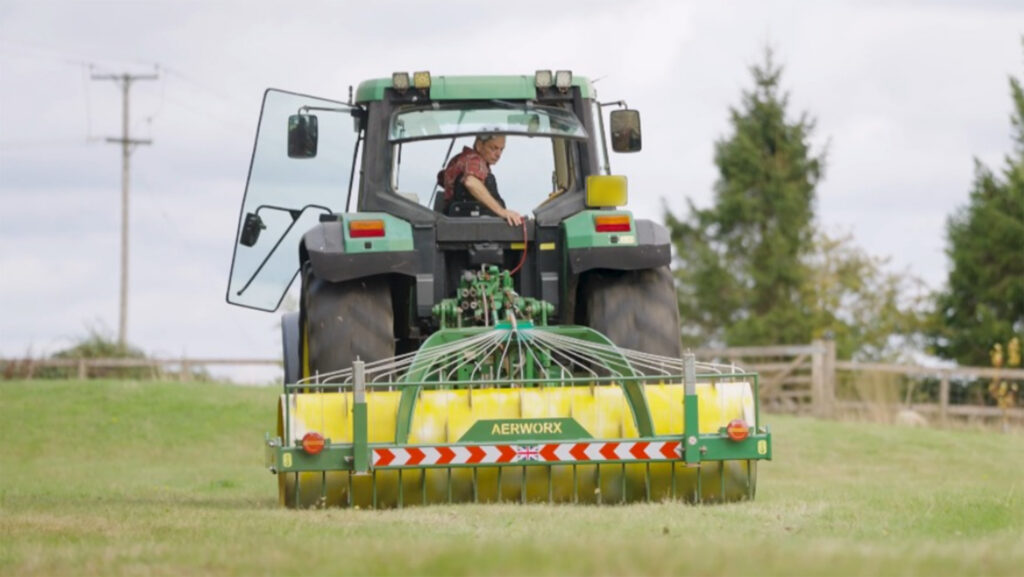
Addressing this has been at the heart of the work of Aerworx, the UK manufacturer of a large drum-and-blade aerator.
The company recently conducted a grassland trial to investigate whether the efficacy of soil applicants changed when applied to decompacted soil.
Aerworx, used on dry ground, creates slots in the soil surface and uses kinetic energy to shatter the compacted subsoil, with minimal surface disturbance.
The trial tested Microbz, alongside four other biostimulants and one soil mineral amendment, in strips with and without Aerworx aeration (conducted twice per plot per year), to determine whether dry matter production and water infiltration could be improved. Uplift was monitored within plots to account for soil variation.
Preliminary dry matter results |
||
|
Trial plot |
Standing grass dry matter net uplift v control in 12m period |
Dry matter loss during 2026 drought (June-Aug) |
|
Control |
n/a |
-460kg/ha |
|
Microbz only |
+15% (261kg/ha) |
-230kg/ha |
|
Aerworx+Microbz |
+26% (456kg/ha) |
-30kg/ha |
Average infiltration time for one inch of rainfall per plot |
||
|
Trial plot |
Start of trial |
End of trial |
|
Aerworx only |
24 mins |
11 sec (99% faster) |
|
Products (average of all six product only plots) |
10 mins |
6.5 mins (35% faster) |
|
Aerworx+products average |
11 mins |
41 sec (94% faster) |
There was little benefit in infiltration for the Microbz-only plot, but when combined with Aerworx there was an 86% improvement.
Throughout the trial a clear synergy was seen when Microbz and Aerworx were used together.
Results indicate the value of combining biological and physical approaches to soil management, supporting productivity and helping soils make better use of rainfall – underpinned by the need to give the soil biology the right physical environment to thrive.
Netty Palliser, trial lead and Aerworx business development manager, said: “The improvements we saw in productivity and water management are especially relevant as farmers face increasingly challenging weather extremes and [need] to build farm resilience.”
The contributors to this piece were speaking at the recent Microbial Revolution event held in Wiltshire.
Staying sharp shouldn't be a chore
Explore more / Transition
Follow the experiences of our 16 Transition Farmers and access in-depth supplements, expert webinars, live events and practical content covering the challenges and opportunities facing farm businesses.
Transition is an independent editorial initiative supported by our UK-wide network of partners.
Explore the Transition hub for the latest insights, resources and events.
