

Why UK faces growing mycotoxin risk in silage
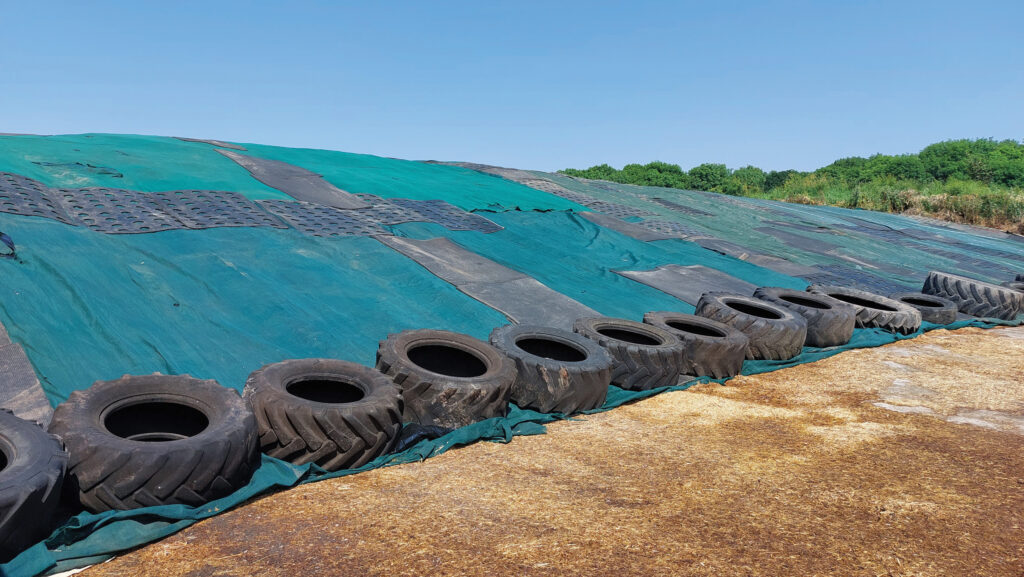 Silage clamp © MAG/Shirley Macmillan
 Extreme weather patterns are increasing the risk that mycotoxins will cause problems for the UK’s high-yielding dairy herds.
A global shift in crop production fuelled by climate change is expected to result in a net migration of mycotoxin-producing pests and fungi, says Volac International’s global technical manager for feed additives, Dr Hsueh-lui Ho.
See also: How one farm is trialling a regen approach to forage maize

Hsueh-lui Ho © Agribusiness Communications
Mycotoxins are “not an issue at a low frequency”, but this could alter as conditions lead to greater prevalence. Depending on the fungi species seen in the UK, it is likely to produce a different mycotoxin profile, she says.
Mycotoxins are secondary metabolites produced by fungi when stressed. There are more than 500 known mycotoxins (some fungal species can produce more than one) and there are new ones emerging.
There are also “masked” mycotoxins, whereby the plant adds carbohydrate to render it harmless but, once in the cow’s digestive system, this breaks down and produces toxicity.
“We can’t yet test for these, so you may get a clean mycotoxin result but have masked ones [in the feed],” says Hsueh-lui.
Mycotoxins in most UK maize silage samples
She reveals that higher rates of mycotoxins are seen now around the world because of better detection methods.
Volac’s own survey of maize, grass silages, concentrates and total mixed ration (TMR) samples show that 98% of UK maize silage samples tested positive for at least one mycotoxin (it’s usual for maize silage to contain up to three) in 2025, with results so far in 2026 at 94%.
Species and sex determine how badly mycotoxins affect a mammal.
“Ruminants can handle mycotoxins fairly well, compared with pigs and humans, which are the most susceptible. But females are more susceptible than males and get immunosuppression, so they are sick for longer.
“We don’t know why, though research says [females] are slightly more resilient when pregnant – maybe to protect their foetus,” explains Hseuh-lui.
“High-yielding dairy cows are highly susceptible because they use more of their energy [intake] in milk production. They can divert 10-30% of their energy away from milk to [support] their immune response.
“Additional stressors tip the balance, such as a change in diet, increased milk yield or a change in environment that stresses the cow, heat stress, disease or transition phase. [With these] the cow then can’t handle mycotoxins.”
Cropping advice to reduce contamination risk
Aside from selecting resistant maize varieties, Hsueh-lui says crop rotation and tillage are important to prevent mould populations stabilising in fields and contaminating the next year’s harvest.
“Avoid planting crops too densely to reduce humid microclimates that promote mould growth, and don’t irrigate during flowering and maturing stages,” she adds.
She also points out that fertiliser rates must be site-specific because low soil nitrogen levels can trigger fusarium species to produce the mycotoxin deoxynivalenol.
And using chemical products to control fungi, weeds and insects helps because fusarium species can colonise weed species without showing symptoms.
Clamp, clamp face and feed-out management
At harvest, crops must be cut at the recommended maturity stage, or dry matter content, and cutting heights set to avoid soil contamination.
Silos should be sealed rapidly and tightly packed to create anaerobic conditions and curtail mould development; inoculants and/or oxygen barrier plastic films should be considered.
“Good clamp management is key to reducing the risk of mycotoxins in silage. Maintain a straight, firm clamp face during feed-out.
“Feed silage immediately [after removal from the clamp] at a minimum rate of 10-16cm/day in winter and 25-35cm/day in summer, to enhance aerobic stability,” says Hseuh-lui.
She advises farmers who are concerned about mycotoxins affecting cow performance to test their TMR rather than the clamp. It will establish the risks from what is being fed to the cow before narrowing down the problem.
Prevention better than cure
Clay binders can be used to absorb mycotoxins, but they are less effective when pH rises and do not readily bind with fusarium.
Instead, Hsueh-lui recommends a remediator as a preventative. This breaks down some mycotoxins to a less harmless form with additional ingredients to help repair damage.
“Prevention is always better than trying to fix a problem afterwards. Consider using a remediator in feed if your herd might be experiencing more stress; as a general preventative strategy to decrease risk; and if you’re unsure of the source of your feed.”
Maize pest and diseases rise with climate change
A broad rotation and good trash management will help keep the risk of mycotoxins in maize crops low – and be effective in pest control, says KWS regional manager Thomas Turner.
“We see smut on repeated crops of maize in the same field,” he says. Most modern maize hybrids are disease resistant, he adds, but he strongly advises using the descriptive list when selecting varieties.

Thomas Turner © Agribusiness Communications
Corn borers moving further west
Climate change has seen the corn borer population, for instance, move west into Wiltshire and as far as Wales, says Thomas.
Although still a small population and not causing “horrific” damage, by the time it is spotted it is too late to do much about it.
“Damage is a very distinctive hole in the side of the stem, and it causes the plant to lodge just above or below the cob,” he says.
Similarly, while severe infestations of beet armyworm caterpillars can completely defoliate young plants, healthy maize plants can usually rapidly grow through early stages, says Thomas.
Insecticide can be used for big infestations. The concern is that this migratory moth will, however, become more prevalent and problematic.
What mycotoxins do to the cow
- Depress dry matter intake through gut irritation and systemic stress
- Reduce milk yield by impairing nutrient absorption and rumen efficiency
- Damage gut integrity, increasing inflammation and leaky gut
- Suppress immune functions, raising mastitis, metritis and lameness risk
- Disrupt reproduction: poorer heats, early embryonic loss, lower conception
Source: Iwan Vaughan, nutritionist at Dairy Diagnosis
Dr Hsueh-lui Ho, Thomas Turner and Iwan Vaughan were speaking at the Volac 2026 Maize Symposia at Harper Adams University College, Shropshire, on 9 July