Can British farming afford another neonics moment?
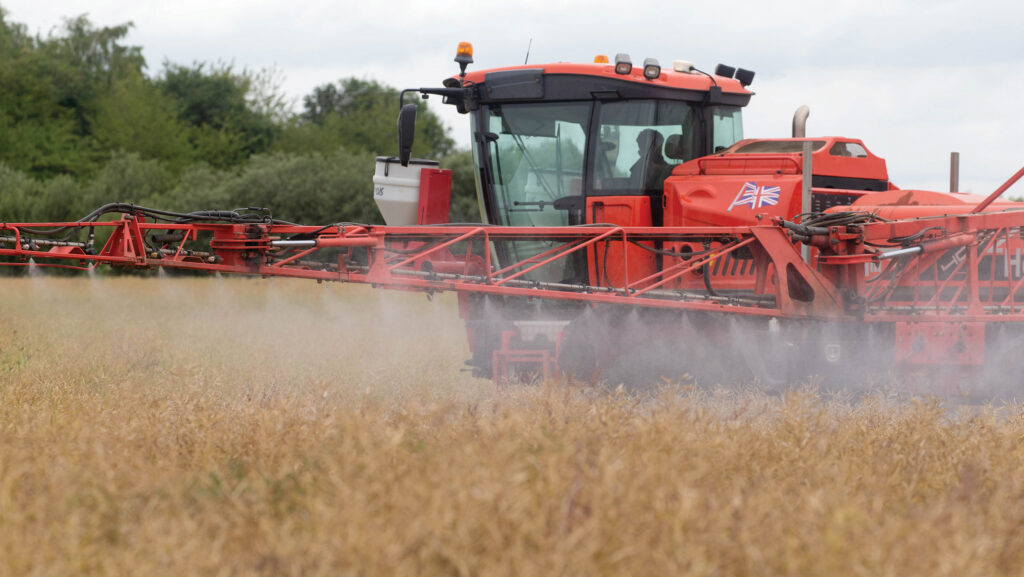 © Tim Scrivener
 When British farmers lost neonicotinoid seed treatments for oilseed rape, they began an expensive experiment in how to grow a crop without their main defence against cabbage stem flea beetle.
More than a decade later, the lessons extend well beyond crop establishment, with Britain becoming increasingly dependent on imports to supply its crushers, food manufacturers and livestock sector.
See also: Find all our oilseed rape content in one place
That experience should matter now, as the prospect of closer alignment with EU pesticide rules raises questions over glyphosate’s future as a pre-harvest desiccant.
Having spent years rebuilding growers’ ability to establish oilseed rape, the industry could face another upheaval in how they harvest it.
The difficult question is how to change crop protection policy without losing the markets and infrastructure farmers need while they adapt.
The neonicotinoids experience shows those losses can accumulate long before research delivers practical answers.
For United Oilseeds managing director James Warner, keeping that infrastructure intact was a central reason for launching OSR Reboot in 2024.
With domestic demand for rapeseed at about 2m tonnes, he could see a growing mismatch between what British crushers wanted to buy and what British farmers could reliably produce.
Defra records UK production of just 824,000t in 2024, the lowest in more than 40 years.
And its latest Food Security Digest, published in December 2025, identifies difficulties controlling flea beetle as a driver of declining production and greater dependence on imports of vegetable oils.
Although rapeseed imports can sustain throughput for domestic crushers, further closures would leave Britain buying finished oil from overseas, with little prospect of recovering the processing capacity.
Import dependence
Crushers’ association Scopa has already seen how falling production changes the supply chain.
Secretary general Angela Bowden explains how reduced domestic supplies contributed to the closure of Cargill’s Hull plant in 2022.
“It has made the crushing industry massively reliant on imported OSR,” she says.
“Pre the neonics ban, we were importing around 10% of our needs and this had been stable for some time. After 2018, import levels rose steeply to around 55% of UK supply at the peak.
“There is availability on the world market, but this is an expensive option and adds complexity for buyers in terms of checks and tests.”
The contraction has also stripped business from the firms supplying and handling the British crop.
Mr Warner calculates that a fall in annual production from 2.7m tonnes to about 900,000t represents roughly 62,000 lorry-loads of home-grown seed no longer moving through the supply chain, with associated work for stores, laboratories and merchants all gone.
He estimates that the loss of 500,000ha of plantings also removed demand for about 167,000 bags of certified OSR seed.
Although replacement crops and imports generate their own business, the figures illustrate how widely the consequences of a crop’s decline spread.
Feed implications
And there is another issue for the livestock sector. British seed delivered to a crusher can provide the inward load for a vehicle collecting rapeseed meal, an important protein source for livestock, particularly ruminants.
At Erith, near Dartford, losing those seed deliveries can leave hauliers travelling in empty to collect meal.
This means a £30/t round trip previously shared between two loads at £15/t each becomes a £30/t charge borne entirely by the feed.
Mr Warner says the result is there’s a “really big knock-on impact” on the animal feed sector.
He fears weakening domestic production will deepen reliance on overseas feed, including soya with all its deforestation implications, alongside the growing dependence on imported oil.
Mr Warner also argues that adaptation to life without neonicotinoids has been harder because overseas competitors retain options British growers have lost.
“If we’re going to ban something here, you have to have a level playing field,” he says.
“We can adapt to different regulations as long as those regulations are fair.”
He therefore calls on government to examine where replacement supplies will come from, and under what production rules, before banning actives in future.
Environmental impact
There is, however, evidence that restricting neonicotinoids reduced environmental exposure of the chemicals.
A British study found residues of the three restricted chemicals in 52% of honey samples in 2014, falling to 23% in 2015, following the first OSR drilling season without routine access to those seed treatments.
Water monitoring also shows declining concentrations of thiamethoxam and clothianidin, although Defra’s chief scientific adviser notes that clothianidin’s decline has been slower and may be becoming less consistent.
The comparable monitoring series begins in 2016, so it cannot isolate the effect of the earlier OSR restrictions from subsequent withdrawals on other crops.
But United Oilseeds argues that the environmental assessment must also account for the loss of flowering OSR, which provides pollen and nectar for bees and other pollinators, alongside the benefits of reduced pesticide exposure.
Is the alternative to glyphosate use in OSR ready yet?
Glyphosate serves a different purpose to neonicotinoids, but losing access to it would raise the same question – how well prepared is the industry to cope?
The EU has approved glyphosate until December 2033, while prohibiting desiccation to control harvest timing or optimise threshing.
Proposed alignment through the UK-EU sanitary and phytosanitary agreement puts that use at risk in this country.
United Oilseeds managing director James Warner and Scopa secretary general Angela Bowden fear losing it would threaten OSR’s viability for some northern growers, particularly in Scotland, where catchy weather makes harvest difficult.
One United Oilseeds director in the Borders is investigating swathing, Mr Warner says.
Cutting the crop and leaving it to dry before collection offers an alternative, but its commercial performance depends on weather exposure, crop losses, machinery and cost.
“I’d be dubious about the long-term viability of that,” he adds.
Scottish OSR yields reached 4.7t/ha in 2025, according to official figures.
Mr Warner contrasts Scotland’s productivity with Brazilian yields of about 1.5t/ha, arguing that replacing high-yielding production elsewhere can require substantially more land.
Using his comparison of 4.5t/ha against 1.5t/ha, producing the same tonnage would require three hectares overseas for every hectare lost in Scotland.
He explains the environmental assessment of restrictions on glyphosate cannot end at Britain’s borders, but must also consider whether reducing one pressure at home increases demand for land, inputs and transport elsewhere.
Make the research count
Dr Julian Little, co-ordinator of the cross-industry OSR Reboot campaign to revive and protect production, said the project was beginning to offer growers confidence that the crop can work again.
He pointed to two positive seasons and a larger cropped area, although he cautioned that the improvement cannot conclusively be attributed to the management strategies the campaign has promoted.
He says seed sellers were hoping for a 10-20% increase in sales for the coming season, with the wider ambition of rebuilding UK OSR area to 500,000ha.
Mr Warner is also anticipating further expansion, forecasting a 20-25% increase in plantings this autumn.
But his concern, shared by Dr Little, is that losing glyphosate desiccation could undermine the confidence the industry has spent years rebuilding.
“We need to have transition periods,” says Dr Little. “And investment into research to help us find alternatives. Let’s not pull the rug out from farmers again and leave them high and dry wondering what the heck’s going to happen.”
A Defra spokesman said: “Our Farming Roadmap is helping farmers access the innovation, research and practical tools they need to manage pests effectively, improve resilience and support long-term food production while protecting nature.”
What should have happened sooner?
The first restrictions took effect in December 2013, removing routine access to three neonicotinoid seed treatments for autumn 2014 OSR drilling. The wider outdoor-use withdrawal followed in 2018.
The AHDB’s cereals and oilseeds director Anthony Hopkins says growers had little opportunity to prepare, with the remaining chemical defence against flea beetle already compromised – pyrethroid resistance was being identified in 2014.
“Removing the main line of defence with, in effect, six months’ notice left very little time to prepare or adapt,” he says.
“Farmers could watch their OSR being severely damaged or even destroyed by CSFB, while the only approved treatment available to them had declining efficacy and would probably do more harm than good in the long term by increasing resistance and reducing potential beneficials.”
The AHDB’s analysis puts average autumn larval incidence at 32% of crops in 2009-13, compared with 98% annually in 2019-25.
The result of the neonicotinoid ban was that farmers were left to bear the financial risk while the industry worked out how to manage a changed pest problem.