Rapeseed oil producer reveals how he grows a successful crop
 © Sophie Carson Photography
Sitting at the foot of the Cotswold Hills near Broadway, Worcestershire, Cotswold Gold depends on its farming business to produce a reliable supply of rapeseed to keep its cold-pressing operation running.
However, challenging establishment conditions and persistent cabbage stem flea beetle (CSFB) pressure have made growing the crop increasingly difficult.
See aso: Later-drilled oilseed rape requires tailored agronomy
For farmer and food manufacturing business owner Charlie Beldam, this has meant rethinking everything from variety choice and drilling dates to establishment machinery and when a struggling crop is no longer worth investing in.
Variety choice
When selecting varieties, agronomic traits remain important, but taste and consistency come first for Cotswold Gold.
“Rapeseed oil is similar to olive oil and wine in that every year you will have a slight difference in taste, but if it is the same variety, grown in the same soil type and at the same altitude, it is really just left down to the climate to influence the taste,” Charlie explains.
Charlock is an issue on the farm’s heavy clay soils, with the acids found in the weed causing a bitter taste in the end product. As a result, Charlie opts for two Clearfield varieties.
“We have tried different varieties over the years, and used to do a lot of government trials and work with plant breeders for new upcoming varieties.
“We now try to stick to our Clearfield varieties as much as we can, as long as they are still within germination, and we’re happy with how they are performing on the scale.”
Oil content is also considered, but is less of a priority because Cotswold Gold’s cold-pressing method leaves some oil in the rapeseed meal, which is then used for cattle feed.
“We’re not a farm that needs 46% oil content from our varieties,” says Charlie. “We only take about 31% of the oil out and the remainder stays in the meal and goes for cattle feed. This leaves the bitter tannins and trans-fats in the meal and leaves the oil we extract with many health benefits.”
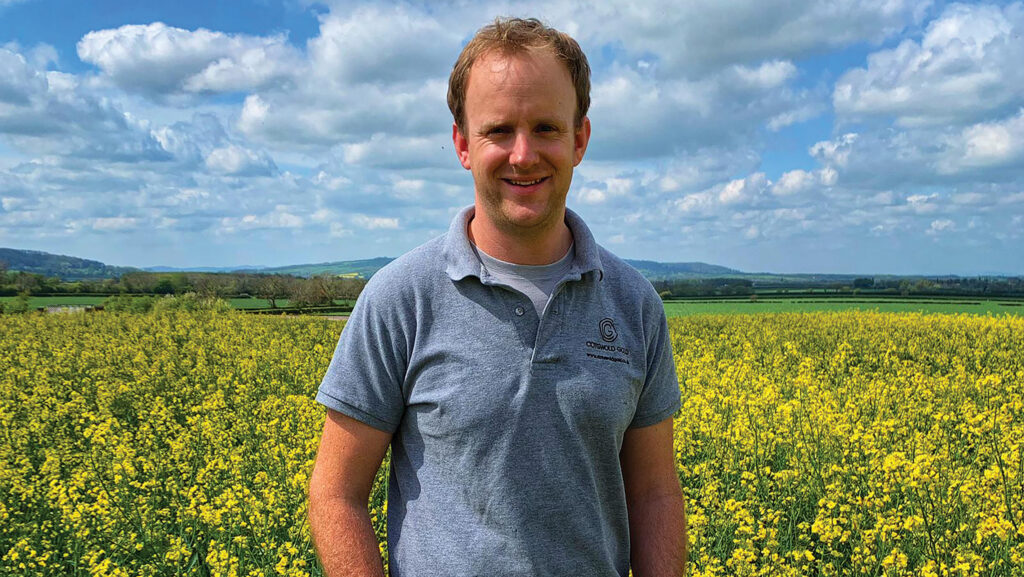
Charlie Beldam © Sophie Carson Photography
Establishment
OSR is currently grown about one in every six years, alongside milling wheat, rye, beans and linseed.
The farm is using fallow and early-cut forage rye as part of a wider effort to reduce blackgrass pressure and clean up fields ahead of subsequent crops. This also provides an opportunity for earlier entry ahead of OSR.
“We used to plough everything, but now we either use low-disturbance subsoiling or go deeper, depending on what we’re doing. We have just bought a new subsoiler from Philip Watkins, which we hope we can follow straight in with the drill to reduce passes,” says Charlie.
Establishment is focused on conserving moisture in the heavy clay soils, with low-disturbance subsoiling followed by rolling and direct drilling.
“This year we tried fully subsoiling to get early establishment, and grew rye so we could get in early, but there was no moisture, so nothing was drilled until we had meaningful rain.
“Due to this autumn’s warm weather and now some moisture, it has meant later-drilled OSR has come out the ground flying this year, luckily.”
The farm previously used a Vaderstad Rapid and a Sky drill, but has since moved to a Horsch Avatar for OSR, which Charlie believes has made a significant difference to establishment.
“We want to give that root the best option to get down to moisture instead of hitting a pan. We feel the Horsch Avatar has made quite a big difference to our planting, and this year, when we were very dry, it worked well. The Vaderstad is fine if you’ve got moisture, but it dries the seed-bed out too much if you don’t have much.”
Perhaps the biggest change to the farm’s growing strategy has been its drilling date.
“We used to have a calendar date for drilling of 15 August. We’ve had some really late OSR that’s been really good, and some really early stuff. And some in the middle that’s been annihilated.
He says he is definitely holding off more than he used to and waiting for the weather pattern to change. This year he rolled it all down to make sure that he could go straight out and drill when there was some significant rain.
“We bump seed rates up a little bit to try to get even establishment and dilute flea beetle pressure, but we sometimes find the thinner crops do better in yield because they have more space to grow.”
© Alice Dyer
Flea beetle
Cabbage stem flea beetle remains the biggest threat to getting the crop established. The farm has experimented with a range of approaches, including companion cropping, retaining longer stubbles, applying digestate, grazing with sheep and managing crops that become too forward.
“Unfortunately, companion cropping didn’t work well enough to justify the extra cost for us. Really, the most important thing we can have is moisture. If you have that and warm soil, you’re halfway there.”
Winter grazing with sheep has proven successful, but Charlie is cautious.
“Last season, we had a very forward crop because we got a bit in early. The sheep are a great tool to stop it growing away too much and dilute the amount of larvae going into the spring.”
However, even if sheep are very small, their footprints are quite heavy on the clay ground. With rain it can cause poaching, so it very much depends on the ground and crop conditions.
It can be really beneficial for removing dead and infected leaves and reducing CSFB larvae pressure, as long as the crop is strong enough and has enough energy around it to keep growing.
Trials on the farm last year compared digestate at establishment with diammonium phosphate (DAP) applied down the spout, with results showing better performance from DAP.
“This year we’re predominantly using DAP, and a bit of digestate on some blocks to give them the best chance of surviving. Fundamentally, we are looking for a strong plant with a good, thick stem and the root as deep as we can, and as yellow a flower as possible.”
© Sophie Carson Photography
Losses
The family now farms about 1,000ha, with the farming and processing businesses closely linked. However, although OSR is vital to the oil business, it is still viewed as a commercial crop that does not receive special treatment, says Charlie.
“We want the best yield with the blackest seed we can get, but we won’t go out and put extra passes on, otherwise you’re damaging one business’ benefit for the other.”
Consequently, Charlie has become more disciplined about assessing whether a crop is worth further investment and when to pull the plug.
“If it’s not a good enough crop to start spending the next tranche of money on by 1 October, we write it off. I am a big believer that your first loss is your best loss.”
Charlie says the farm has written off a “huge amount” of crop due to flea beetles and dry autumns over the past few years.
Crushing some 1,700t of OSR annually, Cotswold Gold also works with three local farms on the same soil type to bridge any supply gaps its own farm cannot fulfil in any given year.
Despite prolonged drought and multiple heatwaves, OSR performed relatively well this year, with yields averaging 3.9t/ha.
“OSR did a lot better than we expected at harvest because its deep taproot was still getting some moisture. It generally looked good all year, and although it could’ve done with a bit of rain before harvest to finish it off, we were happy with it.
“The past few years have been appalling. We’ve had everything from less than 3t/ha to 3.2t/ha.”
Despite the challenges, Charlie believes oilseed rape still has a place in the rotation, regardless of its end destination.
“Not many break crops like this are profitable, and it provides a great entry for wheat. Its deep rooting improves soil structure and it provides opportunities for weed control and, when it establishes well, can deliver a worthwhile return.”
About Cotswold Gold
Third-generation farmer Charlie came up with the idea for Cotswold Gold while studying at the Royal Agricultural College, Cirencester, where he developed the business plan as part of his dissertation.
Seventeen years later, the business employs more than 30 people, produces its own range of products and manufactures for a further 70 companies, with all processing carried out on site.
© Sophie Carson Photography
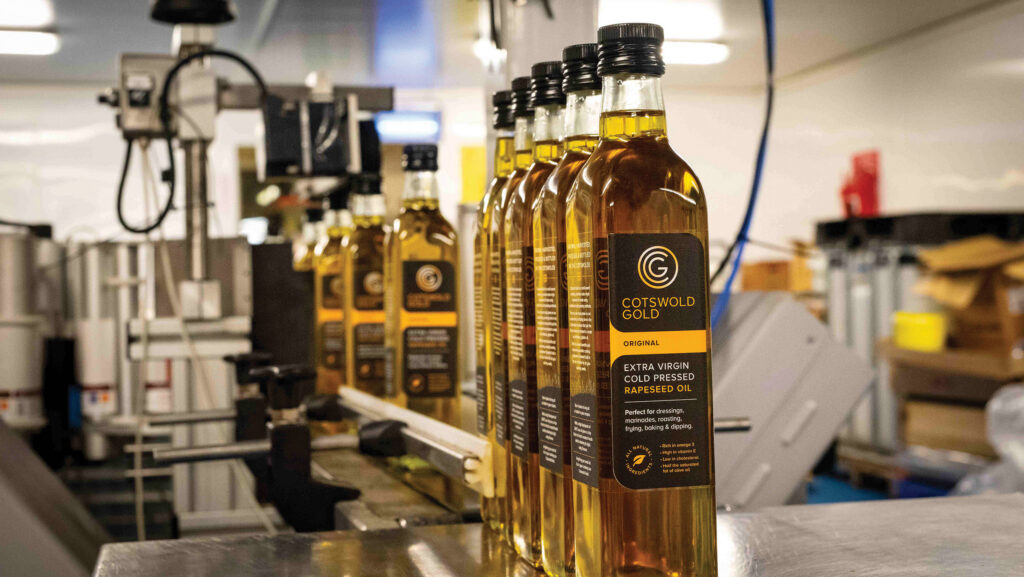
The cold-pressing plant runs 24 hours a day, seven days a week, even on Christmas Day, producing 5,000-6,000 bottles daily. The business has evolved gradually, with Charlie investing when the time is right rather than taking on more than it can afford.
Unable to secure a bank loan when he started during a recession, he had to make the business work from day one. It has remained self-funded and cash-positive ever since.
Despite dramatic changes in farming economics, Charlie has worked to keep prices stable. Wholesale bottled oil prices have remained unchanged for 17 years. Rather than passing every increase in costs on to customers, he believes the answer lies in improving efficiency.
“I looked at my business plan the other day and it said if OSR goes over £150/t, we’re in trouble. I would rather keep my prices where they are and improve my efficiency, which is really the only way of bringing down costs. It is a premium product and priced so.”
Key points:
- Prepare seed-beds early to drill as soon as moisture arrives
- Delay drilling until conditions are favourable
- Use low-disturbance establishment to conserve moisture
- Stick to Clearfield varieties to manage charlock
- Apply di-ammonium phosphate at drilling
- Graze forward crops with sheep where conditions allow
- Increase seed rates slightly to aid establishment
- Write off struggling crops by 1 October.
© Sophie Carson Photography