How agronomist is helping growers earn more from niche crops
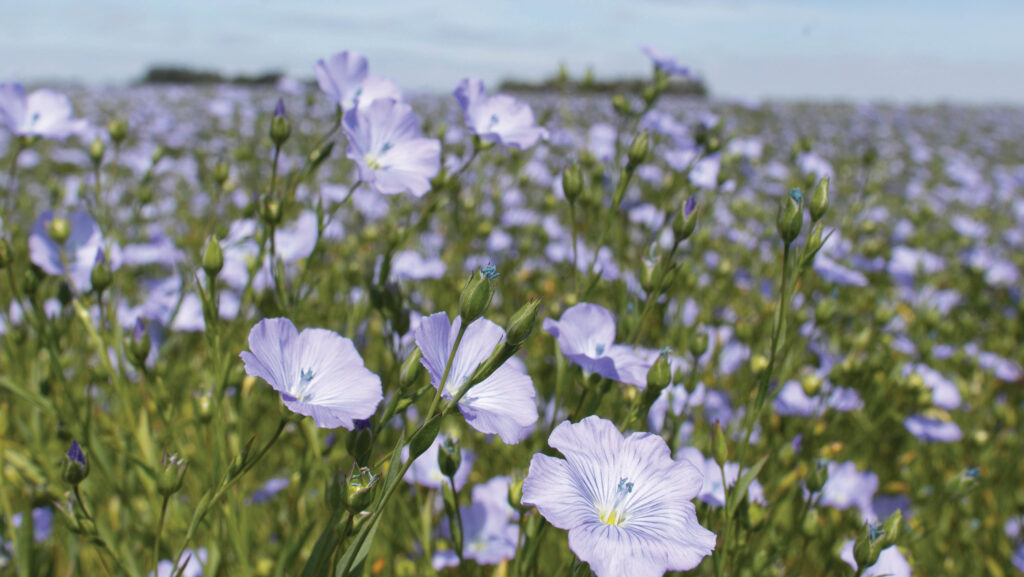 Flowering linseed © Tim Scrivener
 Armed with new research findings, analysis of farm yield data and many hours of crop walking, a team of agronomists are helping farmers maximise returns from their niche crops.
For example, winter linseed has seen a resurgence in the past six years and its average yield has risen 25-30% (1.8t/ha to 2.3t/ha) due to a combination of newer varieties and improved agronomy.
The team of five agronomists at Premium Crops are also identifying and developing potential new break crops that could benefit arable business in the coming years.
See also: Why winter linseed is an option for Scots growers

Fraser Hill © MAG/Richard Allison
Fraser Hill, one of the agronomists, sees them as independent niche crop experts and their key role is knowledge exchange with contracted farmers and the wider industry.
“Mainstream agronomists often don’t have the depth of expertise with niche crops, whether it’s nutrition for canary seed or borage agronomy,” he says.
As part of the Premium Crops contract, farmers are supported by a company agronomist to help them make the most out of the crop.
“It’s really rewarding to have some growers who I helped grow the crop for the first time when I joined the company, that are now in the top 25%, having climbed up the performance table.”
Top 25% growers
When looking for ways to maximise crop performance, a good place to start is with farmers who are already achieving the top yields.
Fraser says as all crops are grown on contract, they have good-quality yield data.
“We know exactly how each crop performed and can analyse the figures to see how differences in agronomy impacted yields.
“These learnings can be used to tweak crop management in the following season.”
As part of Fraser’s role, he looked at the top 25% of linseed growers and examined how their approach differed from the average growers and those in the bottom 25%.
While some of this difference was down to weather and soils, he found that several management factors were having an effect.
A key one is sulphur nutrition and he points to Premium Crops trial work showing the benefit of using polyhalite fertiliser in linseed.
Polyhalite is a source of readily available sulphur plus potassium, magnesium and calcium.
“The trials showed positive crop responses to the sulphur and the top 25% farmers tended to be using it,” he says.
Fraser points out that there is limited nutrition data for linseed, as the AHDB RB209 Fertiliser Manual does not include niche crops.
To fill this knowledge gap, Premium Crops has been carrying out its own work and now recommends the use of Poly4.
Biostimulants
Break crops have a valuable role in helping improve soil health, and combining their inclusion in rotations with soil conditioners can help boost their benefits.
Linseed is well known for its soil health benefits with its fibrous roots.
Fraser points to innovative trials carried out by Premium Crops’ parent company, Cefetra, looking at fulvic and humic acids with a product called SoilPoint Soil Booster.
They are organic compounds found in soil that are thought to enhance nutrient uptake by increasing the carbon, thus nutrient sites to bind with and improve soil structure.
While other companies have looked at these products in mainstream cereal crops, these trials also included niche crops.
Results showed that they did work as soil conditioners and that the benefits can be seen in niche crops too. “The benefits were consistent across the three to four years of trials.
“We now have the data that shows if farmers want a more targeted approach to soil health, using these products in niche crops can maximise the benefits.”
Flax beetle

Drilling spring linseed a little earlier can help reduce the risk from linseed beetle © Blackthorn Arable
Another project Fraser has been involved with is a three-year investigation into flax beetle by the John Innes Centre.
Two years into his role, there had been some problems with spring linseed struggling to establish due to dry springs and flax beetle damage.
A common myth was that the pest was similar to the cabbage stem flea beetle that was affecting oilseed rape crops, but there was no data to support this.
So the researchers carried out a three-year project on a farm in Suffolk to investigate whether there are differences and how best to control the pest using integrated pest management (IPM) practices.
“While the three seasons were different, we saw a clear pattern with flax beetle emergence being triggered when temperatures reached 12C.
However, this happened to coincide with the crop being at the vulnerable cotyledon stage,” he says. Therefore, the best IPM strategy is to drill a little earlier.
“So if you aim to drill in late March/early April, the crop is further on and can cope better with the pest.”
Again, Fraser points out this was something the top 25% farmers were already doing – probably in response to climate change, which meant the traditional mid-April drilling time was getting a little late.
“You should always farm to the conditions present and not calendar date. However, the key is being aware those prime conditions can often be in this date range.
“Profitable, high-yielding crops can still be planted late April, but are less consistent.”
While many farmers don’t want to routinely use insecticides, researchers found that the flax beetle did not have widespread resistance to pyrethroids such as cabbage stem flea beetle.
“So you can spray and get good control, and that was shown in the trial.”
In conclusion, although flax beetle is one reason some growers have been put off from growing the crop, there are effective ways to manage the pest.
“The trial gives us confidence to tell growers there is still good efficacy against flax beetle when using pyrethroids like Hallmark (lambda-cyhalothrin), and this was something we shared with agronomists at a recent Association of Independent Crop Consultants annual conference.”
The other learning was that there was a second flax beetle migration in summer.
“We already knew that flax beetle did not affect winter linseed, and now we know why – as the pest has already emerged and gone before the crop is drilled.”
Developing new break crops
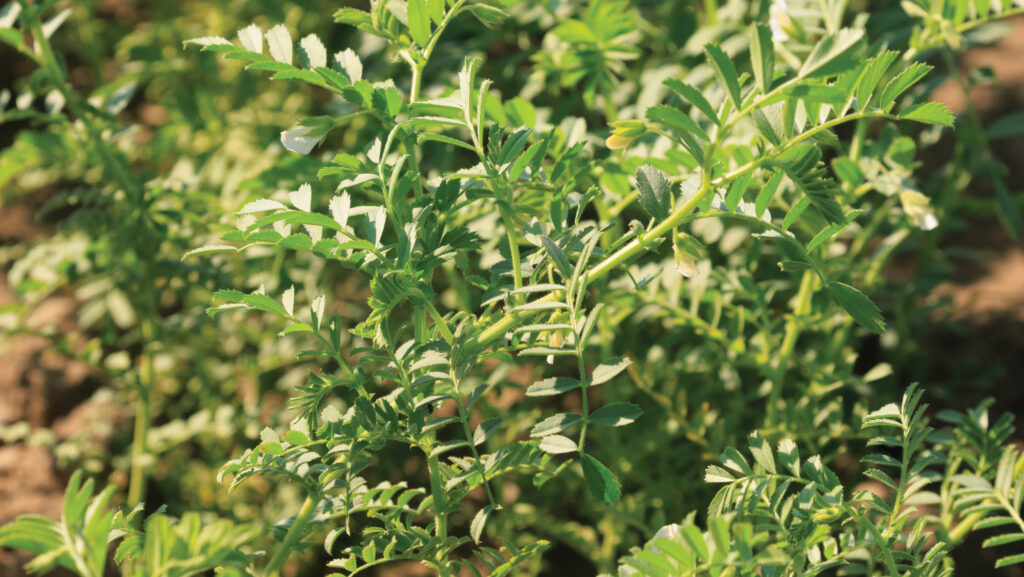
Chickpeas yielded more than 3t/ha in UK trials last summer © TIm Scrivener
Another key part of Fraser’s role is identifying potential break crops of the future, which currently include chickpeas and flax.
Last July, he travelled with a colleague to Canada to look at chickpeas, as they are being successfully grown in a similar climate.
Premium Crops have been involved with chickpeas through Cicero, which is an Innovate UK co-funded project. “We spoke to agronomists and farmers to see how they grow it.”
The potential to grow chickpeas in the UK was demonstrated in trials last year, which yielded more than 3t/ha.
“This is a good performance and at £600-£700/t, it would be a profitable pulse crop.”
However, consistency is the key and it’s likely the crop liked the dry conditions in 2025.
“So how can we do it in a wetter year? Do we need to drill it earlier or do we need to look at nutrition or is it down to variety?”
Fraser says the visit gave them confidence that it can be grown here.
“We came back with some agronomic ideas such as soil conditioners to aid establishment of chickpeas, something Canadian growers routinely use.”
Flax for fibre is another potential future crop, with some fields being grown for the first time in Kent.
He explains that less flax is being grown in Europe, so they are seeing stronger prices.
This is because the large co-ops are focused on growing wheat, barley and oilseed rape, so there are more opportunities, and he believes this crop is on the up.
Ultimately, any new crop has to add value to the farm business and not be a one-year wonder. “It has to fit rotations and work in the UK,” he says.
Career progression
Fraser Hill grew up on a small mixed farm in Dorset, comprising mainly sheep and pigs with a small area of arable (wheat, barley and oats) producing feed.
The family farm has always grown cover crops for grazing and this is where his interest in the integration of livestock with arable started.
They also graze cereals with sheep to help with disease.
“It gave us an extra month of grass buffer in spring and it helped to reduce fungicide use. Ultimately, crop yield was unaffected.”
Having seen the wider benefits first hand, Fraser encourages farmers growing specialist oilseed rape crops for the company to consider this practice where appropriate.
Qualifications
At the University of Reading, he studied environmental management specialising in crop agronomy.
During the summer, he worked for Cetefra in a grain store and came across the Premium Crops division.
He found niche crops interesting and was attracted by the innovative work being carried out, so he joined the team in 2019.
He gained his Basis and Facts qualifications while at Premium Crops.
Now in his sixth season at the company, Fraser is working towards a diploma in agronomy to add value to the role. He hopes to complete it in the next two years.
Fraser oversees a range of crops in his area covering East Anglia and the South East.
Linseed and oilseed rape account for three-quarters of the area, with rest being a mix of borage, canary seed, naked oats and red wheat.
He oversees and consults on broadacre crops as well.