Potato bruising ratings unreliable
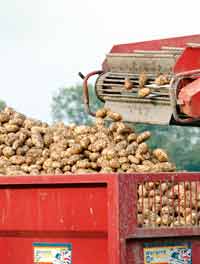
Variety ratings for resistance to bruising in potato varieties are not reliable, James Fowler, a researcher for Cambridge University Farms told growers at the Cambridge University Potato Growers Research Association annual conference.
Bruising remained a major problem within the industry despite a huge amount of research and knowledge transfer efforts in recent years, he said.
“One question is are we growing the right varieties?” Dr Fowler asked. “And according to a survey of the top 49 varieties on the British Potato Variety database, which covers around about 80% of the cropped area, 24% of the area does have high or very high resistance to bruising.
“But there isn’t much faith in the indexes. For example, most growers wouldn’t consider Lady Rosetta to be more resistant than Saturna. Yet it is a six on the database while Saturna is a four.”
There was also little consistency between other sources of resistance ratings, he said. Hermes, for example, was a six in UK but a three in The Netherlands, while the reverse was true of Agria.
“It is quite clear there are fundamental differences.”
Testing for bruising was extremely difficult because of the complexity of the condition, he said. “Different varieties behave differently in different years too. But we’re not helping ourselves. Any ratings test must replicate what occurs in practice.”
That might not be possible because of the interaction of so many different factors in its cause, he told Farmers Weekly.
But it might be possible to use data collected at delivery by packers and processors to provide a more realistic rating, he said.
Earlier in the conference, Paul Coleman, technical director at Greenvale AP, reported how his firm used a system called Navision to record the primary defect on 3900 loads of white potatoes entering its premises.
Analysis of that data suggested bruising was the third most common primary defect recorded after greening and mechanical damage across all varieties.
But it also allowed Greenvale to analyse the data by variety, which could potentially be a useful source of data provided it was analysed carefully, Dr Fowler said.
Greenvale was using the Navision analysis to help shape bespoke agronomy advice for its growers, Mr Coleman said.
For example, the data suggested Vales Sovereign was prone to star cracking, a condition caused by over-watering, but was much less susceptible to common scab, which irrigation helps control.
That led to a research project with Cambridge University Farm, which concluded it was possible to grow Vales Sovereign with large soil moisture deficits and see no increase of common scab, and reduce the threat from star cracking.
Staying sharp shouldn't be a chore