

Advertiser content
Precision potassium timing for maximum yield impact
After the wettest February on record, attention is turning to hitting key nutritional timings that boost yield potential.
While excess rainfall and waterlogged soils have added to crop stress, advisers say the priority now is ensuring crops receive potassium (K) at peak demand.
Often described as the ‘engine support’ behind nitrogen, potassium plays a central role in water regulation, nutrient movement and stress tolerance.
Without sufficient K, crops can struggle to make full use of applied nitrogen, particularly after periods of flooding, drought or rapid early growth.
“Growers focus heavily on nitrogen, but potassium is what keeps the plant functioning efficiently,” says Linda Sheppard, area sales manager and agronomist with Agrovista’s South East team.
“If crops are going to stand up, cope with stress and deliver consistent yields, potassium is fundamental.”
© Unium Bioscience
Stress exposes weak K indices
The last two years have highlighted two key challenges. In dry springs, restricted root activity can limit nutrient uptake just as crops enter peak demand.
Conversely, in wet conditions, particularly on lighter soils, potassium can be lost through leaching.
That combination can leave crops short at exactly the wrong time.
Applying a foliar potassium such as Wholly K from Unium Biosciences, can help to deliver readily available K directly through the leaf when conditions may limit uptake.
“Applying a foliar product in dry springs is better than relying solely on the roots,” says Andy Crow of Lingfield Lodge Farm, near Edenbridge, Kent.
“Soil indices on farm can be low in potash. Wholly K helps with the spring workload as there’s just me here, and it saves a pass.
“Soil is often very wet late winter and early spring, so when it dries up enough to travel, there’s generally much to do in a short weather window. The ability to tank-mix and save an extra pass really helps. There are cost savings too.”
According to Unium Biosciences, Wholly K can help maintain nutrient flow, improve water-use efficiency and support nitrogen use efficiency (NUE), particularly important in high-input crops where every kilo of applied N needs to work harder.
“The potassium metabolite complex delivers K efficiently through the leaf, while enhancing nutrient use efficiency, particularly nitrogen.” explains Andrew Cromie at Unium Biosciences.
“By stimulating root development, it helps crops access soil potassium more effectively, overcoming deficiencies or periods of limited availability,” he says.
Used alongside fungicides or PGRs, foliar applications can be integrated into existing spray tank mixtures, helping manage workload during compressed spring periods.
Trial results
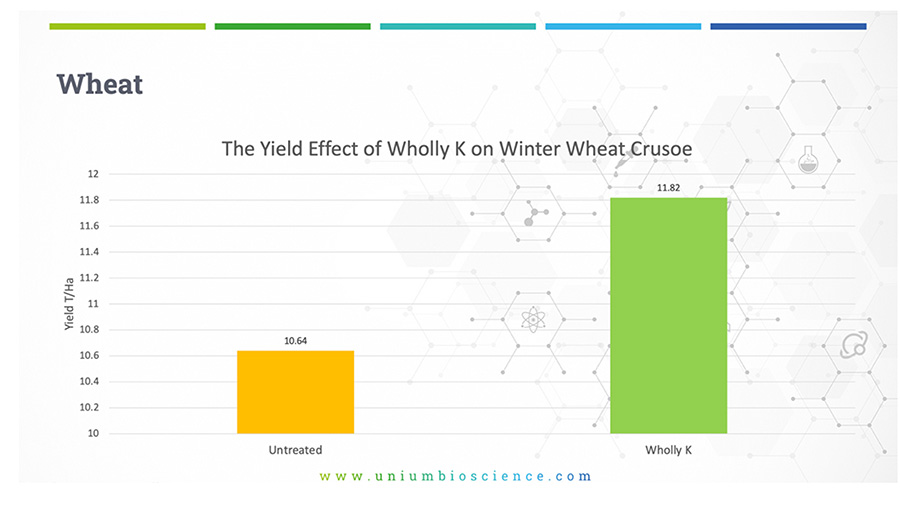
Results from 2025 trials showed a clear yield response to foliar potassium in winter wheat. On Crusoe, crops treated with Wholly K yielded 11.82 t/ha compared with 10.64 t/ha untreated – an uplift of 1.18 t/ha.
A similar response was seen in Illustrious, where treated plots achieved 13.91 t/ha versus 12.2 t/ha untreated, delivering a 1.71 t/ha increase.
The results highlight the potential for targeted potassium nutrition to support yield performance across different wheat varieties.
Protecting margins under pressure
With volatile weather patterns and tight margins, Agrovista’s Linda Sheppard says rebuilding resilience after stress events is critical.
“Potassium plays a key role in maintaining cell turgor, regulating stomatal function and supporting carbohydrate movement – all essential processes when crops are under pressure.”
While foliar nutrition is not a substitute for correcting severely deficient soils, it can provide a practical tool when uptake from the soil is restricted.
“As seasons become more unpredictable, potassium management is becoming more important,” says Linda. “It’s about making sure crops can recover, stay standing and convert inputs into yield, even when conditions aren’t on our side.”
Flexible, easy to integrate and proven across crops and timings, Wholly K isn’t about reinventing nutrition programmes, it’s about strengthening them.
By supporting water balance, nutrient movement and overall plant efficiency, it helps narrow the gap between potential and realised yield.
In seasons where weather swings can quickly erode performance, giving crops the ability to stay balanced and resilient could make the difference between an average result and a consistent one.
Learn more at uniumbioscience.com
Provided by
Unium Bioscience is a science lead innovator in the biologicals, bio stimulants, specialty fertiliser and alternative crop protection industry, located in Howden, UK.