Profitable farming and birds can co-exist, RSPB shows
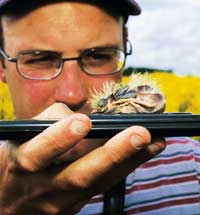
Farmland bird numbers have been boosted by 119% at the RSPB‘s demonstration arable unit in Cambridgeshire by “putting the right things in the right places”.
The 182ha farm has achieved both good crop yields and biodiversity improvements since the organisation bought Grange Farm, Knapwell, in 2001, says Chris Bailey, farmland project manager, showing how the two can coexist.
The original aim was to try to show how winter combinable crop production and farmland bird populations could both benefit from the right management, he says. “We also knew that we would learn some valuable lessons along the way, which we could then share with other farmers.”
Putting RSPB ideas into practice has been a valuable exercise, he adds. “It’s shown us what is possible in a commercial farming situation, as well as some of the difficulties.”
Grange Farm has its fair share of challenges, he notes, including heavy clay soils, high populations of resistant blackgrass, increasing pest problems and the volatility of commodity markets.
“First and foremost, this is a commercial farm,” stresses Dr Bailey. “Our intention is to make a profit – which we do – and for the site to be as representative of commercial arable production as it can.”
For this reason, winter cropping dominates. A four-year rotation of winter wheat, oilseed rape, winter wheat and spring beans is in place, prioritising profitable first wheats.
“Having a spring crop is less typical of this type of farm,” admits Dr Bailey. “And the combination of spring beans with heavy soil gives the potential for things to go wrong, especially if the weather is against us.
“But we weren’t making any money at all from second wheats, so it was an economic decision made when wheat was £70/t. Of course, it also helps with blackgrass control and workload management, but the birds have benefited, too.”
The fact that it allows them to keep over-wintered stubbles in place is a bonus. “The stubbles help to provide winter food for the birds, which is one of the big three for birds on all farms.”
Grange Farm is contract farmed by neighbouring grower George Topham. Min-till cultivations are used across the unit, to maximise returns, and oilseed rape is established by broadcasting it into standing wheat crops.
Last year’s wheat yield was 11.7t/ha, higher than usual. “But we always get over 10t/ha from our first wheats.”
Feed varieties are grown, as the RSPB insists on orange wheat blossom midge resistance. This year the wheat is Oakley, although yellow rust may make Dr Bailey reconsider for next year.
“We’re seeing orange wheat blossom midge resistance coming through in new varieties now, so that may give us an opportunity to add some value to the wheat crop.”
Bird populations have flourished since 2001, despite a slight dip last year, he reports. “Numbers have increased by 119%. Species such as skylarks, linnets, yellowhammers and reed buntings have all doubled in numbers, while grey partridges, lapwings and yellow wagtails have returned – probably due to having some spring cropping.”
Unproductive corners of the farm have been used to create habitats, with a whole suite of options being employed. Some 3% of the farm is in pollen and nectar or wild bird seed mixes, largely sown on the margins.
Sympathetic hedgerow management, beetle banks, buffer strips and water features are also used, both to boost wildlife and to demonstrate their value to visitors.
Not surprisingly, some of the land is used for RSPB trials. “About 4% is taken up with that work. One of our projects is finding ways of meeting the hunger gap – the period of time between February and late April – when food for birds is very scarce on arable farms. We haven’t found the solution yet.”
Predator control isn’t carried out and numbers have risen, he admits. “We monitor wildlife all the time, not just the birds at the top of the chain.”
Skylark plots can be found dotted around the farm, at the advised rate of two per hectare. That means there are 50 such plots in one 30ha field. “But that only represents 0.04% of the cropped area,” points out Dr Bailey. “They’ve shown to be very important for late-season skylark survival.”
Grange Farm is proof that bird numbers can be increased with the right habitats, he suggests. “But it also shows that profitable farming can take place, too. We’ve made economic decisions here which have helped the birds as much as they’ve helped our bottom line.”