Chickpeas: An alternative break crop for hotter summers?
 © Louise Impey
 The viability of growing combinable chickpeas for the UK human consumption market is being investigated as the search for alternative break crops suited to the changing climate continues.
With the support of two-year Adopt funding, two farmers have teamed up with pulse and grain retailer Hodmedod’s and crop scientists Niab to assess whether chickpeas can fit into rotations and deliver both yield and quality.
See also: Winter beans beat wheat gross margin for northern grower
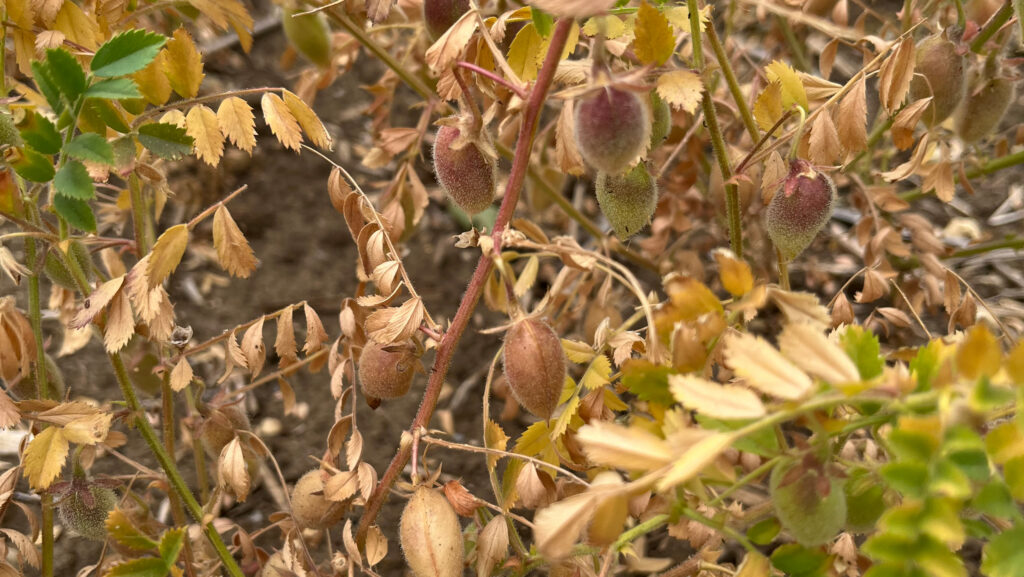
The focus of the work is to look for ways to bring their maturity and harvest earlier, as chickpeas have an indeterminate growth habit that can have implications for their management.
This means that in cool, damp summers they continue growing and flowering into October, creating harvesting difficulties and disrupting future cropping.
© Louise Impey
Extreme heat
Getting them off the field by mid-September is the aim for the UK crop – although this year’s extreme heat and very dry weather means that they have been ripening well in the farm trials and could be ready to harvest by the end of July.
“That’s a nice surprise,” says David White of Hawk Mill Farm in Cambridgeshire, one of the growers involved in the project. “The weather we’ve had this year seem to be more suited to the crop.”
Even so, growing chickpeas as bicrops is being explored as a means of getting them to ripen evenly and David has a trial with wheat, barley and oats used separately as companions, sown at two different seed rates.
These are being compared to plots of straight chickpeas. “I have experience of growing bicrops and we do tend to see both species ripening at the same time,” he says. “So we wondered if we could synchronise the maturity of the chickpeas and cereals to our advantage.”
To date, they are growing well and are on their way to maturity. Bicrops have both potential senescence and weed control benefits, so their use could add to the sustainability credentials of the crop.
“At this stage, oats seem to be the happy medium, but we await the results.”
Chickpea varieties
There are two main types of chickpea – Kabuli and Desi:
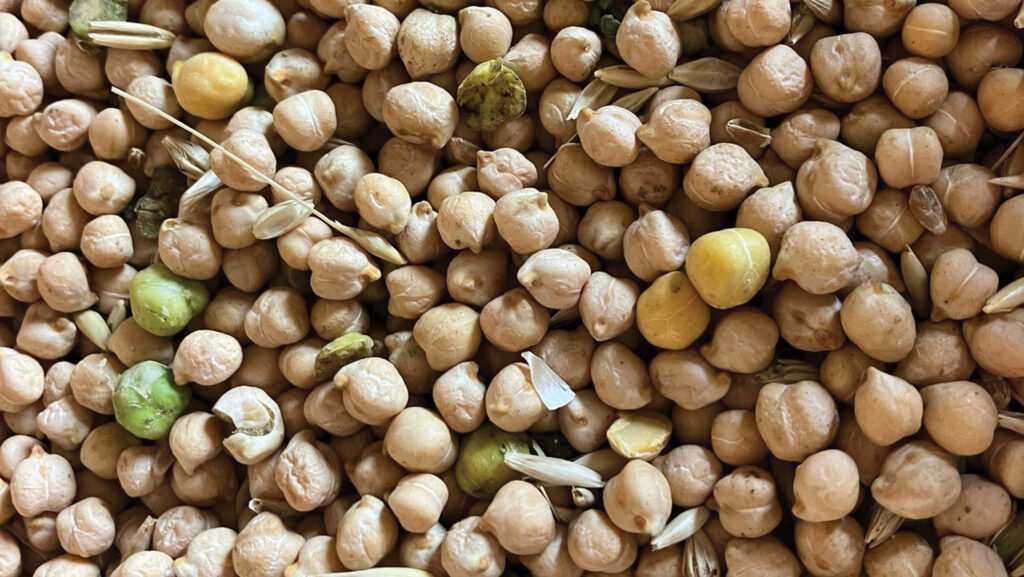
- Kabuli are the larger, lighter cream-coloured chickpeas typically used in salads and hummus
- Desi are the smaller, darker chickpeas with a thicker seed coat, often split or milled into gram flour.
Harvest options
Suffolk-based organic grower John Pawsey, who is the other farmer involved in the trial, is growing chickpeas with spring oats.
He drilled the oats in wide rows and then “stitched in” the chickpeas three weeks later. Using a slightly different approach, he is contemplating whether to try and harvest the oats without touching the chickpeas and then come back later for the crop – as would be done in a relay cropping approach.
Otherwise, swathing the crop as a means of controlling its ripening is also being tested on-farm.
“We just don’t know what will happen to the chickpeas, but we need to understand more about whether it could be a solution,” says John.
Learning by growing
As Dr Phil Howell of Niab explains, chickpeas have traditionally been grown much further south and east in the world, in warmer, semi-arid climates, so there is plenty to learn about how to grow them in the UK and if their earliness can be manipulated.
“Previous work with them saw us cutting in late October following a dull summer,” he recalls. “We got the yield but the quality suffered.”
Conventional thinking was that they couldn’t be planted before early May, notes Phil, who questions that and points out that if they are planted earlier, they flower earlier.
“Soil moisture and soil temperature matter. They don’t like sitting in cold, wet soil.”
Work done with PGRO in 2025 with a crop planted in early March gave a yield of just under 4t/ha, he reveals.
“It was a nice dry year with plenty of sunshine.” Phil adds that it’s important not to think about the chickpea crop in isolation, but as part of the farm system.
“On these farms, the following crop will be wheat, so we will be continuing the trial by looking at any effects on it.”
© David White
Working together
Josiah Meldrum of Hodmedod’s reveals that the company has been working with chickpeas for the past 11 years, building a knowledgebase and assessing varieties for their suitability to the UK.
“Up until now, growing chickpeas took bravery,” he says. “This year, Adopt funding is helping to de-risk the process and allowing us to look at intercropping, swathing and other techniques of interest.”
He explains this is really important if we are going to get more pulses into rotations. “There isn’t a one-crop solution to the changing climate, but there are crops such as lentils and chickpeas that might have a place.”
While this year’s heat may be suiting them, they are no different to other spring-drilled crops in that they do need soil moisture at drilling, he stresses.
Josiah says that the average chickpea yield globally is 1-1.5t/ha, but the potential yield is much higher, at 5-6t/ha.
“The varieties we’re using in these trials, Flamenco and Rondo, have a yield potential of 3-4t/ha but I expect we will see 1.5-2.0t/ha this year.”
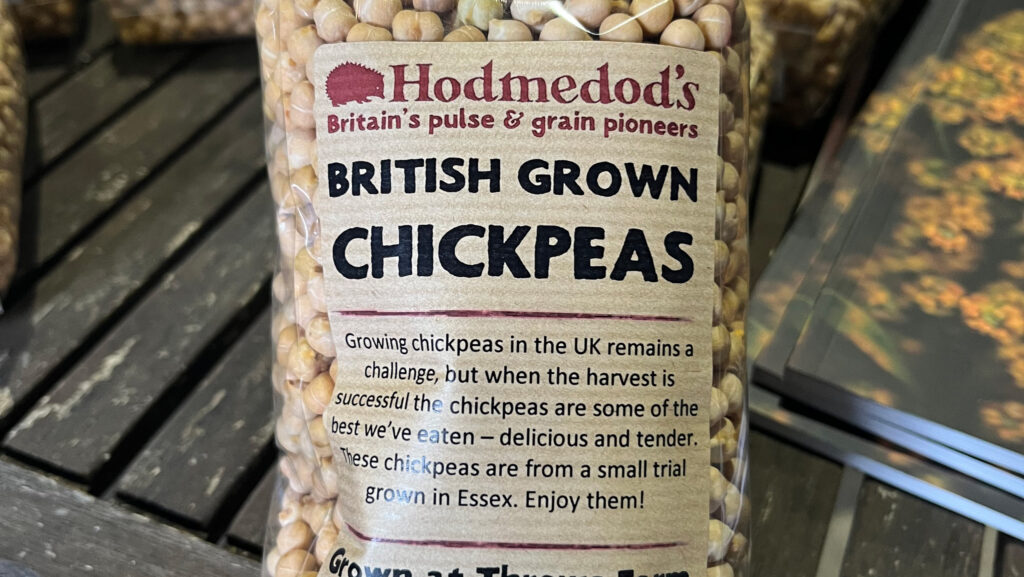
At a value of about £1,000/t, the route to market is critical as growers must get the return that reflects the risk they have taken, he adds.
Grower observations
David White © Louise Impey
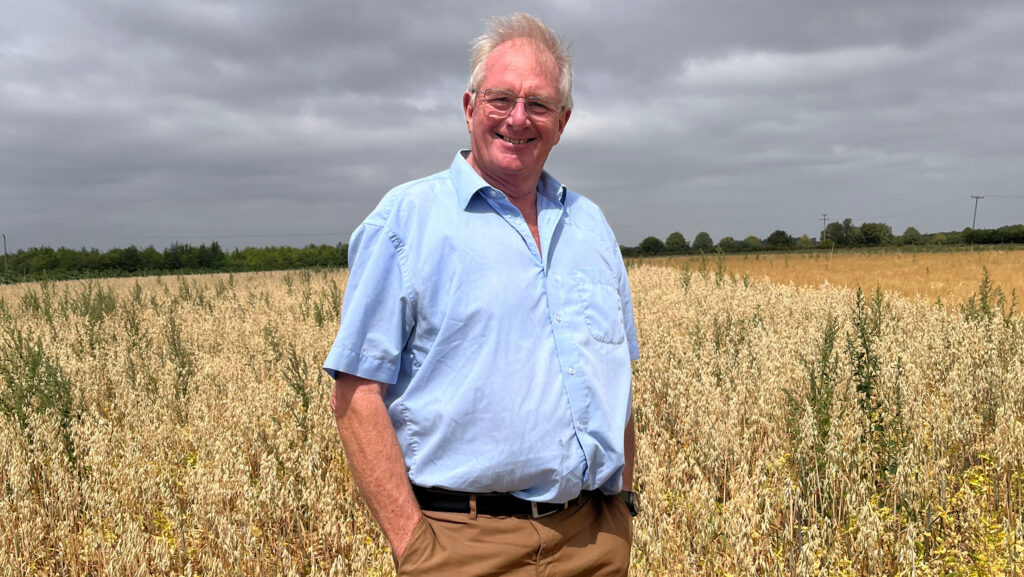
The need for a better selection of break crops was the motivation for Cambridgeshire grower David White to take part in the chickpea project.
He also recognises that the climate has changed, so was keen to be involved in assessing whether chickpeas could be successful on his farm as hot, dry summers become more common.
He drilled the chickpea trial on 4 April, following an overwinter cover crop. The seed-bed was prepared using three passes and the seed had to be inoculated with bacteria ahead of planting, as is required with soya, to stimulate root nodule formation.
“I compared cultivations with direct drilling and the direct-drilled plot was poor – with hindsight it may have been drilled a bit deep,” he recalls. “Drilling them at the same depth as cereals seems to be best.”
David drilled the chickpeas and cereal companions down the spout together. The two chickpea varieties were sown at 50 seeds/sq m, while the wheat, barley and oat components went in at two seed rates – 60 and 100 seeds/sq m.
“One of the varieties emerged better than the other, but that could have been due to seed viability, rather than a varietal effect,” he says.
A pre-emergence treatment with Stomp Aqua (pendimethalin) was used. “Then we had a hot, dry spring. It may be that drilling them on wider rows and using an inter-row hoe would be a better approach for weed control.
“There aren’t many herbicide options.” Otherwise he reports that hares and rooks seem to love chickpeas. “We also lost a few plants due to an unidentified pest chewing on their roots.”
Harvesting will be done at 15% moisture and, after this year’s record high temperatures, is on track to take place earlier than David had predicted.